

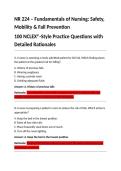
NR 224 – Fundamentals of Nursing: Safety,
Mobility & Fall Prevention
100 NCLEX®-Style Practice Questions with
Detailed Rationales
1. A nurse is assessing a newly admitted patient for fall risk. Which finding places
the patient at the greatest risk for falling?
A. History of previous falls
B. Wearing eyeglasses
C. Having a private room
D. Drinking adequate fluids
Answer: A. History of previous falls
Rationale: A previous fall is one of the strongest predictors of future falls and
requires implementation of fall prevention strategies.
2. A nurse is preparing a patient’s room to reduce the risk of falls. Which action is
appropriate?
A. Keep the bed in the lowest position.
B. Raise all four side rails.
C. Place frequently used items out of reach.
D. Turn off the room lighting.
Answer: A. Keep the bed in the lowest position.
Rationale: Keeping the bed low reduces injury risk if the patient attempts to get
up without assistance.
,3. A nurse is teaching a patient how to use a cane. Which instruction is correct?
A. Hold the cane on the stronger side of the body.
B. Move the weak leg first without the cane.
C. Hold the cane on the weaker side.
D. Place the cane far away from the body.
Answer: A. Hold the cane on the stronger side of the body.
Rationale: Holding the cane on the stronger side provides support and improves
balance while walking.
4. A nurse is assisting a patient from the bed to a chair. Which action promotes
safety?
A. Lock the wheels of the bed and chair.
B. Pull the patient by the arms.
C. Allow the patient to stand alone immediately.
D. Keep the patient’s feet unstable.
Answer: A. Lock the wheels of the bed and chair.
Rationale: Locked equipment prevents movement during transfer and reduces fall
risk.
5. A nurse is teaching a patient about proper body mechanics. Which statement
indicates understanding?
A. "I should bend my knees when lifting."
B. "I should twist my back while lifting."
C. "I should keep my feet together."
D. "I should lift using my back muscles."
Answer: A. "I should bend my knees when lifting."
Rationale: Using leg muscles and bending the knees protects the back and
reduces injury risk.
,6. A nurse is caring for a patient who is weak and at risk for falls. Which
intervention is appropriate?
A. Place the call light within reach.
B. Keep personal items across the room.
C. Encourage the patient to walk without assistance.
D. Remove nonskid footwear.
Answer: A. Place the call light within reach.
Rationale: Easy access to the call light allows patients to request help before
attempting unsafe activities.
7. A nurse is assisting a patient who uses a walker. Which instruction is correct?
A. Move the walker forward before stepping.
B. Pull up on the walker to stand.
C. Place all weight on one side of the walker.
D. Move the weak leg last.
Answer: A. Move the walker forward before stepping.
Rationale: The walker provides stability when moved forward before the patient
takes steps.
8. A nurse is repositioning a bedridden patient. Why is repositioning important?
A. To prevent pressure injuries.
B. To increase infection risk.
C. To decrease circulation.
D. To avoid skin assessment.
Answer: A. To prevent pressure injuries.
, Rationale: Regular repositioning reduces prolonged pressure on tissues and
improves circulation.
9. A nurse is caring for a patient who has difficulty moving independently. Which
device may assist with transfers?
A. Gait belt
B. Thermometer
C. Stethoscope
D. Pulse oximeter
Answer: A. Gait belt
Rationale: A gait belt provides support and allows the nurse to assist with
transfers safely.
10. A nurse is preparing to ambulate a patient for the first time after surgery.
Which action should the nurse take first?
A. Assess the patient’s strength and ability to stand.
B. Leave the patient alone to walk.
C. Encourage rapid movement.
D. Skip assessment.
Answer: A. Assess the patient’s strength and ability to stand.
Rationale: Assessment identifies limitations and prevents falls or injury during
ambulation.
11. A nurse is caring for a patient who is confused and attempts to get out of bed
without assistance. Which intervention is appropriate?
A. Provide frequent observation and safety measures.
B. Ignore the behavior.
Mobility & Fall Prevention
100 NCLEX®-Style Practice Questions with
Detailed Rationales
1. A nurse is assessing a newly admitted patient for fall risk. Which finding places
the patient at the greatest risk for falling?
A. History of previous falls
B. Wearing eyeglasses
C. Having a private room
D. Drinking adequate fluids
Answer: A. History of previous falls
Rationale: A previous fall is one of the strongest predictors of future falls and
requires implementation of fall prevention strategies.
2. A nurse is preparing a patient’s room to reduce the risk of falls. Which action is
appropriate?
A. Keep the bed in the lowest position.
B. Raise all four side rails.
C. Place frequently used items out of reach.
D. Turn off the room lighting.
Answer: A. Keep the bed in the lowest position.
Rationale: Keeping the bed low reduces injury risk if the patient attempts to get
up without assistance.
,3. A nurse is teaching a patient how to use a cane. Which instruction is correct?
A. Hold the cane on the stronger side of the body.
B. Move the weak leg first without the cane.
C. Hold the cane on the weaker side.
D. Place the cane far away from the body.
Answer: A. Hold the cane on the stronger side of the body.
Rationale: Holding the cane on the stronger side provides support and improves
balance while walking.
4. A nurse is assisting a patient from the bed to a chair. Which action promotes
safety?
A. Lock the wheels of the bed and chair.
B. Pull the patient by the arms.
C. Allow the patient to stand alone immediately.
D. Keep the patient’s feet unstable.
Answer: A. Lock the wheels of the bed and chair.
Rationale: Locked equipment prevents movement during transfer and reduces fall
risk.
5. A nurse is teaching a patient about proper body mechanics. Which statement
indicates understanding?
A. "I should bend my knees when lifting."
B. "I should twist my back while lifting."
C. "I should keep my feet together."
D. "I should lift using my back muscles."
Answer: A. "I should bend my knees when lifting."
Rationale: Using leg muscles and bending the knees protects the back and
reduces injury risk.
,6. A nurse is caring for a patient who is weak and at risk for falls. Which
intervention is appropriate?
A. Place the call light within reach.
B. Keep personal items across the room.
C. Encourage the patient to walk without assistance.
D. Remove nonskid footwear.
Answer: A. Place the call light within reach.
Rationale: Easy access to the call light allows patients to request help before
attempting unsafe activities.
7. A nurse is assisting a patient who uses a walker. Which instruction is correct?
A. Move the walker forward before stepping.
B. Pull up on the walker to stand.
C. Place all weight on one side of the walker.
D. Move the weak leg last.
Answer: A. Move the walker forward before stepping.
Rationale: The walker provides stability when moved forward before the patient
takes steps.
8. A nurse is repositioning a bedridden patient. Why is repositioning important?
A. To prevent pressure injuries.
B. To increase infection risk.
C. To decrease circulation.
D. To avoid skin assessment.
Answer: A. To prevent pressure injuries.
, Rationale: Regular repositioning reduces prolonged pressure on tissues and
improves circulation.
9. A nurse is caring for a patient who has difficulty moving independently. Which
device may assist with transfers?
A. Gait belt
B. Thermometer
C. Stethoscope
D. Pulse oximeter
Answer: A. Gait belt
Rationale: A gait belt provides support and allows the nurse to assist with
transfers safely.
10. A nurse is preparing to ambulate a patient for the first time after surgery.
Which action should the nurse take first?
A. Assess the patient’s strength and ability to stand.
B. Leave the patient alone to walk.
C. Encourage rapid movement.
D. Skip assessment.
Answer: A. Assess the patient’s strength and ability to stand.
Rationale: Assessment identifies limitations and prevents falls or injury during
ambulation.
11. A nurse is caring for a patient who is confused and attempts to get out of bed
without assistance. Which intervention is appropriate?
A. Provide frequent observation and safety measures.
B. Ignore the behavior.

