

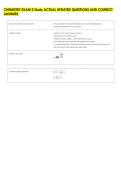
CHEMISTRY EXAM 2 Study ACTUAL UPDATED QUESTIONS AND CORRECT
ANSWERS
Factors that affect reaction rate 1)Physical state of the reactants2)Reactant concentrations3)Reaction
temperature4)Presence of a catalyst
Collision Model is based on the kinetic molecular theory.
• Molecules must collide to react.
• If there are more collisions, more reactions can occur.
• So, if there are more molecules, the reaction rate is faster.
• In a chemical reaction, bonds are broken and new bonds are formed. Molecules
can only react if they collide with each other.
Arrhenius Equation
Activation Energy equation
, For the reaction 2AsH3 (g) → As2 (g) + 3H2 (g), the +∆[As2]/∆t
reaction rate can be given by which of the following?
For the reaction: 4PH3(g) → P4(g) + 6H2(g) about 0.065 Δ[P4] = (1/4)(0.013 mol/L s) and Δ[H2] = (6/4)(0.013 mol/L s)
mol/s of PH3 is consumed in a 5.0 L flask. What are the
rates of production of P4 and H2?
The rate law for the reaction NH2 (g) + NO (g) → N2 (g) + 1.2 × 10⁹ M−1s−1
H2O (g) was determined to be as follows: Rate = k[NH2]
[NO]. In an experiment at 1200K, where the initial
concentration of NH2 was 1.00 × 10⁻⁵ M and the initial
concentration of NO was 1.00 × 10⁻⁵ M, the reaction rate
was measured to be 0.12 M/s. Calculate the value of the
rate constant.
2NO(g)+2H2(g) → N2(g)+2H2O(g)2NO(g)+2H2(g) → remain the same
N2(g)+2H2O(g)
is Rate = k[NO]2
If the concentration of H2H2 is doubled, will the reaction
rate quadruple, double, or remain the same?
The reaction rate=k[ClO2]2[OH−]
2ClO2(aq)+2OH−(aq)→ClO3−(aq)+ClO2−
(aq)+H2O(l)2ClO2(aq)+2OH−(aq)→ClO3−(aq)+ClO2−
(aq)+H2O(l)
was studied and the results listed in the table were
obtained.
Determine the rate law.
Ans: rate=k[NO]2[Br2]
Calculate the average value of the rate constant for the kk =1.2×10⁴M−2s−1M−2s−1
appearance of NOBrNOBr from the four data sets.
(above table)
How is the rate of appearance of NOBrNOBr related to the rate of disappearance of Br2Br2 is half the rate of appearance of NOBr
the rate of disappearance of Br2Br2? (above table)
What is the rate of disappearance of Br2Br2 when [NO]= rate =13M/s
[NO]= 8.3×10⁻² MM and [Br2]=[Br2]= 0.32 MM ? (above
table)
ANSWERS
Factors that affect reaction rate 1)Physical state of the reactants2)Reactant concentrations3)Reaction
temperature4)Presence of a catalyst
Collision Model is based on the kinetic molecular theory.
• Molecules must collide to react.
• If there are more collisions, more reactions can occur.
• So, if there are more molecules, the reaction rate is faster.
• In a chemical reaction, bonds are broken and new bonds are formed. Molecules
can only react if they collide with each other.
Arrhenius Equation
Activation Energy equation
, For the reaction 2AsH3 (g) → As2 (g) + 3H2 (g), the +∆[As2]/∆t
reaction rate can be given by which of the following?
For the reaction: 4PH3(g) → P4(g) + 6H2(g) about 0.065 Δ[P4] = (1/4)(0.013 mol/L s) and Δ[H2] = (6/4)(0.013 mol/L s)
mol/s of PH3 is consumed in a 5.0 L flask. What are the
rates of production of P4 and H2?
The rate law for the reaction NH2 (g) + NO (g) → N2 (g) + 1.2 × 10⁹ M−1s−1
H2O (g) was determined to be as follows: Rate = k[NH2]
[NO]. In an experiment at 1200K, where the initial
concentration of NH2 was 1.00 × 10⁻⁵ M and the initial
concentration of NO was 1.00 × 10⁻⁵ M, the reaction rate
was measured to be 0.12 M/s. Calculate the value of the
rate constant.
2NO(g)+2H2(g) → N2(g)+2H2O(g)2NO(g)+2H2(g) → remain the same
N2(g)+2H2O(g)
is Rate = k[NO]2
If the concentration of H2H2 is doubled, will the reaction
rate quadruple, double, or remain the same?
The reaction rate=k[ClO2]2[OH−]
2ClO2(aq)+2OH−(aq)→ClO3−(aq)+ClO2−
(aq)+H2O(l)2ClO2(aq)+2OH−(aq)→ClO3−(aq)+ClO2−
(aq)+H2O(l)
was studied and the results listed in the table were
obtained.
Determine the rate law.
Ans: rate=k[NO]2[Br2]
Calculate the average value of the rate constant for the kk =1.2×10⁴M−2s−1M−2s−1
appearance of NOBrNOBr from the four data sets.
(above table)
How is the rate of appearance of NOBrNOBr related to the rate of disappearance of Br2Br2 is half the rate of appearance of NOBr
the rate of disappearance of Br2Br2? (above table)
What is the rate of disappearance of Br2Br2 when [NO]= rate =13M/s
[NO]= 8.3×10⁻² MM and [Br2]=[Br2]= 0.32 MM ? (above
table)

