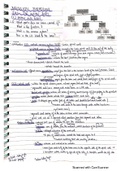
1.8C All Problem Summaries
1.8 C Problem 1
(Un)Motivated to Learn
Intrinsic and Extrinsic Motivation
Trait theory- motivation is based on individual characteristics eg. interested in art, so
spend hours in an art gallery
State theory- motivation is a temporary state eg. have a test tomorrow so temporarily
motivated to read all about the art pieces that the test is on
Motivation usually combo- trait + state eg. study the info about the art pieces as you’re
interested in it and because you have a test on it
Amotivation- lack of any intent to act, no engagement at all, no motivation
Intrinsic motivation- motivated by natural human tendency to seek and conquer
challenges as we pursue personal interests and exercise our capabilities
During this, don’t need incentives or punishments as satisfied by activity itself
Eg. read books about art because you love it
Extrinsic motivation- motivated causes by external factors such as rewards and
punishments
Little to do with task itself, only care about what we will gain from completing the
activity
o Associated with:
Negative emotions
Poor academic achievement
Maladaptive learning strategies
Provides incentives to try new things
Pushes to get started
Helps persist to complete difficult task
Difference between ex/intrinsic motivation is locus of causality- whether the student’s
reason for the action is internal or external
o Internal locus of control, intrinsic motivation: external locus of control, extrinsic
motivation
Division between the two is usually too either/or
Explanations of motivation
1. Activities fall in a continuum from fully self-determined (intrinsic) to full
determined by others (extrinsic)
o Four types of extrinsic motivation (based on level of internal drive to
engage)
External regulation- completely controlled by outside consequences
Introjected regulation- engage in task to avoid guilt/negative self-
perception
Identification- participating despite lack of interest as it serves larger
goal that’s personally motivating
Integrated regulation- participating in task because it’s interesting and
has extrinsic reward value
2. Motivations are not two ends of a continuum: extrinsic/intrinsic
tendencies are two independent possibilities
o Can be motivated by both types of factors at anytime
Teacher Lessons
Encourage/nurture intrinsic motivation & extrinsic to support learning
Both motivation types decline with age
,Views
Needs
and Self-
Determination (Chronologically)
1. Preliminary research: motivation is trait like needs, 3 main needs: achievement,
power, affiliation
2. Maslow’s Hierarchy of Needs
o Humans have seven levels of needs in hierarchy from (low level) survival -
> self-actualisation (high level)
(self-actualisation- fulfilling one’s potential)
o Deficiency needs- four lower levels of Maslow’s Hierarchy: survival,
safety, belonging, self-esteem
When satisfied, motivation for fulfilling them decreases
o Being needs- three higher levels of Maslow’s Hierarch: cognitive needs,
aesthetic needs, self-actualisation
When satisfied, motivation increases as can never fully fill these
Eg. more successful you are in exams, the more you will
strive to improve further
People don’t always behave as theory predicts
o move among different need types
o can be motivated by many needs at once
eg. feel unsafe at uni, likelier concerned with safety than learning
views the student as a whole, with physical, emotional, intellectual needs
being interrelated
eg. hungry student likely struggles to focus
3. Self Determination Theory
o Need to feel competent and capable to have sense of autonomy and
control over our lives and be connected to others in relationships
o Need for competence- individual’s need to demonstrate ability or
mastery over tasks at hand
- Satisfaction= accomplishment, promotes self-efficacy, helps
establish learning goals for future tasks
, o Need for autonomy- desire to have our own wishes and choices, rather
than external rewards or pressures determining our actions
o Need for relatedness- desire to belong and establish close emotional
bonds and attachments with others who care about use
Like preliminary research:
Achievement > competence
Power > autonomy and control
Affiliation > relatedness
May not be universal
Study (Jang Et Al.)- experiences of competence, autonomy, relatedness,
associated with satisfying learning experiences in
Korean high school
Significance- needs important even in collectivist society
Self-determination in the classroom
o Students’ motivational profiles for learning influenced by classroom goal
structure and level of autonomy support from parents
Older students, impact of parental attitudes/support declines,
classroom goal structure (teacher’s message) remains
Consistent throughout year groups
Study: choice for college students enhances interest, sense of competence, valuing
of reading task of boring passage
choice less important if reading already engaging/interesting
more authority to make choices, likelier to believe work is
important (internalise educational goals)
o Controlling/pressuring environments improve performance only on recall
tasks
- Teachers pressurised to discipline and take charge; some think
efficient classroom structure= control
4.Cognitive Evaluation Theory
o Students’ experiences (eg. reminders, grades) influence intrinsic
motivation
- Affects self-determination and competence
o All events have two aspects
1. Controlling
Highly controlling- pressures students to act or feel a certain way
experience less control, intrinsic motivation diminished
2. Information
If event provides info increasing students’ sense of competence,
intrinsic motivation increases
o Support student needs for autonomy/competence by:
Limiting controlling messages
Controlling language undermines motivation
Ensure info provided highlights students increasing
competence, emphasising gains made via persistence,
practice, student reflection
Eg. work samples
Needs: Teacher lessons
, Positive relationships with teachers increase chances of succeeding in high school
and continuing to college
(Like Maslow’s sense of belonging)
o Likelier participate in activities helping grow more competent, not ones
with possibility of failure
students need choices and appropriately challenging tasks
o Benefit from watching self-competence grow
Eg. portfolios
o Need to feel people in school care/can trusted to help learn
Goals (Locke and Latham)- 4 reasons why goals improve performance
1. Direct attention- attention given to task at hand and away from distractions
2. Energise effort- more challenging the goal (to a point) the greater the effort
3. Increase persistence- clear goals, less likely to give up until reaching the
goal
Hard goals= effort, deadlines= faster work
4. Promote development of new knowledge- new knowledge and strategies
when old strategies fall short
Goal Types/Goal Orientations
Specific, Elaborated, Moderate difficulty, Proximal= enhance motivation/persistence
(Mnemonic- Silver Elephants Make Porn)
Specific/Elaborate= clear standards to judge performance
Study- specific subgoals= more effective
Moderate difficulty= provides challenge
Proximal= not put off for more immediate concerns
Study- alcoholics anonymous, “one day at a time” beneficial to stop
drinking
o Four Achievement Goal Orientations
Goals- specific targets
Goal orientations- reasons we pursue goals and standards used to
evaluate progress towards those goals
Four goal orientations
1. Mastery (learning)- To improve and learn irrelevant of how
awkward you appear
Seek challenges
Persist during difficulties
Feel better about work
Not worried about their performance compared to others
Focus on task in hand
Likelier seek appropriate help, use better study strategies and
cognitive processing, approach tasks with confidence
2. Performance (looking good)- demonstrating one’s ability to
others
Do things to look smart
Act in ways that interfere with learning, eg. cheating
Choose easy tasks, avoid student collaboration, uncomfortable if
assignments have unclear evaluation
not always bad: mastery and performance
goals associated with: using active learning
strategies, high self-efficacy, higher
achievement
3. Work-avoidance
Work-avoidant learners- students who don’t want to learn or look
smart, but just want to avoid work
Feel successful when don’t have to try hard
May disrupt, complain about assignment difficulty, cheat
Learn very little
1.8 C Problem 1
(Un)Motivated to Learn
Intrinsic and Extrinsic Motivation
Trait theory- motivation is based on individual characteristics eg. interested in art, so
spend hours in an art gallery
State theory- motivation is a temporary state eg. have a test tomorrow so temporarily
motivated to read all about the art pieces that the test is on
Motivation usually combo- trait + state eg. study the info about the art pieces as you’re
interested in it and because you have a test on it
Amotivation- lack of any intent to act, no engagement at all, no motivation
Intrinsic motivation- motivated by natural human tendency to seek and conquer
challenges as we pursue personal interests and exercise our capabilities
During this, don’t need incentives or punishments as satisfied by activity itself
Eg. read books about art because you love it
Extrinsic motivation- motivated causes by external factors such as rewards and
punishments
Little to do with task itself, only care about what we will gain from completing the
activity
o Associated with:
Negative emotions
Poor academic achievement
Maladaptive learning strategies
Provides incentives to try new things
Pushes to get started
Helps persist to complete difficult task
Difference between ex/intrinsic motivation is locus of causality- whether the student’s
reason for the action is internal or external
o Internal locus of control, intrinsic motivation: external locus of control, extrinsic
motivation
Division between the two is usually too either/or
Explanations of motivation
1. Activities fall in a continuum from fully self-determined (intrinsic) to full
determined by others (extrinsic)
o Four types of extrinsic motivation (based on level of internal drive to
engage)
External regulation- completely controlled by outside consequences
Introjected regulation- engage in task to avoid guilt/negative self-
perception
Identification- participating despite lack of interest as it serves larger
goal that’s personally motivating
Integrated regulation- participating in task because it’s interesting and
has extrinsic reward value
2. Motivations are not two ends of a continuum: extrinsic/intrinsic
tendencies are two independent possibilities
o Can be motivated by both types of factors at anytime
Teacher Lessons
Encourage/nurture intrinsic motivation & extrinsic to support learning
Both motivation types decline with age
,Views
Needs
and Self-
Determination (Chronologically)
1. Preliminary research: motivation is trait like needs, 3 main needs: achievement,
power, affiliation
2. Maslow’s Hierarchy of Needs
o Humans have seven levels of needs in hierarchy from (low level) survival -
> self-actualisation (high level)
(self-actualisation- fulfilling one’s potential)
o Deficiency needs- four lower levels of Maslow’s Hierarchy: survival,
safety, belonging, self-esteem
When satisfied, motivation for fulfilling them decreases
o Being needs- three higher levels of Maslow’s Hierarch: cognitive needs,
aesthetic needs, self-actualisation
When satisfied, motivation increases as can never fully fill these
Eg. more successful you are in exams, the more you will
strive to improve further
People don’t always behave as theory predicts
o move among different need types
o can be motivated by many needs at once
eg. feel unsafe at uni, likelier concerned with safety than learning
views the student as a whole, with physical, emotional, intellectual needs
being interrelated
eg. hungry student likely struggles to focus
3. Self Determination Theory
o Need to feel competent and capable to have sense of autonomy and
control over our lives and be connected to others in relationships
o Need for competence- individual’s need to demonstrate ability or
mastery over tasks at hand
- Satisfaction= accomplishment, promotes self-efficacy, helps
establish learning goals for future tasks
, o Need for autonomy- desire to have our own wishes and choices, rather
than external rewards or pressures determining our actions
o Need for relatedness- desire to belong and establish close emotional
bonds and attachments with others who care about use
Like preliminary research:
Achievement > competence
Power > autonomy and control
Affiliation > relatedness
May not be universal
Study (Jang Et Al.)- experiences of competence, autonomy, relatedness,
associated with satisfying learning experiences in
Korean high school
Significance- needs important even in collectivist society
Self-determination in the classroom
o Students’ motivational profiles for learning influenced by classroom goal
structure and level of autonomy support from parents
Older students, impact of parental attitudes/support declines,
classroom goal structure (teacher’s message) remains
Consistent throughout year groups
Study: choice for college students enhances interest, sense of competence, valuing
of reading task of boring passage
choice less important if reading already engaging/interesting
more authority to make choices, likelier to believe work is
important (internalise educational goals)
o Controlling/pressuring environments improve performance only on recall
tasks
- Teachers pressurised to discipline and take charge; some think
efficient classroom structure= control
4.Cognitive Evaluation Theory
o Students’ experiences (eg. reminders, grades) influence intrinsic
motivation
- Affects self-determination and competence
o All events have two aspects
1. Controlling
Highly controlling- pressures students to act or feel a certain way
experience less control, intrinsic motivation diminished
2. Information
If event provides info increasing students’ sense of competence,
intrinsic motivation increases
o Support student needs for autonomy/competence by:
Limiting controlling messages
Controlling language undermines motivation
Ensure info provided highlights students increasing
competence, emphasising gains made via persistence,
practice, student reflection
Eg. work samples
Needs: Teacher lessons
, Positive relationships with teachers increase chances of succeeding in high school
and continuing to college
(Like Maslow’s sense of belonging)
o Likelier participate in activities helping grow more competent, not ones
with possibility of failure
students need choices and appropriately challenging tasks
o Benefit from watching self-competence grow
Eg. portfolios
o Need to feel people in school care/can trusted to help learn
Goals (Locke and Latham)- 4 reasons why goals improve performance
1. Direct attention- attention given to task at hand and away from distractions
2. Energise effort- more challenging the goal (to a point) the greater the effort
3. Increase persistence- clear goals, less likely to give up until reaching the
goal
Hard goals= effort, deadlines= faster work
4. Promote development of new knowledge- new knowledge and strategies
when old strategies fall short
Goal Types/Goal Orientations
Specific, Elaborated, Moderate difficulty, Proximal= enhance motivation/persistence
(Mnemonic- Silver Elephants Make Porn)
Specific/Elaborate= clear standards to judge performance
Study- specific subgoals= more effective
Moderate difficulty= provides challenge
Proximal= not put off for more immediate concerns
Study- alcoholics anonymous, “one day at a time” beneficial to stop
drinking
o Four Achievement Goal Orientations
Goals- specific targets
Goal orientations- reasons we pursue goals and standards used to
evaluate progress towards those goals
Four goal orientations
1. Mastery (learning)- To improve and learn irrelevant of how
awkward you appear
Seek challenges
Persist during difficulties
Feel better about work
Not worried about their performance compared to others
Focus on task in hand
Likelier seek appropriate help, use better study strategies and
cognitive processing, approach tasks with confidence
2. Performance (looking good)- demonstrating one’s ability to
others
Do things to look smart
Act in ways that interfere with learning, eg. cheating
Choose easy tasks, avoid student collaboration, uncomfortable if
assignments have unclear evaluation
not always bad: mastery and performance
goals associated with: using active learning
strategies, high self-efficacy, higher
achievement
3. Work-avoidance
Work-avoidant learners- students who don’t want to learn or look
smart, but just want to avoid work
Feel successful when don’t have to try hard
May disrupt, complain about assignment difficulty, cheat
Learn very little