

A+
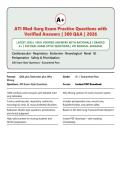
ATI Med-Surg Exam Practice Questions with
Verified Answers | 300 Q&A | 2026
LATEST 2026 | 100% VERIFIED ANSWERS WITH RATIONALE | GRADED
A+ | 300 REAL EXAM-STYLE QUESTIONS | ATI MEDICAL-SURGICAL
Cardiovascular · Respiratory · Endocrine · Neurological · Renal · GI ·
Perioperative · Safety & Prioritization
300 Exam-Style Questions · Guaranteed Pass
Format: Q&A plus Rationales plus Why Grade: A+ / Guaranteed Pass
Wrong
Questions: 300 Exam-Style Questions Access: Instant PDF Download
100% verified correct answers with detailed med- Why Wrong sections for every incorrect option
surg rationales
Covers cardiovascular, respiratory, endocrine, Includes perioperative care, wound care,
neurological, renal, GI, musculoskeletal disorders fluid/electrolytes, and patient safety
Addresses NCLEX-style questions, prioritization, Based on ATI Med-Surg Proctored Exam Blueprint
and clinical judgment
High-yield content for nursing students and Instant PDF download – start studying
NCLEX preparation immediately
,Description
This ATI Med-Surg Exam Practice Study Guide is designed to help nursing students master the
essential medical-surgical concepts needed to excel on the ATI Med-Surg Proctored Exam. Inside,
you will find 300 practice questions that closely mirror the actual exam in style, difficulty, and
content distribution. We cover all key topics: cardiovascular disorders, respiratory disorders,
endocrine disorders, neurological conditions, renal and gastrointestinal disorders, perioperative
care, wound care, fluid and electrolytes, and patient safety. Each question comes with a 100%
verified correct answer, a clear rationale that explains the reasoning behind it, and a targeted Why
Wrong section that shows you exactly why the other choices are incorrect. Updated for the latest
testing cycle, this A+ graded review will give you the confidence you need to pass your ATI Med-
Surg Exam on the very first attempt.
Abstract
This document provides a complete review of the ATI Med-Surg Proctored Exam through 300
realistic exam-style questions covering cardiovascular, respiratory, endocrine, neurological, renal,
GI disorders, perioperative care, and patient safety. Each question is paired with a 100% verified
correct answer, a detailed rationale, and a thorough Why Wrong breakdown. Updated for the
latest testing cycle, this study guide is designed to help nursing students achieve a high score and
pass the ATI Med-Surg Exam with guaranteed accuracy.
,Content Area Questions Key Topics
Cardiovascular Disorders 1 – 55 Heart failure, MI, dysrhythmias, HTN, DVT, anticoagulation,
cardiac catheterization
Respiratory Disorders 56 – 100 COPD, asthma, pneumonia, chest tubes, pneumothorax,
respiratory failure, TB
Endocrine Disorders 101 – 140 Diabetes mellitus (DKA, HHNS), thyroid disorders,
Cushing's, Addison's
Neurological Disorders 141 – 180 Stroke, ICP, seizures, spinal cord injury, autonomic
dysreflexia, Parkinson's
GI, Renal & 181 – 220 GI bleed, cirrhosis, AKI, CKD, fractures, joint replacement,
Musculoskeletal amputation
Perioperative & Critical 221 – 260 Preop assessment, postop complications, wound care,
Care NGN case scenarios
Safety, Delegation & 261 – 300 Infection control, fall prevention, delegation, priority
Prioritization setting, clinical judgment
Pass your ATI Med-Surg Exam on your first attempt with this comprehensive, A+
graded review.
, 300 Exam-Style Questions with Verified Answers
and Rationales
Question 1: A client with heart failure reports sudden onset of dyspnea and coughing
pink, frothy sputum. Which action should the nurse take FIRST?
A Administer furosemide IV push
B Apply oxygen via non-rebreather mask
C Place the client in high-Fowler's position
D Notify the healthcare provider immediately
Correct Answer: Place the client in high-Fowler's position
Rationale: Positioning the client upright reduces venous return and pulmonary congestion,
which is the priority intervention for acute pulmonary edema before other treatments are
initiated. High-Fowler's position maximizes lung expansion and decreases preload,
alleviating respiratory distress.
Why Wrong:
A: Furosemide is important but positioning is the priority first action.
B: Oxygen is necessary but positioning should be done first to maximize effectiveness.
C: Provider notification is important but not the immediate priority intervention.
References: ATI Med-Surg Proctored Exam Blueprint; Lewis's Medical-Surgical Nursing;
Brunner & Suddarth's.
ATI Med-Surg Exam Practice Questions with
Verified Answers | 300 Q&A | 2026
LATEST 2026 | 100% VERIFIED ANSWERS WITH RATIONALE | GRADED
A+ | 300 REAL EXAM-STYLE QUESTIONS | ATI MEDICAL-SURGICAL
Cardiovascular · Respiratory · Endocrine · Neurological · Renal · GI ·
Perioperative · Safety & Prioritization
300 Exam-Style Questions · Guaranteed Pass
Format: Q&A plus Rationales plus Why Grade: A+ / Guaranteed Pass
Wrong
Questions: 300 Exam-Style Questions Access: Instant PDF Download
100% verified correct answers with detailed med- Why Wrong sections for every incorrect option
surg rationales
Covers cardiovascular, respiratory, endocrine, Includes perioperative care, wound care,
neurological, renal, GI, musculoskeletal disorders fluid/electrolytes, and patient safety
Addresses NCLEX-style questions, prioritization, Based on ATI Med-Surg Proctored Exam Blueprint
and clinical judgment
High-yield content for nursing students and Instant PDF download – start studying
NCLEX preparation immediately
,Description
This ATI Med-Surg Exam Practice Study Guide is designed to help nursing students master the
essential medical-surgical concepts needed to excel on the ATI Med-Surg Proctored Exam. Inside,
you will find 300 practice questions that closely mirror the actual exam in style, difficulty, and
content distribution. We cover all key topics: cardiovascular disorders, respiratory disorders,
endocrine disorders, neurological conditions, renal and gastrointestinal disorders, perioperative
care, wound care, fluid and electrolytes, and patient safety. Each question comes with a 100%
verified correct answer, a clear rationale that explains the reasoning behind it, and a targeted Why
Wrong section that shows you exactly why the other choices are incorrect. Updated for the latest
testing cycle, this A+ graded review will give you the confidence you need to pass your ATI Med-
Surg Exam on the very first attempt.
Abstract
This document provides a complete review of the ATI Med-Surg Proctored Exam through 300
realistic exam-style questions covering cardiovascular, respiratory, endocrine, neurological, renal,
GI disorders, perioperative care, and patient safety. Each question is paired with a 100% verified
correct answer, a detailed rationale, and a thorough Why Wrong breakdown. Updated for the
latest testing cycle, this study guide is designed to help nursing students achieve a high score and
pass the ATI Med-Surg Exam with guaranteed accuracy.
,Content Area Questions Key Topics
Cardiovascular Disorders 1 – 55 Heart failure, MI, dysrhythmias, HTN, DVT, anticoagulation,
cardiac catheterization
Respiratory Disorders 56 – 100 COPD, asthma, pneumonia, chest tubes, pneumothorax,
respiratory failure, TB
Endocrine Disorders 101 – 140 Diabetes mellitus (DKA, HHNS), thyroid disorders,
Cushing's, Addison's
Neurological Disorders 141 – 180 Stroke, ICP, seizures, spinal cord injury, autonomic
dysreflexia, Parkinson's
GI, Renal & 181 – 220 GI bleed, cirrhosis, AKI, CKD, fractures, joint replacement,
Musculoskeletal amputation
Perioperative & Critical 221 – 260 Preop assessment, postop complications, wound care,
Care NGN case scenarios
Safety, Delegation & 261 – 300 Infection control, fall prevention, delegation, priority
Prioritization setting, clinical judgment
Pass your ATI Med-Surg Exam on your first attempt with this comprehensive, A+
graded review.
, 300 Exam-Style Questions with Verified Answers
and Rationales
Question 1: A client with heart failure reports sudden onset of dyspnea and coughing
pink, frothy sputum. Which action should the nurse take FIRST?
A Administer furosemide IV push
B Apply oxygen via non-rebreather mask
C Place the client in high-Fowler's position
D Notify the healthcare provider immediately
Correct Answer: Place the client in high-Fowler's position
Rationale: Positioning the client upright reduces venous return and pulmonary congestion,
which is the priority intervention for acute pulmonary edema before other treatments are
initiated. High-Fowler's position maximizes lung expansion and decreases preload,
alleviating respiratory distress.
Why Wrong:
A: Furosemide is important but positioning is the priority first action.
B: Oxygen is necessary but positioning should be done first to maximize effectiveness.
C: Provider notification is important but not the immediate priority intervention.
References: ATI Med-Surg Proctored Exam Blueprint; Lewis's Medical-Surgical Nursing;
Brunner & Suddarth's.

