

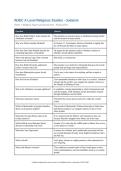
WJEC A Level Religious Studies - Judaism
Theme 1: Religious Figures and Sacred Texts - Flashcard Set
Question Answer
How does Rabbi Ruth H. Sohn interpret the She identifies its central promise as Abraham becoming fruitful
Abrahamic covenant? and the ancestor of many nations.
Why was Abram renamed Abraham? In Genesis 17, God renames Abram as Abraham to signify that
he will become the father of many nations.
How does Dan Cohn-Sherbok describe the He argues that the promises made to Abraham continue to
continuing importance of Abraham? influence Jewish identity and belief.
What is the physical sign of the covenant Brit milah, or circumcision.
between God and Abraham?
How does Rabbi Jill Jacobs understand She presents it as a distinctive relationship that gives the Jewish
Israel's covenant with God? people both privileges and responsibilities.
How does Maimonides express Jewish God is one, is the creator of everything, and has no equal or
monotheism? partner.
How did God test Abraham? God commanded Abraham to offer Isaac as a sacrifice. Abraham
obeyed, but the sacrifice was stopped; this episode is known as
the Akedah, or Binding of Isaac.
Why is the Abrahamic covenant significant? It establishes a lasting relationship in which God promises land
and descendants, while Abraham and his descendants respond
through faithfulness and brit milah.
What does immanence mean? The belief that God is present and active within the created
world.
Which of Maimonides' principles identifies The seventh of Maimonides' Thirteen Principles of Faith states
Moses as the greatest prophet? that Moses' prophecy was uniquely superior to that of every
other prophet.
What does the name Moses mean in the It is connected with the Hebrew verb meaning 'to draw out',
Exodus narrative? because Pharaoh's daughter drew Moses out of the water.
Which biblical verse illustrates Moses' Exodus 33:11 states that the LORD spoke to Moses 'face to face,
distinctive relationship with God? as one speaks to a friend'.
What does Yam Suph mean? It means 'Sea of Reeds' and is traditionally associated with the
sea crossed during the Exodus; many English translations call it
the Red Sea.
What is kavod? God's glory, honour or weighty presence, often experienced as
awe-inspiring.
What is the Mosaic covenant? The conditional covenant made at Sinai: Israel agrees to obey
God's commandments, and God establishes Israel as a covenant
people.
Unofficial independent revision resource. Not affiliated with or endorsed by WJEC/CBAC.
, Question Answer
What is a suzerainty covenant? An agreement between a powerful ruler and a subordinate
people, in which the ruler offers protection and the people
promise loyalty and obedience.
How is Israel described in Exodus 19:5-6? As God's 'treasured possession', 'a kingdom of priests' and 'a
holy nation'.
What is a theophany? A manifestation or visible disclosure of God to human beings,
such as the divine presence at Mount Sinai.
How did Jewish sacred law and interpretation Written Torah -> Oral Torah -> Mishnah and Gemara (the
develop? Talmud) -> later legal codes -> responsa addressing new
questions.
What are the Five Books of Moses? Genesis, Exodus, Leviticus, Numbers and Deuteronomy.
What happens in Exodus 19-20? Israel arrives at Mount Sinai, enters the covenant with God, and
receives the Ten Commandments amid a dramatic theophany.
What is the main content of Genesis? Genesis describes creation, the early history of humanity, and
the patriarchal narratives, ending with Jacob's family living in
Egypt.
What is the main content of Exodus? Exodus tells of liberation from slavery in Egypt, the leadership
of Moses, the covenant at Sinai and the beginning of Israel's life
under Torah.
What is the main content of Numbers? Numbers follows Israel's wilderness journey and emphasises
trust, obedience, holiness and preparation to enter the promised
land.
What is the main content of Deuteronomy? Deuteronomy presents Moses' final speeches before Israel enters
the promised land, restates the law and concludes with Moses'
death.
What is the main content of Leviticus? Leviticus contains laws about worship, sacrifice, purity,
priesthood and ethical conduct, all directed towards holiness.
What is the Jewish Bible called? The Tanakh, also known as the Hebrew Bible. The Torah is its
first section.
What are the three sections of the Tanakh? Torah: the Five Books of Moses.
Nevi'im: the Prophets.
Ketuvim: the Writings.
What is the Orthodox Jewish view of the The Torah is divine revelation and, in traditional belief, was
Torah's origin? given by God to Moses. Its commandments therefore possess
enduring authority.
What is the Orthodox Jewish view of the It guides daily life, defines covenantal obligations and shows
Torah's purpose? how the Jewish people are to live as a holy community.
Unofficial independent revision resource. Not affiliated with or endorsed by WJEC/CBAC.
Theme 1: Religious Figures and Sacred Texts - Flashcard Set
Question Answer
How does Rabbi Ruth H. Sohn interpret the She identifies its central promise as Abraham becoming fruitful
Abrahamic covenant? and the ancestor of many nations.
Why was Abram renamed Abraham? In Genesis 17, God renames Abram as Abraham to signify that
he will become the father of many nations.
How does Dan Cohn-Sherbok describe the He argues that the promises made to Abraham continue to
continuing importance of Abraham? influence Jewish identity and belief.
What is the physical sign of the covenant Brit milah, or circumcision.
between God and Abraham?
How does Rabbi Jill Jacobs understand She presents it as a distinctive relationship that gives the Jewish
Israel's covenant with God? people both privileges and responsibilities.
How does Maimonides express Jewish God is one, is the creator of everything, and has no equal or
monotheism? partner.
How did God test Abraham? God commanded Abraham to offer Isaac as a sacrifice. Abraham
obeyed, but the sacrifice was stopped; this episode is known as
the Akedah, or Binding of Isaac.
Why is the Abrahamic covenant significant? It establishes a lasting relationship in which God promises land
and descendants, while Abraham and his descendants respond
through faithfulness and brit milah.
What does immanence mean? The belief that God is present and active within the created
world.
Which of Maimonides' principles identifies The seventh of Maimonides' Thirteen Principles of Faith states
Moses as the greatest prophet? that Moses' prophecy was uniquely superior to that of every
other prophet.
What does the name Moses mean in the It is connected with the Hebrew verb meaning 'to draw out',
Exodus narrative? because Pharaoh's daughter drew Moses out of the water.
Which biblical verse illustrates Moses' Exodus 33:11 states that the LORD spoke to Moses 'face to face,
distinctive relationship with God? as one speaks to a friend'.
What does Yam Suph mean? It means 'Sea of Reeds' and is traditionally associated with the
sea crossed during the Exodus; many English translations call it
the Red Sea.
What is kavod? God's glory, honour or weighty presence, often experienced as
awe-inspiring.
What is the Mosaic covenant? The conditional covenant made at Sinai: Israel agrees to obey
God's commandments, and God establishes Israel as a covenant
people.
Unofficial independent revision resource. Not affiliated with or endorsed by WJEC/CBAC.
, Question Answer
What is a suzerainty covenant? An agreement between a powerful ruler and a subordinate
people, in which the ruler offers protection and the people
promise loyalty and obedience.
How is Israel described in Exodus 19:5-6? As God's 'treasured possession', 'a kingdom of priests' and 'a
holy nation'.
What is a theophany? A manifestation or visible disclosure of God to human beings,
such as the divine presence at Mount Sinai.
How did Jewish sacred law and interpretation Written Torah -> Oral Torah -> Mishnah and Gemara (the
develop? Talmud) -> later legal codes -> responsa addressing new
questions.
What are the Five Books of Moses? Genesis, Exodus, Leviticus, Numbers and Deuteronomy.
What happens in Exodus 19-20? Israel arrives at Mount Sinai, enters the covenant with God, and
receives the Ten Commandments amid a dramatic theophany.
What is the main content of Genesis? Genesis describes creation, the early history of humanity, and
the patriarchal narratives, ending with Jacob's family living in
Egypt.
What is the main content of Exodus? Exodus tells of liberation from slavery in Egypt, the leadership
of Moses, the covenant at Sinai and the beginning of Israel's life
under Torah.
What is the main content of Numbers? Numbers follows Israel's wilderness journey and emphasises
trust, obedience, holiness and preparation to enter the promised
land.
What is the main content of Deuteronomy? Deuteronomy presents Moses' final speeches before Israel enters
the promised land, restates the law and concludes with Moses'
death.
What is the main content of Leviticus? Leviticus contains laws about worship, sacrifice, purity,
priesthood and ethical conduct, all directed towards holiness.
What is the Jewish Bible called? The Tanakh, also known as the Hebrew Bible. The Torah is its
first section.
What are the three sections of the Tanakh? Torah: the Five Books of Moses.
Nevi'im: the Prophets.
Ketuvim: the Writings.
What is the Orthodox Jewish view of the The Torah is divine revelation and, in traditional belief, was
Torah's origin? given by God to Moses. Its commandments therefore possess
enduring authority.
What is the Orthodox Jewish view of the It guides daily life, defines covenantal obligations and shows
Torah's purpose? how the Jewish people are to live as a holy community.
Unofficial independent revision resource. Not affiliated with or endorsed by WJEC/CBAC.

