

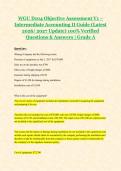
WGU D104 Objective Assessment V1 –
Intermediate Accounting II Guide (Latest
2026/ 2027 Update) 100% Verified
Questions & Answers | Grade A
Question:
Watauga Company had the following events:
Purchase of equipment on July 1, 2017 for $70,000
Sales tax on the purchase was $700
Other costs of freight charges of $800
Insurance during shipping of $150
Repairs of $1,300 for damage during installation
Installation costs of $1,050
What is the cost of the equipment?
The cost of a piece of equipment includes all expenditures incurred in acquiring the equipment
and preparing it for use.
Therefore the cost includes the cost of $70,000, sales tax of $700, freight charges of $800,
insurance of $ 150, and installation costs of $1,050. The repair costs of $1,300 are expensed and
not included in the capitalized cost of the equipment.
The reasons the the repairs of damage during installation are not included in the capitalized costs
include such repairs should either be warrantied by the company performing the installation and
therefore would be reimbursable from that company or those repairs could be reimbursable by
the company's or the suppliers insurance policy.
Cost of equipment: $72,700
,Cotton Hotel Corporation recently purchased Emporia Hotel and the land on which it is located
with the plan to tear down the Emporia Hotel and build a new luxury hotel on the site.
How should the cost of the Emporia Hotel be treated?
If a company purchases land with an old building on it, then the cost of demolition less its
salvage value is a cost of getting the land ready for its intended use and relates to the land rather
than to the new building.
Therefore, the cost of the Emporia hotel is capitalized as part of the cost of the land.
How are fences and parking lots reported on the balance sheet?
Improvements with limited lives, such as driveways, walks, fences, and parking lots are
classified on the balance sheet as Land Improvements and depreciated over their estimated lives.
Reported on the balance sheet as "Land Improvements"
Land was purchased to be used as the site for the construction of a plant. A building on the
property was sold and removed by the buyer so that construction on the plant could begin.
'How should the proceeds from the sale of the building be treated?
If a company purchases land with an old building on it, then the cost of demolition less its
salvage value is a cost of getting the land ready for its intended use and relates to the land rather
than to the new building. Therefore, the proceeds from the sale of the old building is deducted
from the cost of the land.
, So, the proceeds should be deducted from the cost of the land.
Wilson Co. purchased land as a factory site for $1,350,000.
Wilson paid $120,000 to tear down two buildings on the land.
Salvage was sold for $8,100.
Legal fees of $5,220 were paid for title investigation and making the purchase.
Architect's fees were $46,800. Title insurance cost $3,600, and liability insurance during
construction cost $3,900.
Excavation cost $15,660.
The contractor was paid $4,200,000.
An assessment made by the city for pavement was $9,600.
At what cost should Wilson Co record the land?
Removal of old buildings—clearing, grading, and filling—is a land cost because this activity is
necessary to get the land in condition for its intended purpose. Architect Fees, liability insurance,
and excavation are included in the cost of the building.
Therefore, the cost of the land is calculated as: $1,350,000 + $120,000 - $8,100 + $5,220 +
$3,600 + $9,600 = $1,480,320.
The excavation cost of $15,660 is a cost related to the building, not to the acquisition of the land,
as the excavation cost is directly related to building the building on the land.
So, the Wilson Co should record the cost of land at $1,480,320
How does GAAP recommend accounting for interest costs incurred during construction?
Using this approach ignores the implicit interest cost associated with the use of the cash.
Intermediate Accounting II Guide (Latest
2026/ 2027 Update) 100% Verified
Questions & Answers | Grade A
Question:
Watauga Company had the following events:
Purchase of equipment on July 1, 2017 for $70,000
Sales tax on the purchase was $700
Other costs of freight charges of $800
Insurance during shipping of $150
Repairs of $1,300 for damage during installation
Installation costs of $1,050
What is the cost of the equipment?
The cost of a piece of equipment includes all expenditures incurred in acquiring the equipment
and preparing it for use.
Therefore the cost includes the cost of $70,000, sales tax of $700, freight charges of $800,
insurance of $ 150, and installation costs of $1,050. The repair costs of $1,300 are expensed and
not included in the capitalized cost of the equipment.
The reasons the the repairs of damage during installation are not included in the capitalized costs
include such repairs should either be warrantied by the company performing the installation and
therefore would be reimbursable from that company or those repairs could be reimbursable by
the company's or the suppliers insurance policy.
Cost of equipment: $72,700
,Cotton Hotel Corporation recently purchased Emporia Hotel and the land on which it is located
with the plan to tear down the Emporia Hotel and build a new luxury hotel on the site.
How should the cost of the Emporia Hotel be treated?
If a company purchases land with an old building on it, then the cost of demolition less its
salvage value is a cost of getting the land ready for its intended use and relates to the land rather
than to the new building.
Therefore, the cost of the Emporia hotel is capitalized as part of the cost of the land.
How are fences and parking lots reported on the balance sheet?
Improvements with limited lives, such as driveways, walks, fences, and parking lots are
classified on the balance sheet as Land Improvements and depreciated over their estimated lives.
Reported on the balance sheet as "Land Improvements"
Land was purchased to be used as the site for the construction of a plant. A building on the
property was sold and removed by the buyer so that construction on the plant could begin.
'How should the proceeds from the sale of the building be treated?
If a company purchases land with an old building on it, then the cost of demolition less its
salvage value is a cost of getting the land ready for its intended use and relates to the land rather
than to the new building. Therefore, the proceeds from the sale of the old building is deducted
from the cost of the land.
, So, the proceeds should be deducted from the cost of the land.
Wilson Co. purchased land as a factory site for $1,350,000.
Wilson paid $120,000 to tear down two buildings on the land.
Salvage was sold for $8,100.
Legal fees of $5,220 were paid for title investigation and making the purchase.
Architect's fees were $46,800. Title insurance cost $3,600, and liability insurance during
construction cost $3,900.
Excavation cost $15,660.
The contractor was paid $4,200,000.
An assessment made by the city for pavement was $9,600.
At what cost should Wilson Co record the land?
Removal of old buildings—clearing, grading, and filling—is a land cost because this activity is
necessary to get the land in condition for its intended purpose. Architect Fees, liability insurance,
and excavation are included in the cost of the building.
Therefore, the cost of the land is calculated as: $1,350,000 + $120,000 - $8,100 + $5,220 +
$3,600 + $9,600 = $1,480,320.
The excavation cost of $15,660 is a cost related to the building, not to the acquisition of the land,
as the excavation cost is directly related to building the building on the land.
So, the Wilson Co should record the cost of land at $1,480,320
How does GAAP recommend accounting for interest costs incurred during construction?
Using this approach ignores the implicit interest cost associated with the use of the cash.

