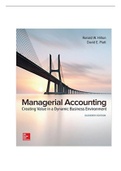
TEST BANK SOLUTIONS MANUAL FOR MANAGERIAL ACCOUNTING: CREATING VALUE IN A DYNAMIC BUSINESS ENVIRONMENT, 12TH EDITION, RONALD HILTON, DAVID PLATT
TEST BANK SOLUTIONS MANUAL FOR MANAGERIAL ACCOUNTING: CREATING VALUE IN A DYNAMIC BUSINESS ENVIRONMENT, 12TH EDITION, RONALD HILTON, DAVID PLATT 1. The Crucial Role of Managerial Accounting in a Dynamic Business Environment 2 2. Basic Cost Management Concepts 34 3. Product Costing and Cost Accumulation in a Batch Production Environment 80 4. Process Costing and Hybrid Product-Costing Systems 136 5. Activity-Based Costing and Management 168 6. Activity Analysis, Cost Behavior, and Cost Estimation 232 7. Cost-Volume-Profit Analysis 282 8. Variable Costing and the Measurement of ESG and Quality Costs 332 9. Financial Planning and Analysis: The Master Budget 368 10. Standard Costing and Analysis of Direct Costs 430 11. Flexible Budgeting and Analysis of Overhead Costs 474 12. Responsibility Accounting and the Balanced Scorecard 520 13. Investment Centers and Transfer Pricing 572 14. Decision Making: Relevant Costs and Benefits 616 15. Target Costing and Cost Analysis for Pricing Decisions 666 16. Capital Expenditure Decisions 708 17. Allocation of Support Activity Costs and Joint Costs 760 Chapter 1 The Changing Role of Managerial Accounting in a Dynamic Business Environment Answer Key True / False Questions 1. Two things that all organizations have in common are a set of goals and information needed by managers. TRUE AACSB: Reflective Thinking AICPA: BB Critical Thinking AICPA FN: Decision Making Blooms: Remember Difficulty: 1 Easy Learning Objective: 01-01 Feedback True: Correct! All organizations have a set of goals and managers need information to accomplish these goals. Feedback False: It is true that all organizations have a set of goals and managers need information to accomplish these goals. 2. The role of managerial accounting in organizations is the same as it has been over many years. FALSE AACSB: Reflective Thinking AICPA: BB Critical Thinking AICPA FN: Decision Making Blooms: Remember Difficulty: 1 Easy Learning Objective: 01-01 Feedback True: The role of managerial accounting has been changing in recent years. Feedback False: Correct! The role of managerial accounting has been changing in recent years. 3. Controlling involves the coordination of daily business functions within an organization. FALSE AACSB: Reflective Thinking AICPA: BB Critical Thinking AICPA FN: Decision Making Blooms: Remember Difficulty: 1 Easy Learning Objective: 01-02 Feedback True: This is actually the definition for directing operational activities, which is a managerial activity. Feedback False: Correct! This is actually the definition for directing operational activities, which is a managerial activity. 4. Decision making requires managers to choose among the available alternatives. TRUE AACSB: Reflective Thinking AICPA: BB Critical Thinking AICPA FN: Decision Making Blooms: Remember Difficulty: 1 Easy Learning Objective: 01-02 Feedback True: Correct! This is the correct definition for decision making. Feedback False: This is the correct definition for decision making. 5. The balanced scorecard is an important managerial accounting tool for short-run competitiveness. FALSE AACSB: Reflective Thinking AICPA: BB Critical Thinking AICPA FN: Decision Making Blooms: Remember Difficulty: 1 Easy Learning Objective: 01-03 Feedback True: The balanced scorecard is an important managerial accounting tool for long-run competitiveness. Feedback False: Correct! The balanced scorecard is an important managerial accounting tool for long-run competitiveness. 6. In most situations, managerial accounting reports solve decision problems. FALSE AACSB: Reflective Thinking AICPA: BB Critical Thinking AICPA FN: Decision Making Blooms: Remember Difficulty: 1 Easy Learning Objective: 01-03 Feedback True: Managerial accounting reports rarely solve a decision problem; instead they direct attention to issues. Feedback False: Correct! Managerial accounting reports rarely solve a decision problem; instead they direct attention to issues. 7. Middle-level managers would likely be considered internal users of accounting information rather than external users. TRUE AACSB: Reflective Thinking AICPA BB: Resource Management AICPA FN: Reporting Blooms: Remember Difficulty: 1 Easy Learning Objective: 01-03 Feedback True: Correct! Middle-level managers are generally considered internal users of accounting information. Feedback False: Middle-level managers are generally considered internal users of accounting information. 8. Measuring the performance of managers and subunits is not an objective of managerial accounting. FALSE AACSB: Analytic AICPA BB: Critical Thinking AICPA FN: Research Blooms: Remember Difficulty: 1 Easy Learning Objective: 01-04 Feedback True: In fact, measuring the performance of managers and subunits is an objective of managerial accounting.. Feedback False: Correct! In fact, measuring the performance of managers and subunits is an objective of managerial accounting. 9. The nature of managerial accounting reports is to focus on the enterprise in its entirety. FALSE AACSB: Analytic AICPA BB: Critical Thinking AICPA FN: Research Blooms: Remember Difficulty: 1 Easy Learning Objective: 01-04 Feedback True: The nature of financial accounting rather than managerial accounting reports is to focus on the enterprise in its entirety. Feedback False: Correct! The nature of financial accounting rather than managerial accounting reports is to focus on the enterprise in its entirety. 10. Line positions are indirectly involved in operational activities. FALSE AACSB: Analytic AICPA BB: Critical Thinking AICPA FN: Research Blooms: Remember Difficulty: 1 Easy Learning Objective: 01-05 Feedback True: Managers in line positions are directly involved in the provision of goods or services. Feedback False: Correct! Managers in line positions are directly involved in the provision of goods or services. 11. The position of chief financial officer (CFO) is typically a staff position. TRUE AACSB: Analytic AICPA BB: Critical Thinking AICPA FN: Research Blooms: Remember Difficulty: 1 Easy Learning Objective: 01-05 Feedback True: Correct! The position of chief financial officer (CFO) is typically a staff position. Feedback False: The position of chief financial officer (CFO) is typically a staff position. 12. A controller is normally involved with preparing financial statements. TRUE AACSB: Reflective Thinking AICPA BB: Resource Management AICPA FN: Reporting Blooms: Remember Difficulty: 1 Easy Learning Objective: 01-06 Feedback True: Correct! A controller is typically involved in the process to prepare financial Chapter 2 Basic Cost Management Concepts True / False Questions 1. Inventoriable costs are expensed when incurred. True False 2. Finished goods inventory is ordinarily held for sale by a manufacturing company. True False 3. Indirect labor is not a component of manufacturing overhead. True False 4. The following equation—Beginning finished goods + cost of goods manufactured - ending finished goods—is used to calculate cost of goods sold during the period. True False 5. A suitable cost driver for the amount of direct materials used is the number of direct labor hours worked. True False Multiple Choice Questions 6. Which of the following statements is true? A. The word "cost" has the same meaning in all situations in which it is used. B. Cost data, once classified and recorded for a specific application, are appropriate for use in any application. C. Different cost concepts and classifications are used for different purposes. D. All organizations incur the same types of costs. E. Costs incurred in one year are always meaningful in the following year. 7. Product costs are: A. expensed when incurred. B. inventoried. C. treated in the same manner as period costs. D. treated in the same manner as advertising costs. E. subtracted from cost of goods sold. 8. Which of the following is a product cost? A. Glass in an automobile. B. Advertising. C. The salary of the vice president-finance. D. Rent on a factory. E. Advertising and rent on a factory. 9. Which of the following would not be classified as a product cost? A. Direct materials. B. Direct labor. C. Indirect materials. D. Insurance on a manufacturing plant. E. Sales commissions. 10. The accounting records of Georgia Company revealed the following costs: direct materials used, $250,000; direct labor, $425,000; manufacturing overhead, $375,000; and selling and administrative expenses, $220,000. Georgia's product costs total: A. $1,050,000. B. $830,000. C. $895,000. D. $1,270,000. E. None of the other answers are correct. 11. Costs that are expensed when incurred are called: A. product costs. B. direct costs. C. inventoriable costs. D. period costs. E. indirect costs. A. Direct material. B. Advertising expense. C. Indirect labor. D. Miscellaneous supplies used in production activities. E. Advertising expense and indirect labor. 13. Which of the following is not a period cost? A. Legal costs. B. Public relations costs. C. Sales commissions. D. Wages of assembly-line workers. E. The salary of a company's chief financial officer (CFO). 14. The accounting records of Reynolds Corporation revealed the following selected costs: Sales commissions, $65,000; plant supervision, $190,000; and administrative expenses, $185,000. Reynolds's period costs total: A. $250,000. B. $440,000. C. $375,000. D. $255,000. E. $185,000.
Información del documento
- Subido en
- 25 de junio de 2021
- Archivo actualizado en
- 26 de enero de 2022
- Número de páginas
- 210
- Escrito en
- 2020/2021
- Tipo
- Examen
- Contiene
- Preguntas y respuestas