

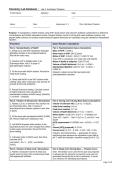
Chemistry Lab Notebook | Lab 3: Acid-Base Titrations
Printed Name: Signature: Date:
_______________________ ___________________________ _____________________________
___
Name: Date: Experiment #: 3 Title: Acid-Base Titrations
________________ _________________
Purpose: To standardize a NaOH solution using KHP, titrate known and unknown acid/base combinations to determine
concentrations and identify equivalence points, interpret titration curves for strong and weak acid/base systems, and
prepare buffer solutions to compare experimental pH against theoretical pH calculated using the Henderson-Hasselbalch
equation.
Procedure Data / Results / Calculations
Part 1: Standardization of NaOH Part 1: Standardization Data & Calculations
1. Weigh out a solid KHP (potassium hydrogen Mass of KHP: 0.3548 g
phthalate) sample on the analytical balance. Molar mass of KHP: 204.22 g/mol
Record the exact mass. Moles of KHP: 0.3548 ÷ 204.22 = 0.001737 mol
Since KHP is monoprotic (1:1 molar ratio with NaOH):
2. Dissolve KHP in distilled water in an Moles of NaOH at endpoint: 0.001737 mol
Erlenmeyer flask. Add 2–3 drops of Volume of NaOH delivered: 18.1 mL = 0.0181 L
phenolphthalein indicator.
Standardized [NaOH]: 0.001737 mol ÷ 0.0181 L =
0.0961 M
3. Fill the buret with NaOH solution. Record the Endpoint: solution turned faint persistent pink
initial buret reading. (phenolphthalein indicator).
4. Slowly add NaOH to the KHP solution while
swirling. Stop when a faint pink color persists for
at least 30 seconds (endpoint).
5. Record final buret reading. Calculate volume
of NaOH delivered, then calculate the
standardized molarity of NaOH using: M(NaOH)
= mol KHP ÷ V(NaOH).
Part 2: Titration of Strong Acid / Strong Base Part 2: Strong Acid / Strong Base Data & Calculations
1. Pipette 21.0 mL of unknown HCl solution into Volume of unknown HCl: 21.0 mL = 0.0210 L
an Erlenmeyer flask. Add 2–3 drops of Initial buret reading: 0.0 mL
bromothymol blue indicator (yellow in acid, blue Final buret reading: 27.7 mL
in base).
Volume of NaOH delivered: 27.7 mL = 0.0277 L
Moles NaOH = 0.0961 M × 0.0277 L = 0.002662 mol
2. Fill the buret with standardized NaOH (0.0961 Since HCl + NaOH → NaCl + H₂O is 1:1, mol HCl = mol
M). Record initial buret reading (0.0 mL). NaOH:
[HCl] experimental = 0.002662 mol ÷ 0.0210 L = 0.127
3. Add NaOH dropwise while swirling. At the M
equivalence point, the color changes from yellow Known [HCl] (prepared): 0.123 M
to blue-green and persists. Record the final
Percent error: |0.127 − 0.123| ÷ 0.123 × 100 = 3.3%
buret reading.
Indicator: bromothymol blue — appropriate for strong
acid/strong base because the equivalence point falls at
4. Calculate moles of NaOH used, then back- pH 7, within the indicator's transition range (pH 6.0–7.6).
calculate [HCl]:
mol NaOH = M × V, [HCl] = mol NaOH ÷
V(HCl)
Part 3: Titration of Weak Acid / Strong Base Part 3: Weak Acid / Strong Base — Titration Curve
1. Pipette a measured volume of weak acid Note: The titration curve used for this part was prepared
(acetic acid, HC₂H₃O₂) into an Erlenmeyer flask. in advance by the instructor (a real-time curve was not
Add appropriate indicator. generated during lab due to time constraints). It serves
as a reference for identifying key features.
Page 1 of 4
Printed Name: Signature: Date:
_______________________ ___________________________ _____________________________
___
Name: Date: Experiment #: 3 Title: Acid-Base Titrations
________________ _________________
Purpose: To standardize a NaOH solution using KHP, titrate known and unknown acid/base combinations to determine
concentrations and identify equivalence points, interpret titration curves for strong and weak acid/base systems, and
prepare buffer solutions to compare experimental pH against theoretical pH calculated using the Henderson-Hasselbalch
equation.
Procedure Data / Results / Calculations
Part 1: Standardization of NaOH Part 1: Standardization Data & Calculations
1. Weigh out a solid KHP (potassium hydrogen Mass of KHP: 0.3548 g
phthalate) sample on the analytical balance. Molar mass of KHP: 204.22 g/mol
Record the exact mass. Moles of KHP: 0.3548 ÷ 204.22 = 0.001737 mol
Since KHP is monoprotic (1:1 molar ratio with NaOH):
2. Dissolve KHP in distilled water in an Moles of NaOH at endpoint: 0.001737 mol
Erlenmeyer flask. Add 2–3 drops of Volume of NaOH delivered: 18.1 mL = 0.0181 L
phenolphthalein indicator.
Standardized [NaOH]: 0.001737 mol ÷ 0.0181 L =
0.0961 M
3. Fill the buret with NaOH solution. Record the Endpoint: solution turned faint persistent pink
initial buret reading. (phenolphthalein indicator).
4. Slowly add NaOH to the KHP solution while
swirling. Stop when a faint pink color persists for
at least 30 seconds (endpoint).
5. Record final buret reading. Calculate volume
of NaOH delivered, then calculate the
standardized molarity of NaOH using: M(NaOH)
= mol KHP ÷ V(NaOH).
Part 2: Titration of Strong Acid / Strong Base Part 2: Strong Acid / Strong Base Data & Calculations
1. Pipette 21.0 mL of unknown HCl solution into Volume of unknown HCl: 21.0 mL = 0.0210 L
an Erlenmeyer flask. Add 2–3 drops of Initial buret reading: 0.0 mL
bromothymol blue indicator (yellow in acid, blue Final buret reading: 27.7 mL
in base).
Volume of NaOH delivered: 27.7 mL = 0.0277 L
Moles NaOH = 0.0961 M × 0.0277 L = 0.002662 mol
2. Fill the buret with standardized NaOH (0.0961 Since HCl + NaOH → NaCl + H₂O is 1:1, mol HCl = mol
M). Record initial buret reading (0.0 mL). NaOH:
[HCl] experimental = 0.002662 mol ÷ 0.0210 L = 0.127
3. Add NaOH dropwise while swirling. At the M
equivalence point, the color changes from yellow Known [HCl] (prepared): 0.123 M
to blue-green and persists. Record the final
Percent error: |0.127 − 0.123| ÷ 0.123 × 100 = 3.3%
buret reading.
Indicator: bromothymol blue — appropriate for strong
acid/strong base because the equivalence point falls at
4. Calculate moles of NaOH used, then back- pH 7, within the indicator's transition range (pH 6.0–7.6).
calculate [HCl]:
mol NaOH = M × V, [HCl] = mol NaOH ÷
V(HCl)
Part 3: Titration of Weak Acid / Strong Base Part 3: Weak Acid / Strong Base — Titration Curve
1. Pipette a measured volume of weak acid Note: The titration curve used for this part was prepared
(acetic acid, HC₂H₃O₂) into an Erlenmeyer flask. in advance by the instructor (a real-time curve was not
Add appropriate indicator. generated during lab due to time constraints). It serves
as a reference for identifying key features.
Page 1 of 4

