

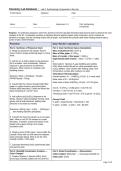
Chemistry Lab Notebook | Lab 6: Synthesizing Compounds in the Lab
Printed Name: Signature: Date:
_______________________ ___________________________ _____________________________
___
Name: Date: Experiment #: 6 Title: Synthesizing
________________ _________________ Compounds
Purpose: To synthesize potassium alum from aluminum foil and calculate theoretical and percent yield; to observe the color
changes of the Ni²⁺ coordination complex as ethylene diamine ligands replace water molecules; and to combust six
elements in oxygen, test the resulting oxides with pH paper, and identify the periodic table trend relating element type to
acidic or basic oxide formation.
Procedure Data / Results / Calculations
Part 1: Synthesis of Potassium Alum Part 1: Alum Synthesis Data & Calculations
1. Weigh out aluminum foil sample. Record Mass of aluminum foil: 0.4797 g
mass. Perform all gas-producing steps in a fume Mass of filter paper: 0.1793 g
hood. Mass of crystals + filter paper: 7.4624 g
Experimental yield of alum: 7.4624 − 0.1793 = 7.2831
2. Add 13 mL of KOH solution to the aluminum g
foil in a beaker. Swirl occasionally. Observe Observations: Vigorous H₂ gas bubbling upon adding
vigorous H₂ gas production as aluminum KOH; black residue filtered out; white precipitate upon
dissolves. Allow reaction to complete until H₂SO₄ addition; clear solution after heating; large, well-
bubbling ceases. formed alum crystals after cooling in ice bath.
Theoretical Yield Calculation:
Reaction: 2Al(s) + 2KOH(aq) + 6H₂O(l) → Overall reaction: Al → KAl(SO₄)₂·12H₂O (1:1 molar ratio)
2KAl(OH)₄(aq) + 3H₂(g) Molar mass of Al = 26.98 g/mol
Molar mass of alum (KAl(SO₄)₂·12H₂O) = 474.32 g/mol
3. Gravity filter the mixture through folded filter
paper in a glass funnel to remove the black
residue (alloy impurities). Collect the filtrate (the mol Al = 0.4797 g ÷ 26.98 g/mol = 0.01778 mol
liquid containing K⁺ and Al³⁺ ions). mol alum = 0.01778 mol (1:1 ratio)
Theoretical yield = 0.01778 mol × 474.32 g/mol = 8.433 g
4. Add sulfuric acid (H₂SO₄) dropwise to the
filtrate. Observe white precipitate forming. Heat Percent Yield:
gently until all solid dissolves, adding small % yield = (experimental ÷ theoretical) × 100
amounts of hot water as needed.
% yield = (7.2831 ÷ 8.433) × 100 = 86.36%
Reactions: Al(OH)₄⁻(aq) + H₂SO₄ → Al(OH)₃(s) +
… then heating dissolves precipitate.
5. Transfer the clear hot solution to an ice-water
bath. Allow to cool 20–30 minutes for crystal
formation. If needed, scratch the bottom of the
beaker with a glass stirring rod to create
nucleation sites.
6. Weigh a piece of filter paper. Vacuum filter the
crystals. Rinse with ice-cold ethanol to displace
water and begin drying. Allow to air dry, then
reweigh crystals + filter paper.
7. Calculate theoretical yield, experimental yield,
and percent yield.
Part 2: Nickel(II) Coordination Complex — Part 2: Nickel Coordination — Observations
Color Changes Initial complex: [Ni(H₂O)₆]²⁺ — hexa-aqua nickel(II) ion
1. Prepare Solution A: dissolve NiSO₄·6H₂O Initial color: Green
(hexa-aqua nickel(II) sulfate) with KCl and HCl.
Page 1 of 4
Printed Name: Signature: Date:
_______________________ ___________________________ _____________________________
___
Name: Date: Experiment #: 6 Title: Synthesizing
________________ _________________ Compounds
Purpose: To synthesize potassium alum from aluminum foil and calculate theoretical and percent yield; to observe the color
changes of the Ni²⁺ coordination complex as ethylene diamine ligands replace water molecules; and to combust six
elements in oxygen, test the resulting oxides with pH paper, and identify the periodic table trend relating element type to
acidic or basic oxide formation.
Procedure Data / Results / Calculations
Part 1: Synthesis of Potassium Alum Part 1: Alum Synthesis Data & Calculations
1. Weigh out aluminum foil sample. Record Mass of aluminum foil: 0.4797 g
mass. Perform all gas-producing steps in a fume Mass of filter paper: 0.1793 g
hood. Mass of crystals + filter paper: 7.4624 g
Experimental yield of alum: 7.4624 − 0.1793 = 7.2831
2. Add 13 mL of KOH solution to the aluminum g
foil in a beaker. Swirl occasionally. Observe Observations: Vigorous H₂ gas bubbling upon adding
vigorous H₂ gas production as aluminum KOH; black residue filtered out; white precipitate upon
dissolves. Allow reaction to complete until H₂SO₄ addition; clear solution after heating; large, well-
bubbling ceases. formed alum crystals after cooling in ice bath.
Theoretical Yield Calculation:
Reaction: 2Al(s) + 2KOH(aq) + 6H₂O(l) → Overall reaction: Al → KAl(SO₄)₂·12H₂O (1:1 molar ratio)
2KAl(OH)₄(aq) + 3H₂(g) Molar mass of Al = 26.98 g/mol
Molar mass of alum (KAl(SO₄)₂·12H₂O) = 474.32 g/mol
3. Gravity filter the mixture through folded filter
paper in a glass funnel to remove the black
residue (alloy impurities). Collect the filtrate (the mol Al = 0.4797 g ÷ 26.98 g/mol = 0.01778 mol
liquid containing K⁺ and Al³⁺ ions). mol alum = 0.01778 mol (1:1 ratio)
Theoretical yield = 0.01778 mol × 474.32 g/mol = 8.433 g
4. Add sulfuric acid (H₂SO₄) dropwise to the
filtrate. Observe white precipitate forming. Heat Percent Yield:
gently until all solid dissolves, adding small % yield = (experimental ÷ theoretical) × 100
amounts of hot water as needed.
% yield = (7.2831 ÷ 8.433) × 100 = 86.36%
Reactions: Al(OH)₄⁻(aq) + H₂SO₄ → Al(OH)₃(s) +
… then heating dissolves precipitate.
5. Transfer the clear hot solution to an ice-water
bath. Allow to cool 20–30 minutes for crystal
formation. If needed, scratch the bottom of the
beaker with a glass stirring rod to create
nucleation sites.
6. Weigh a piece of filter paper. Vacuum filter the
crystals. Rinse with ice-cold ethanol to displace
water and begin drying. Allow to air dry, then
reweigh crystals + filter paper.
7. Calculate theoretical yield, experimental yield,
and percent yield.
Part 2: Nickel(II) Coordination Complex — Part 2: Nickel Coordination — Observations
Color Changes Initial complex: [Ni(H₂O)₆]²⁺ — hexa-aqua nickel(II) ion
1. Prepare Solution A: dissolve NiSO₄·6H₂O Initial color: Green
(hexa-aqua nickel(II) sulfate) with KCl and HCl.
Page 1 of 4

