

Escrito por estudiantes que aprobaron Inmediatamente disponible después del pago Leer en línea o como PDF ¿Documento equivocado? Cámbialo gratis 4,6 TrustPilot
logo-home
Document preview thumbnail
Vista previa 3 fuera de 25 páginas
Examen

TCU Finance Exit Exam | 350+ Practice Questions & Verified Answers | Time Value of Money, Bonds, Stocks, Capital Budgeting, WACC & Financial Markets | Texas Christian University Finance

Document preview thumbnail
Vista previa 3 fuera de 25 páginas

Prepare confidently for the TCU Finance Exit Exam with this comprehensive 350+ practice questions and verified answers study guide covering the core principles of corporate finance, investments, financial markets, valuation, capital budgeting, risk management, and macroeconomics. This resource provides an in-depth review of time value of money (TVM), annuities, perpetuities, bond and stock valuation, portfolio theory, capital structure, weighted average cost of capital (WACC), financial statement analysis, monetary policy, and investment decision-making. Presented in a structured question-and-answer format with detailed explanations, it strengthens quantitative reasoning, financial analysis, and problem-solving skills while preparing students for the Texas Christian University (TCU) Finance Exit Exam and upper-level finance coursework. This study guide provides extensive coverage of present value (PV), future value (FV), lump-sum valuation, annuities, annuities due, perpetuities, effective annual rate (EAR), loan amortization schedules, bond pricing, yield to maturity (YTM), bond duration, preferred stock valuation, common stock valuation using the dividend discount model (DDM), expected return, dividend yield, free cash flow (FCF), free cash flow to equity (FCFE), adjusted present value (APV), mergers and acquisitions, Efficient Market Hypothesis (EMH), market efficiency, beta, alpha, Capital Asset Pricing Model (CAPM), diversification, systematic and unsystematic risk, Sharpe ratio, investment banking, financial leverage, operating leverage, primary and secondary markets, cost of debt, cost of preferred stock, cost of equity, flotation costs, capital structure weights, weighted average cost of capital (WACC), and marginal cost of capital. The guide emphasizes financial formulas, valuation techniques, investment analysis, and decision-making methods commonly assessed in undergraduate finance curricula. Additionally, this resource reviews capital budgeting techniques including payback period, discounted payback, net present value (NPV), internal rate of return (IRR), modified internal rate of return (MIRR), project cash flow development, financial ratio analysis, DuPont analysis, profitability ratios, liquidity ratios, debt utilization ratios, agency theory, corporate governance, financial distress, interest tax shields, term structure of interest rates, foreign exchange markets, monetary policy, central banking, money supply, IS-LM-FE model, aggregate demand and aggregate supply, inflation, moral hazard, adverse selection, financial institutions, and macroeconomic policy. High-yield formulas, calculator applications, valuation methods, investment principles, corporate finance concepts, and exam-style practice questions are integrated throughout, making this an exceptional resource for finance majors, business students, CFA foundations, MBA preparation, and comprehensive finance examination review. The concepts presented align with evidence-based finance references, including Brigham, E. F., & Ehrhardt, M. C. Financial Management: Theory & Practice (16th ed., Cengage Learning), Ross, S. A., Westerfield, R. W., Jordan, B. D., & Lim, J. Fundamentals of Corporate Finance (13th ed., McGraw-Hill), Brealey, R. A., Myers, S. C., Allen, F., & Edmans, A. Principles of Corporate Finance (14th ed., McGraw-Hill), Bodie, Z., Kane, A., & Marcus, A. J. Investments (12th ed., McGraw-Hill), Damodaran, A. Applied Corporate Finance (Wiley), and CFA Institute Investment Foundations Program. These authoritative references provide the theoretical and analytical foundation for corporate finance, valuation, investment analysis, portfolio management, capital budgeting, financial markets, and risk management. The questions and answers contained within this uploaded document are derived from the study guide itself and are not reproduced from these publications. Relevant Students: TCU Finance students Finance majors Corporate Finance students Investment Analysis students Business Administration students Bachelor of Business Administration (BBA) students Master of Business Administration (MBA) students Economics students Banking and Financial Services students Investment Banking students Financial Management students CFA Level I candidates Finance certification candidates Business school examination candidates Financial Markets students Keywords TCU Finance Exit Exam, Texas Christian University, Corporate Finance, Financial Management, Time Value of Money, TVM, Present Value, Future Value, Lump Sum Valuation, Annuities, Annuity Due, Perpetuity, Effective Annual Rate, EAR, Loan Amortization, Bond Valuation, Bond Pricing, Yield to Maturity, YTM, Bond Duration, Preferred Stock, Common Stock Valuation, Dividend Discount Model, DDM, Dividend Yield, Expected Return, Free Cash Flow, FCF, FCFE, APV, Mergers and Acquisitions, Efficient Market Hypothesis, EMH, Market Efficiency, Beta, Alpha, CAPM, Diversification, Systematic Risk, Unsystematic Risk, Sharpe Ratio, Investment Banking, Financial Leverage, Operating Leverage, Primary Market, Secondary Market, Cost of Debt, Cost of Equity, Cost of Preferred Stock, Flotation Costs, Capital Structure, WACC, Marginal Cost of Capital, Capital Budgeting, Payback Period, Discounted Payback, Net Present Value, NPV, Internal Rate of Return, IRR, Modified Internal Rate of Return, MIRR, Financial Statement Analysis, DuPont Analysis, Profitability Ratios, Liquidity Ratios, Debt Ratios, Agency Theory, Corporate Governance, Financial Distress, Interest Tax Shield, Yield Curve, Foreign Exchange, Monetary Policy, Central Banking, IS LM FE Model, Aggregate Demand, Aggregate Supply, Inflation, Moral Hazard, Adverse Selection, Financial Institutions, Finance Practice Questions, Business Exam Review

Vista previa del contenido

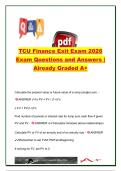
TCU Finance Exit Exam 2026
Exam Questions and Answers |
Already Graded A+


Calculate the present value or future value of a lump (single) sum. -

ANSWER ✔✔o PV = FV / (1+i)^n


o FV = PV(1+i)^n

Find number of periods or interest rate for lump sum cash flow if given

PV and FV - ANSWER ✔✔Calculator time(see above relationships)


Calculate PV or FV of an annuity and of an annuity due - ANSWER

✔✔Remember to set TVM: PMT:end/beginning


If solving for FV, set PV to 0

,If solving for PV, set FV to 0

PMT=annual payment

FV=0 or solve for

i=market rate

PV=0 or solve for

Find PMT, interest rate, or number of payments in annuity or annuity due

problem with annual or non-annual payments - ANSWER

✔✔Remember to adjust for non-annual payments


Find the PV, PMT, or interest rate for a perpetuity - ANSWER

✔✔Perpetuity: PV=PMT/interest rate


Calculate the effective annual rate for an interest rate compounded more

than one time per year - ANSWER ✔✔o ((1+ i/n)^n) - 1


o I = stated annual interest rate

o N = number of periods


Prepare a loan amortization table - ANSWER ✔✔Monthly payment:

Calculator: solve for PMT using PV=principal and FV=0

Pay attention to annuity or annuity due

, For each payment, multiply interest rate times remaining principle to

determine interest portion of payment. The remaining amount goes

towards principle.

Understand the effect of time and interest rate on present and future

values of a cash flow - ANSWER ✔✔• The further out in time, the less

the PV becomes


• The higher the discount rate, the lower the PV becomes


Calculate the price of a bond - ANSWER ✔✔o PV of interest

payments

-Find annual coupon rate, or semiannual

-Find semiannual discount rate, or the bonds with similar maturities

-Multiple time to maturity by 2

o PV of principal amount


Calculate the yield to maturity of a bond - ANSWER ✔✔o The yield to

maturity is the discount rate that equates the bond's current price with its

stream of promised future cash flows.

o On calculator, solve for I/Y, and then multiply by two if semiannual to

get annual yield

COPYRIGHT©PROFFKERRYMARTIN 2025/2026. YEAR PUBLISHED 2026. COMPANY REGISTRATION NUMBER: 619652435. TERMS OF USE.
PRIVACY STATEMENT. ALL RIGHTS RESERVED


Información del documento

Subido en
28 de julio de 2026
Número de páginas
25
Escrito en
2025/2026
Tipo
Examen
Contiene
Preguntas y respuestas
$18.99

¿Documento equivocado? Cámbialo gratis Dentro de los 14 días posteriores a la compra y antes de descargarlo, puedes elegir otro documento. Puedes gastar el importe de nuevo.
Escrito por estudiantes que aprobaron
Inmediatamente disponible después del pago
Leer en línea o como PDF

Seller avatar
Los indicadores de reputación están sujetos a la cantidad de artículos vendidos por una tarifa y las reseñas que ha recibido por esos documentos. Hay tres niveles: Bronce, Plata y Oro. Cuanto mayor reputación, más podrás confiar en la calidad del trabajo del vendedor.
PROFFKERRYMARTIN
3.4
(53)
Vendido
267
Seguidores
9
Artículos
10856
Última venta
1 día hace


Por qué los estudiantes eligen Stuvia

Creado por compañeros estudiantes, verificado por reseñas

Calidad en la que puedes confiar: escrito por estudiantes que aprobaron y evaluado por otros que han usado estos resúmenes.

¿No estás satisfecho? Elige otro documento

¡No te preocupes! Puedes elegir directamente otro documento que se ajuste mejor a lo que buscas.

Paga como quieras, empieza a estudiar al instante

Sin suscripción, sin compromisos. Paga como estés acostumbrado con tarjeta de crédito y descarga tu documento PDF inmediatamente.

Student with book image

“Comprado, descargado y aprobado. Así de fácil puede ser.”

Alisha Student

Preguntas frecuentes