

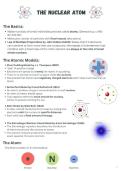
THE NUCLEAR ATOM ' ~ ;
The Basics:
• Matter consists of small indivisible particles called atoms. (Democritus, c.460
BC-370 BC)
• Molecules consist of particles with fixed masses (aka atoms)
• Law of Multiple Proportions by John Dalton (1803): States that if 2 elements
can combine to form more than one compound, the masses of one element that
combine with a fixed mass of the other element are always In the ratio of small
whole numbers.
The Atomic Models:
1. Plum Pudding Model by J.J. Thompson (1897)
• "Sea" of positive charge ~
• Electrons are spread out evenly like raisins in a pudding.
• There is no central core and no space inside (no nucleus). oTo
• Discovered that atoms have negatively charged electrons (with mass much less than an
atom)
2. Rutherford Model by Ernest Rutherford (1911) /
~ '
• An atom's positive charge is concentrated in a small nucleus. I
/
~ '\
I ~ I
• An atom is mostly empty space.
I .,I Cl -I I
• Tiny negative electrons move around the nucleus,
similar to planets orbiting the sun. Nudrus
I
\
'
~
.. /
/
I
~
/
3. Bohr Model by Niels Bohr (1913)
• Further refined the Rutherford model by stating that
electrons orbit the nucleus at specific distances.
• Each orbit has a fixed amount of energy.
4. The Schrodinger/Electron Cloud Model by Erwin Schrodinger (1926)
• The Schr6dinger equation describes the distribution
of electrons around the nucleus as waves.
• You cannot measure an electron's exact position and
exact speed at the same moment.
The Atom:
The Atom consists of: (In the Nucleus)
0 Proton
N
Neutron
0
Electron
The Basics:
• Matter consists of small indivisible particles called atoms. (Democritus, c.460
BC-370 BC)
• Molecules consist of particles with fixed masses (aka atoms)
• Law of Multiple Proportions by John Dalton (1803): States that if 2 elements
can combine to form more than one compound, the masses of one element that
combine with a fixed mass of the other element are always In the ratio of small
whole numbers.
The Atomic Models:
1. Plum Pudding Model by J.J. Thompson (1897)
• "Sea" of positive charge ~
• Electrons are spread out evenly like raisins in a pudding.
• There is no central core and no space inside (no nucleus). oTo
• Discovered that atoms have negatively charged electrons (with mass much less than an
atom)
2. Rutherford Model by Ernest Rutherford (1911) /
~ '
• An atom's positive charge is concentrated in a small nucleus. I
/
~ '\
I ~ I
• An atom is mostly empty space.
I .,I Cl -I I
• Tiny negative electrons move around the nucleus,
similar to planets orbiting the sun. Nudrus
I
\
'
~
.. /
/
I
~
/
3. Bohr Model by Niels Bohr (1913)
• Further refined the Rutherford model by stating that
electrons orbit the nucleus at specific distances.
• Each orbit has a fixed amount of energy.
4. The Schrodinger/Electron Cloud Model by Erwin Schrodinger (1926)
• The Schr6dinger equation describes the distribution
of electrons around the nucleus as waves.
• You cannot measure an electron's exact position and
exact speed at the same moment.
The Atom:
The Atom consists of: (In the Nucleus)
0 Proton
N
Neutron
0
Electron

