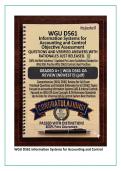
WGU D561 Information Systems for Accounting and Control
,Objective Assessment
Complete 200+ Practice Questions with Verified Answers &
Detailed Rationales | 2026 Update
INTRODUCTION TO WGU D561
WGU D561 Information Systems for Accounting and Control is
a comprehensive course covering the role of Accounting
Information Systems (AIS) in organizations. The objective
assessment (OA) tests your ability to document and evaluate
process flows, evaluate internal controls, and understand
transaction cycles . The exam covers eight competencies and
represents three competency units .
Content Area Focus
Competency Information Systems – Components of an AIS, data v
3025.1.1 information, types of data processing
Competency AIS Processes – Transaction processing cycle, chart o
3025.1.2 accounts, general and subsidiary ledgers
Competency Documenting Processes and Controls – Transaction
3025.1.3 cycles, business documents
,Content Area Focus
Competency IT Controls – Internal controls framework, segregati
3025.1.5 of duties, authorization controls
Competency Transaction Cycle Activities – Revenue, expenditure
3025.1.6 production/conversion cycles
Competency Acquiring & Auditing AIS – System development
3025.1.7 & 1.8 controls, ERP systems, information system auditing
SECTION 1: AIS FUNDAMENTALS AND INFORMATION SYSTEMS
1. What is the primary purpose of an Accounting Information
System (AIS)?
A) To replace all management functions
B) To collect, process, store, and report financial and some non-
financial data for decision-making
C) To eliminate all business risks
D) To increase tax liabilities
Correct Answer: B
Rationale: An AIS integrates people, processes, data, and
technology to collect, process, store, and communicate
financial and accounting information. It supports decision-
, making at all levels. No system can eliminate all risks; AIS only
helps identify and mitigate them .
2. Which of the following is NOT a core component of an AIS?
A) People
B) Procedures and instructions
C) Data
D) Marketing strategies
Correct Answer: D
Rationale: Core components of an AIS include people,
procedures, data, software, IT infrastructure, and internal
controls. Marketing strategies are a business function, not an
AIS component .
3. What is the difference between data and information?
A) Data is always numerical; information is always textual
B) Data are raw facts about events and transactions;
information is data that has been organized and processed to
provide meaning and improve decision-making
C) Data is processed; information is unprocessed
D) There is no difference
Correct Answer: B
,Objective Assessment
Complete 200+ Practice Questions with Verified Answers &
Detailed Rationales | 2026 Update
INTRODUCTION TO WGU D561
WGU D561 Information Systems for Accounting and Control is
a comprehensive course covering the role of Accounting
Information Systems (AIS) in organizations. The objective
assessment (OA) tests your ability to document and evaluate
process flows, evaluate internal controls, and understand
transaction cycles . The exam covers eight competencies and
represents three competency units .
Content Area Focus
Competency Information Systems – Components of an AIS, data v
3025.1.1 information, types of data processing
Competency AIS Processes – Transaction processing cycle, chart o
3025.1.2 accounts, general and subsidiary ledgers
Competency Documenting Processes and Controls – Transaction
3025.1.3 cycles, business documents
,Content Area Focus
Competency IT Controls – Internal controls framework, segregati
3025.1.5 of duties, authorization controls
Competency Transaction Cycle Activities – Revenue, expenditure
3025.1.6 production/conversion cycles
Competency Acquiring & Auditing AIS – System development
3025.1.7 & 1.8 controls, ERP systems, information system auditing
SECTION 1: AIS FUNDAMENTALS AND INFORMATION SYSTEMS
1. What is the primary purpose of an Accounting Information
System (AIS)?
A) To replace all management functions
B) To collect, process, store, and report financial and some non-
financial data for decision-making
C) To eliminate all business risks
D) To increase tax liabilities
Correct Answer: B
Rationale: An AIS integrates people, processes, data, and
technology to collect, process, store, and communicate
financial and accounting information. It supports decision-
, making at all levels. No system can eliminate all risks; AIS only
helps identify and mitigate them .
2. Which of the following is NOT a core component of an AIS?
A) People
B) Procedures and instructions
C) Data
D) Marketing strategies
Correct Answer: D
Rationale: Core components of an AIS include people,
procedures, data, software, IT infrastructure, and internal
controls. Marketing strategies are a business function, not an
AIS component .
3. What is the difference between data and information?
A) Data is always numerical; information is always textual
B) Data are raw facts about events and transactions;
information is data that has been organized and processed to
provide meaning and improve decision-making
C) Data is processed; information is unprocessed
D) There is no difference
Correct Answer: B