

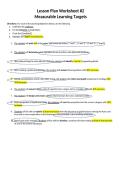
Lesson Plan Worksheet #2
Measurable Learning Targets
Directions: For each of the Learning Objectives below, do the following
a. Underline the audience.
b. Put the behavior in bold letters.
c. Circle the condition.
d. Highlight the degree of proficiency.
1. The student will print 6/8 of the upper and lowercase letters ‘i’ and ‘I’, ‘o’ and ‘O’, ‘d’ and ‘D’, ‘t’ and ‘T’.
2. The student will determine what operation to use to solve a one-step work problem.
3. After determining the main idea of a text, the student will identify 3 out of 4 supporting details.
4. After reading a grade level passage, the student will answer literal questions with 80% accuracy.
5. During a precipitation event (rain, sleet, snow), the student will collect and graph temperature readings with
95% accuracy.
6. The student will convert metric units of capacity from a larger unit to a smaller unit with 85% accuracy.
7. The student will design and create a device that increases the rate a substance melts.
8. Given properties of liquids and solids, the students will sort the properties into the correct category with 90%
accuracy.
9. Students will be able to explain at least one reason how the discovery of gold treasures among the Aztec and
Inca lead to more exploration in the Americas on the provided critical thinking worksheet
10. Based upon prior research, students will be able to develop a creative talk show stating at least 4 characteristic
of one of the twelve Olympians.
, Directions: For each of the Learning Objectives below, identify which piece is missing: Audience, Behavior, Condition, or
Degree.
1. After the lesson, the students will be able to explain how the tilt of the Earth’s axis contributes to the changing
seasons in a written paragraph. Degree
2. After this lesson, the students will be able to determine discounts and markups as well as gratuity. Degree
3. After completing this lesson, the student will have the ability to gather measurement data with 80% accuracy.
Condition
4. After completing this unit, students will write a research paper arguing either for or against the acts imposed by
the British. Degree
5. After completing this lesson, the students will be able to describe the distinctive characteristics and purposes of
physical and political maps. Degree
Translating Kudos into Learning Targets
Directions: Using the KUDOs you wrote on the first lesson plan worksheet, write a measurable learning/lesson
target.
Standard 1:
Ohio Academic Standard: History - Topic Historical Thinking and Skills
3.1 Events in local history can be shown on timelines organized by years, decades and centuries.
KUDOs:
Know:
- Have a clear sense of time – past, present and future
- Identify significant events in history
Understand:
- The relationship between events and how to draw conclusions.
- Organize these events by years, decades and centuries
Do:
Create and interpret timelines that display historical events using different time scales
Learning/Lesson Target: A student will be able to use primary and secondary sources to identify and describe
changes in their local community.
Standard 2:
Ohio Academic Standard: Mathematics- Domain OPERATIONS AND ALGEBRAIC THINKING 3.OA.1 Interpret products
of whole numbers
KUDOs: Know:
- Interpret and solve multiplication and division problems
Measurable Learning Targets
Directions: For each of the Learning Objectives below, do the following
a. Underline the audience.
b. Put the behavior in bold letters.
c. Circle the condition.
d. Highlight the degree of proficiency.
1. The student will print 6/8 of the upper and lowercase letters ‘i’ and ‘I’, ‘o’ and ‘O’, ‘d’ and ‘D’, ‘t’ and ‘T’.
2. The student will determine what operation to use to solve a one-step work problem.
3. After determining the main idea of a text, the student will identify 3 out of 4 supporting details.
4. After reading a grade level passage, the student will answer literal questions with 80% accuracy.
5. During a precipitation event (rain, sleet, snow), the student will collect and graph temperature readings with
95% accuracy.
6. The student will convert metric units of capacity from a larger unit to a smaller unit with 85% accuracy.
7. The student will design and create a device that increases the rate a substance melts.
8. Given properties of liquids and solids, the students will sort the properties into the correct category with 90%
accuracy.
9. Students will be able to explain at least one reason how the discovery of gold treasures among the Aztec and
Inca lead to more exploration in the Americas on the provided critical thinking worksheet
10. Based upon prior research, students will be able to develop a creative talk show stating at least 4 characteristic
of one of the twelve Olympians.
, Directions: For each of the Learning Objectives below, identify which piece is missing: Audience, Behavior, Condition, or
Degree.
1. After the lesson, the students will be able to explain how the tilt of the Earth’s axis contributes to the changing
seasons in a written paragraph. Degree
2. After this lesson, the students will be able to determine discounts and markups as well as gratuity. Degree
3. After completing this lesson, the student will have the ability to gather measurement data with 80% accuracy.
Condition
4. After completing this unit, students will write a research paper arguing either for or against the acts imposed by
the British. Degree
5. After completing this lesson, the students will be able to describe the distinctive characteristics and purposes of
physical and political maps. Degree
Translating Kudos into Learning Targets
Directions: Using the KUDOs you wrote on the first lesson plan worksheet, write a measurable learning/lesson
target.
Standard 1:
Ohio Academic Standard: History - Topic Historical Thinking and Skills
3.1 Events in local history can be shown on timelines organized by years, decades and centuries.
KUDOs:
Know:
- Have a clear sense of time – past, present and future
- Identify significant events in history
Understand:
- The relationship between events and how to draw conclusions.
- Organize these events by years, decades and centuries
Do:
Create and interpret timelines that display historical events using different time scales
Learning/Lesson Target: A student will be able to use primary and secondary sources to identify and describe
changes in their local community.
Standard 2:
Ohio Academic Standard: Mathematics- Domain OPERATIONS AND ALGEBRAIC THINKING 3.OA.1 Interpret products
of whole numbers
KUDOs: Know:
- Interpret and solve multiplication and division problems

