

Escrito por estudiantes que aprobaron Inmediatamente disponible después del pago Leer en línea o como PDF ¿Documento equivocado? Cámbialo gratis 4,6 TrustPilot
logo-home
Document preview thumbnail
Vista previa 2 fuera de 13 páginas
Examen

BIO 182 Final Exam | 200+ Exam Questions & Verified Answers | Ecology, Population Ecology, Community Ecology, Species Interactions & Climate Change

Document preview thumbnail
Vista previa 2 fuera de 13 páginas

Prepare for your BIO 182 Final Exam with this comprehensive collection of 200+ verified exam questions and detailed answers, designed to help students master the fundamental concepts of ecology, population biology, community ecology, ecosystem ecology, animal behavior, and global environmental change. This study guide provides extensive coverage of ecology, populations, communities, ecosystems, biomes, climate, tropical rainforests, boreal forests, tundra, permafrost, abiotic and biotic factors, behavioral biology, proximate and ultimate causation, innate behavior, communication, foraging, navigation, circadian rhythms, altruism, Hamilton's Rule, inclusive fitness, kin selection, eusociality, reciprocal altruism, population growth, metapopulations, immigration, emigration, survivorship, life tables, fecundity, logistic population growth, carrying capacity, density-dependent and density-independent regulation, and zero population growth. The material is presented in a structured question-and-answer format that strengthens conceptual understanding, reinforces key biological terminology, and prepares students for university-level biology examinations. This exam review also provides an in-depth study of species interactions and ecosystem ecology, including competition, intraspecific and interspecific competition, mutualism, commensalism, consumption, ecological niches, competitive exclusion, resource partitioning, character displacement, constitutive and inducible defenses, Batesian and Müllerian mimicry, succession, primary and secondary succession, pioneer species, facilitation, inhibition, tolerance, species richness, species diversity, food chains, food webs, trophic levels, primary producers, consumers, decomposers, gross primary productivity (GPP), net primary productivity (NPP), top-down control, trophic cascades, global water, nitrogen, and carbon cycles, greenhouse gases, global warming, and global climate change. Students will reinforce ecological principles through concise definitions and exam-style review questions covering the terminology and concepts most frequently assessed in introductory biology courses. Organized in a clear question-and-answer format, this resource is ideal for active recall, self-assessment, homework review, quizzes, cumulative final examinations, and independent study. The guide integrates ecology, behavior, environmental science, and population biology into one comprehensive review, making it an excellent resource for improving long-term retention and exam performance. The concepts covered closely align with the learning objectives presented in leading undergraduate biology references, including Campbell Biology by Urry, Cain, Wasserman, Minorsky, and Orr (Pearson, 12th Edition), Ecology: From Individuals to Ecosystems by Begon, Townsend, and Harper (Wiley-Blackwell), Biology by Raven, Johnson, Mason, Losos, and Singer (McGraw-Hill), and OpenStax Biology 2e. These authoritative academic resources provide comprehensive coverage of ecology, animal behavior, population biology, community ecology, ecosystem dynamics, biodiversity, and global environmental change, closely matching the concepts reviewed throughout this BIO 182 Final Exam study guide. Recommended for Students: BIO 182 Students, General Biology Students, Introductory Biology Students, Ecology Students, Population Ecology Students, Community Ecology Students, Environmental Science Students, Conservation Biology Students, Biological Science Majors, Wildlife Biology Students, Zoology Students, Life Science Students, Biomedical Science Students, Biotechnology Students, Pre-Med Students, Pre-Nursing Students, Health Science Students, Undergraduate Biology Majors, College Biology Final Exam Candidates. Keywords: BIO 182, BIO 182 Final Exam, Biology Final Exam, Ecology, Population Ecology, Community Ecology, Ecosystem Ecology, Ecosystems, Population Biology, Biomes, Climate, Tropical Rainforest, Boreal Forest, Taiga, Tundra, Permafrost, Abiotic Factors, Biotic Factors, Animal Behavior, Behavioral Biology, Proximate Causation, Ultimate Causation, Innate Behavior, Fixed Action Patterns, Communication, Foraging, Circadian Rhythm, Navigation, Inclusive Fitness, Hamilton's Rule, Kin Selection, Eusociality, Reciprocal Altruism, Population Density, Metapopulation, Immigration, Emigration, Survivorship, Life Tables, Fecundity, Logistic Growth, Carrying Capacity, Zero Population Growth, Density-Dependent Factors, Density-Independent Factors, Competition, Intraspecific Competition, Interspecific Competition, Mutualism, Commensalism, Resource Partitioning, Competitive Exclusion, Character Displacement, Batesian Mimicry, Müllerian Mimicry, Succession, Primary Succession, Secondary Succession, Pioneer Species, Species Richness, Species Diversity, Food Chains, Food Webs, Trophic Levels, Gross Primary Productivity, Net Primary Productivity, Top-Down Control, Trophic Cascade, Carbon Cycle, Nitrogen Cycle, Water Cycle, Greenhouse Gases, Global Warming, Climate Change, Biology Study Guide, College Biology Notes, Undergraduate Biology, Exam Questions and Answers, Biology Revision, Final Exam Preparation

Vista previa del contenido

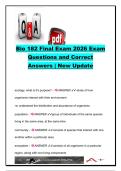
Bio 182 Final Exam 2026 Exam
Questions and Correct
Answers | New Update


ecology; what is it's purpose? - ANSWER ✔✔-study of how

organisms interact with their environment

-to understand the distribution and abundance of organisms


population - ANSWER ✔✔group of individuals of the same species

living in the same area, at the same time


community - ANSWER ✔✔consists of species that interact with one

another within a particular area


ecosystem - ANSWER ✔✔consists of all organisms in a particular

region, along with non-living components

, abiotic components - ANSWER ✔✔air, water, and non-living parts of

soil


range - ANSWER ✔✔geographical distribution; abiotic & biotic

determine range


biomes - ANSWER ✔✔major groupings of plant and animal

communities defined by a dominant vegetation type


climate - ANSWER ✔✔the prevailing, long-term weather conditions

found in an area


tropical wet forests (rain forests) - ANSWER ✔✔found in equator

regions where temperatures are high and annual temperature is very

low; produce abundant plant growth, lead to high above-ground biomass


boreal forest (taiga) - ANSWER ✔✔forms on subarctic lands,

dominated by highly cold-tolerant conifers; productivity is low, above-

ground biomass is high because slow-growing tree species may be long-

lived and become big


tundra - ANSWER ✔✔found throughout the arctic regions; low

productivity and low above-ground biomass and its treeless


permafrost - ANSWER ✔✔soils are in a permanently frozen state;

limits both the release and uptake of nutrients

Información del documento

Subido en
27 de julio de 2026
Número de páginas
13
Escrito en
2025/2026
Tipo
Examen
Contiene
Preguntas y respuestas
$18.99

¿Documento equivocado? Cámbialo gratis Dentro de los 14 días posteriores a la compra y antes de descargarlo, puedes elegir otro documento. Puedes gastar el importe de nuevo.
Escrito por estudiantes que aprobaron
Inmediatamente disponible después del pago
Leer en línea o como PDF

Seller avatar
Los indicadores de reputación están sujetos a la cantidad de artículos vendidos por una tarifa y las reseñas que ha recibido por esos documentos. Hay tres niveles: Bronce, Plata y Oro. Cuanto mayor reputación, más podrás confiar en la calidad del trabajo del vendedor.
NinjaNerd
3.4
(76)
Vendido
396
Seguidores
6
Artículos
15309
Última venta
1 día hace


Por qué los estudiantes eligen Stuvia

Creado por compañeros estudiantes, verificado por reseñas

Calidad en la que puedes confiar: escrito por estudiantes que aprobaron y evaluado por otros que han usado estos resúmenes.

¿No estás satisfecho? Elige otro documento

¡No te preocupes! Puedes elegir directamente otro documento que se ajuste mejor a lo que buscas.

Paga como quieras, empieza a estudiar al instante

Sin suscripción, sin compromisos. Paga como estés acostumbrado con tarjeta de crédito y descarga tu documento PDF inmediatamente.

Student with book image

“Comprado, descargado y aprobado. Así de fácil puede ser.”

Alisha Student

Preguntas frecuentes
