

Escrito por estudiantes que aprobaron Inmediatamente disponible después del pago Leer en línea o como PDF ¿Documento equivocado? Cámbialo gratis 4,6 TrustPilot
logo-home
Document preview thumbnail
Vista previa 2 fuera de 11 páginas
Examen

BIO 182 Exam 2 | 100+ Exam Questions & Verified Answers | Ecology, Evolution, Population Genetics, Natural Selection & Speciation

Document preview thumbnail
Vista previa 2 fuera de 11 páginas

Master the concepts covered in BIO 182 Exam 2 with this comprehensive collection of 100+ verified exam questions and detailed answers, carefully designed to help students excel in introductory biology, ecology, evolution, and population genetics. This study guide provides extensive coverage of mutation types (germ line and somatic mutations), natural selection, sexual selection, artificial selection, genetic drift, founder effect, Hardy-Weinberg equilibrium, adaptive radiation, speciation, reproductive isolation, ecological niches, biodiversity, population ecology, community ecology, trophic interactions, energy transfer, and ecosystem dynamics. It also reviews essential ecological principles, including biotic and abiotic factors, exponential and logistic population growth, density-dependent and density-independent population regulation, competition, predation, parasitism, mutualism, commensalism, resource partitioning, competitive exclusion, keystone species, trophic cascades, food webs, energy pyramids, and biomagnification. The material is presented in a structured question-and-answer format that promotes active recall and reinforces the concepts most frequently tested in university biology examinations. In addition to ecology and population biology, this exam preparation resource thoroughly explores the historical foundations of evolutionary theory through the contributions of Charles Darwin, Alfred Russel Wallace, Thomas Malthus, Peter and Rosemary Grant, Paul Ehrlich, and Robert Paine. Students will strengthen their understanding of Darwin's voyage aboard the HMS Beagle, the theory of evolution by natural selection, adaptive evolution, ecological interactions, species formation, reproductive barriers, population growth models, evolutionary mechanisms, and the application of evolutionary biology to medicine, agriculture, pest management, cancer research, and conservation biology. The guide also examines the Biological Species Concept, allopatric and sympatric speciation, realized and fundamental niches, and the ecological relationships that shape biodiversity and ecosystem stability. This resource is ideal for active recall, self-assessment, classroom quizzes, homework review, midterm examinations, cumulative final exams, and independent study. Its organized question-and-answer format enables students to efficiently review complex biological concepts while improving retention of definitions, ecological principles, and evolutionary processes commonly assessed in undergraduate biology courses. The concepts covered align closely with the learning objectives presented in leading undergraduate biology references, including Campbell Biology by Urry, Cain, Wasserman, Minorsky, and Orr (Pearson, 12th Edition), Biology by Raven, Johnson, Mason, Losos, and Singer (McGraw-Hill), and OpenStax Biology 2e, all of which provide authoritative coverage of ecology, evolution, natural selection, population genetics, biodiversity, community ecology, and ecosystem dynamics. These widely adopted academic resources support the biological concepts reviewed throughout this comprehensive exam study guide. Recommended for Students: BIO 182 Students, General Biology Students, Introductory Biology Students, Ecology Students, Evolutionary Biology Students, Population Genetics Students, Environmental Science Students, Biological Science Majors, Life Science Students, Biomedical Science Students, Biotechnology Students, Zoology Students, Wildlife Biology Students, Conservation Biology Students, Pre-Med Students, Pre-Nursing Students, Undergraduate Biology Majors, College Biology Exam Candidates. Keywords: BIO 182, BIO 182 Exam 2, Biology Exam Questions, Ecology, Evolution, Natural Selection, Population Genetics, Community Ecology, Population Ecology, Biodiversity, Mutation, Germ Line Mutations, Somatic Mutations, Genetic Drift, Founder Effect, Hardy-Weinberg Equilibrium, Adaptive Radiation, Speciation, Biological Species Concept, Allopatric Speciation, Sympatric Speciation, Reproductive Isolation, Ecological Niche, Fundamental Niche, Realized Niche, Competitive Exclusion, Resource Partitioning, Niche Partitioning, Biotic Factors, Abiotic Factors, Exponential Growth, Logistic Growth, Density-Dependent Factors, Density-Independent Factors, Keystone Species, Trophic Cascade, Food Webs, Energy Pyramids, Biomagnification, Predation, Competition, Mutualism, Parasitism, Commensalism, Charles Darwin, Alfred Russel Wallace, Thomas Malthus, Peter Grant, Rosemary Grant, Robert Paine, Paul Ehrlich, Evolutionary Biology, Biology Study Guide, College Biology Notes, Undergraduate Biology, Exam Questions and Answers, Biology Revision, Ecology Exam Preparation

Vista previa del contenido

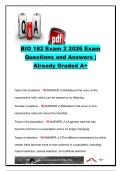
BIO 182 Exam 2 2026 Exam
Questions and Answers |
Already Graded A+


Germ line mutations - ANSWER ✔✔Mutations that occur in the

reproductive cells, which can be passed on to offspring.


Somatic mutations - ANSWER ✔✔Mutations that occur in non-

reproductive cells and cannot be inherited.


Fixed in the population - ANSWER ✔✔A genetic trait that has

become common in a population and is no longer changing.


Types of selection - ANSWER ✔✔The different mechanisms by which

certain traits become more or less common in a population, including

natural selection, sexual selection, and artificial selection.

, Ecology - ANSWER ✔✔The study of interactions between organisms

and their environment.


Biotic factors - ANSWER ✔✔Living components of an ecosystem that

affect the organisms within it, such as plants, animals, and

microorganisms.


Abiotic factors - ANSWER ✔✔Non-living physical and chemical

components of an ecosystem, such as temperature, water, and soil.


Realized niche - ANSWER ✔✔The actual conditions and resources in

which a species exists due to interactions with other species.


Fundamental niche - ANSWER ✔✔The potential mode of existence

of a species, considering the resources and conditions it can

theoretically utilize.


Competitive exclusion - ANSWER ✔✔The principle stating that two

species competing for the same resources cannot coexist if other

ecological factors are constant.


Resource partitioning - ANSWER ✔✔The division of resources

among species to reduce competition and allow coexistence.

Información del documento

Subido en
27 de julio de 2026
Número de páginas
11
Escrito en
2025/2026
Tipo
Examen
Contiene
Preguntas y respuestas
$18.99

¿Documento equivocado? Cámbialo gratis Dentro de los 14 días posteriores a la compra y antes de descargarlo, puedes elegir otro documento. Puedes gastar el importe de nuevo.
Escrito por estudiantes que aprobaron
Inmediatamente disponible después del pago
Leer en línea o como PDF

Seller avatar
Los indicadores de reputación están sujetos a la cantidad de artículos vendidos por una tarifa y las reseñas que ha recibido por esos documentos. Hay tres niveles: Bronce, Plata y Oro. Cuanto mayor reputación, más podrás confiar en la calidad del trabajo del vendedor.
NinjaNerd
3.4
(76)
Vendido
396
Seguidores
6
Artículos
15309
Última venta
1 día hace


Por qué los estudiantes eligen Stuvia

Creado por compañeros estudiantes, verificado por reseñas

Calidad en la que puedes confiar: escrito por estudiantes que aprobaron y evaluado por otros que han usado estos resúmenes.

¿No estás satisfecho? Elige otro documento

¡No te preocupes! Puedes elegir directamente otro documento que se ajuste mejor a lo que buscas.

Paga como quieras, empieza a estudiar al instante

Sin suscripción, sin compromisos. Paga como estés acostumbrado con tarjeta de crédito y descarga tu documento PDF inmediatamente.

Student with book image

“Comprado, descargado y aprobado. Así de fácil puede ser.”

Alisha Student

Preguntas frecuentes
