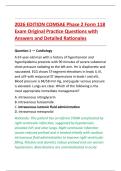
2026 EDITION COMSAE Phase 2 Form 118
Exam Original Practice Questions with
Answers and Detailed Rationales
Question 1 — Cardiology
A 67-year-old man with a history of hypertension and
hyperlipidemia presents with 90 minutes of severe substernal
chest pressure radiating to the left arm. He is diaphoretic and
nauseated. ECG shows ST-segment elevations in leads II, III,
and aVF with reciprocal ST depressions in leads I and aVL.
Blood pressure is 84/58 mm Hg, and jugular venous pressure
is elevated. Lungs are clear. Which of the following is the
most appropriate immediate management?
A. Intravenous nitroglycerin
B. Intravenous furosemide
C. Intravenous isotonic fluid administration
D. Intravenous metoprolol
Rationale: This patient has an inferior STEMI complicated by
right ventricular infarction, suggested by hypotension,
elevated JVP, and clear lungs. Right ventricular infarction
causes reduced preload and is treated initially with cautious
intravenous fluid administration to improve right ventricular
filling. Nitrates and diuretics reduce preload and can worsen
hypotension. Beta-blockers are contraindicated in acute
,hemodynamic instability.
Question 2 — Pulmonology
A 34-year-old woman presents with sudden-onset dyspnea
and pleuritic chest pain 5 days after undergoing knee surgery.
She is tachycardic and mildly hypoxemic. CT pulmonary
angiography demonstrates bilateral pulmonary emboli. Her
blood pressure is 78/46 mm Hg despite initial intravenous
fluids. Which of the following is the most appropriate next
treatment?
A. Low-molecular-weight heparin alone
B. Inferior vena cava filter placement
C. Systemic thrombolytic therapy
D. Aspirin therapy
Rationale: This patient has a massive pulmonary embolism
with hemodynamic instability. Systemic thrombolysis is
indicated for high-risk PE causing shock or persistent
hypotension when there are no major contraindications.
Anticoagulation is essential but insufficient as sole immediate
therapy in a profoundly unstable patient.
Question 3 — Nephrology
A 72-year-old man with chronic kidney disease presents with
weakness. Laboratory studies show potassium of 7.1 mEq/L.
ECG demonstrates peaked T waves, PR prolongation, and
widening of the QRS complex. Which of the following should
be administered first?
,A. Intravenous insulin and dextrose
B. Nebulized albuterol
C. Sodium zirconium cyclosilicate
D. Intravenous calcium gluconate
Rationale: Hyperkalemia with ECG abnormalities is
immediately life-threatening because of the risk of fatal
cardiac arrhythmias. Intravenous calcium stabilizes the
cardiac membrane rapidly but does not lower serum
potassium. Insulin with dextrose and beta-agonists shift
potassium intracellularly, while potassium-binding agents
remove potassium more slowly.
Question 4 — Infectious Disease
A 23-year-old college student presents with fever, headache,
photophobia, and neck stiffness. Lumbar puncture reveals an
opening pressure of 32 cm H₂O, glucose of 28 mg/dL, protein
of 210 mg/dL, and 2,400 WBCs/mm³ with neutrophilic
predominance. Which of the following is the most
appropriate empiric antimicrobial regimen?
A. Acyclovir alone
B. Ampicillin alone
C. Vancomycin plus a third-generation cephalosporin
D. Fluconazole plus amphotericin B
Rationale: The CSF profile is consistent with acute bacterial
meningitis. In a young adult, empiric treatment should
include vancomycin plus ceftriaxone or cefotaxime to cover
resistant Streptococcus pneumoniae and Neisseria
, meningitidis. Ampicillin is added when Listeria coverage is
required, such as in older or immunocompromised patients.
Question 5 — Gastroenterology
A 59-year-old man with cirrhosis presents with massive
hematemesis. Blood pressure is 86/52 mm Hg, and heart rate
is 124/min. After airway protection and initial resuscitation,
which medication should be started immediately to reduce
bleeding from suspected esophageal varices?
A. Intravenous pantoprazole alone
B. Intravenous octreotide
C. Oral propranolol
D. Intravenous metoclopramide
Rationale: Acute variceal hemorrhage requires prompt
vasoactive therapy with octreotide, which reduces portal
venous pressure and splanchnic blood flow. Endoscopic
variceal ligation is definitive therapy, but octreotide should be
initiated early. Antibiotic prophylaxis is also recommended in
cirrhotic patients with GI bleeding.
Question 6 — Endocrinology
A 29-year-old woman with type 1 diabetes mellitus presents
with vomiting, abdominal pain, and Kussmaul respirations.
Laboratory studies show glucose 520 mg/dL, arterial pH 7.08,
bicarbonate 7 mEq/L, and potassium 2.9 mEq/L. Which of the
following is the most appropriate next step?
Exam Original Practice Questions with
Answers and Detailed Rationales
Question 1 — Cardiology
A 67-year-old man with a history of hypertension and
hyperlipidemia presents with 90 minutes of severe substernal
chest pressure radiating to the left arm. He is diaphoretic and
nauseated. ECG shows ST-segment elevations in leads II, III,
and aVF with reciprocal ST depressions in leads I and aVL.
Blood pressure is 84/58 mm Hg, and jugular venous pressure
is elevated. Lungs are clear. Which of the following is the
most appropriate immediate management?
A. Intravenous nitroglycerin
B. Intravenous furosemide
C. Intravenous isotonic fluid administration
D. Intravenous metoprolol
Rationale: This patient has an inferior STEMI complicated by
right ventricular infarction, suggested by hypotension,
elevated JVP, and clear lungs. Right ventricular infarction
causes reduced preload and is treated initially with cautious
intravenous fluid administration to improve right ventricular
filling. Nitrates and diuretics reduce preload and can worsen
hypotension. Beta-blockers are contraindicated in acute
,hemodynamic instability.
Question 2 — Pulmonology
A 34-year-old woman presents with sudden-onset dyspnea
and pleuritic chest pain 5 days after undergoing knee surgery.
She is tachycardic and mildly hypoxemic. CT pulmonary
angiography demonstrates bilateral pulmonary emboli. Her
blood pressure is 78/46 mm Hg despite initial intravenous
fluids. Which of the following is the most appropriate next
treatment?
A. Low-molecular-weight heparin alone
B. Inferior vena cava filter placement
C. Systemic thrombolytic therapy
D. Aspirin therapy
Rationale: This patient has a massive pulmonary embolism
with hemodynamic instability. Systemic thrombolysis is
indicated for high-risk PE causing shock or persistent
hypotension when there are no major contraindications.
Anticoagulation is essential but insufficient as sole immediate
therapy in a profoundly unstable patient.
Question 3 — Nephrology
A 72-year-old man with chronic kidney disease presents with
weakness. Laboratory studies show potassium of 7.1 mEq/L.
ECG demonstrates peaked T waves, PR prolongation, and
widening of the QRS complex. Which of the following should
be administered first?
,A. Intravenous insulin and dextrose
B. Nebulized albuterol
C. Sodium zirconium cyclosilicate
D. Intravenous calcium gluconate
Rationale: Hyperkalemia with ECG abnormalities is
immediately life-threatening because of the risk of fatal
cardiac arrhythmias. Intravenous calcium stabilizes the
cardiac membrane rapidly but does not lower serum
potassium. Insulin with dextrose and beta-agonists shift
potassium intracellularly, while potassium-binding agents
remove potassium more slowly.
Question 4 — Infectious Disease
A 23-year-old college student presents with fever, headache,
photophobia, and neck stiffness. Lumbar puncture reveals an
opening pressure of 32 cm H₂O, glucose of 28 mg/dL, protein
of 210 mg/dL, and 2,400 WBCs/mm³ with neutrophilic
predominance. Which of the following is the most
appropriate empiric antimicrobial regimen?
A. Acyclovir alone
B. Ampicillin alone
C. Vancomycin plus a third-generation cephalosporin
D. Fluconazole plus amphotericin B
Rationale: The CSF profile is consistent with acute bacterial
meningitis. In a young adult, empiric treatment should
include vancomycin plus ceftriaxone or cefotaxime to cover
resistant Streptococcus pneumoniae and Neisseria
, meningitidis. Ampicillin is added when Listeria coverage is
required, such as in older or immunocompromised patients.
Question 5 — Gastroenterology
A 59-year-old man with cirrhosis presents with massive
hematemesis. Blood pressure is 86/52 mm Hg, and heart rate
is 124/min. After airway protection and initial resuscitation,
which medication should be started immediately to reduce
bleeding from suspected esophageal varices?
A. Intravenous pantoprazole alone
B. Intravenous octreotide
C. Oral propranolol
D. Intravenous metoclopramide
Rationale: Acute variceal hemorrhage requires prompt
vasoactive therapy with octreotide, which reduces portal
venous pressure and splanchnic blood flow. Endoscopic
variceal ligation is definitive therapy, but octreotide should be
initiated early. Antibiotic prophylaxis is also recommended in
cirrhotic patients with GI bleeding.
Question 6 — Endocrinology
A 29-year-old woman with type 1 diabetes mellitus presents
with vomiting, abdominal pain, and Kussmaul respirations.
Laboratory studies show glucose 520 mg/dL, arterial pH 7.08,
bicarbonate 7 mEq/L, and potassium 2.9 mEq/L. Which of the
following is the most appropriate next step?