

Escrito por estudiantes que aprobaron Inmediatamente disponible después del pago Leer en línea o como PDF ¿Documento equivocado? Cámbialo gratis 4,6 TrustPilot
logo-home
Document preview thumbnail
Vista previa 3 fuera de 19 páginas
Examen

DBT Intensive Training Part 1 | 100+ Dialectical Behavior Therapy (DBT) Practice Questions & Answers | Mindfulness, Emotion Regulation, Chain Analysis, Validation & Therapist Strategies

Document preview thumbnail
Vista previa 3 fuera de 19 páginas

Master the foundational principles of Dialectical Behavior Therapy (DBT) with this comprehensive DBT Intensive Training Part 1 study guide featuring 100+ expertly compiled practice questions and verified answers designed for therapists, psychology students, counseling professionals, psychiatric nurses, social workers, and mental health trainees. This resource provides an extensive review of DBT theory, treatment structure, behavioral principles, clinical decision-making, therapist strategies, and evidence-based interventions through examination-style questions that reinforce both conceptual understanding and practical clinical application. The material thoroughly covers DBT philosophy, the biosocial model, emotion dysregulation, Borderline Personality Disorder (BPD), acceptance and change dialectics, mindfulness principles, Wise Mind, "What" and "How" mindfulness skills, validation strategies, dialectical strategies, behavioral analysis, chain analysis, missing links analysis, solution analysis, contingency management, reinforcement principles, behavioral learning theory, diary cards, treatment hierarchy, pretreatment commitments, consultation team functions, therapist assumptions, commitment strategies, interpersonal effectiveness (DEAR MAN, GIVE, FAST), emotion regulation (ABC skills, Opposite Action), distress tolerance (STOP, TIP, Pros and Cons), crisis survival skills, therapist consultation, phone coaching, suicide risk assessment, self-harm intervention, Stage 1 and Stage 2 treatment targets, PTSD treatment sequencing, case management, therapist self-disclosure, irreverence, reciprocal communication, environmental intervention, therapy-interfering behaviors, therapy vacation, and evidence-based DBT treatment planning. The question-and-answer format strengthens clinical reasoning while reinforcing the application of DBT across diverse therapeutic settings. This study guide emphasizes the integration of behavioral science, dialectical philosophy, and mindfulness-based interventions that define contemporary DBT practice. Learners will develop competence in selecting appropriate treatment targets, conducting behavioral analyses, applying validation techniques, balancing acceptance with change, implementing evidence-based interventions for suicidal and self-injurious behaviors, improving therapist effectiveness, and delivering structured DBT consistent with established treatment principles. The content is valuable for certification preparation, graduate coursework, intensive DBT training, continuing education, and clinical supervision. The concepts presented throughout this resource align with the evidence-based framework developed by Marsha M. Linehan and reflect the foundational principles of modern Dialectical Behavior Therapy. The material is consistent with internationally recognized DBT training standards and the extensive body of research supporting DBT as an effective treatment for emotion dysregulation, Borderline Personality Disorder, chronic suicidality, self-harm, and other complex mental health conditions. References (APA 7th Edition) Linehan, M. M. (2015). DBT Skills Training Manual (2nd ed.). Guilford Press. Linehan, M. M. (1993). Cognitive-Behavioral Treatment of Borderline Personality Disorder. Guilford Press. Linehan, M. M., Korslund, K. E., Harned, M. S., Gallop, R. J., Lungu, A. D., McDavid, J., Comtois, K. A., Murray-Gregory, A. M., & Lindenboim, N. (2015). Dialectical Behavior Therapy for high suicide risk in individuals with Borderline Personality Disorder: A randomized clinical trial. JAMA Psychiatry, 72(5), 475–482. Behavioral Tech Institute. (2024). Dialectical Behavior Therapy Training Resources. Behavioral Tech. This study guide is highly recommended for psychology students, counseling students, clinical mental health counseling students, social work students (BSW/MSW), Psychiatric Mental Health Nurse Practitioner (PMHNP) students, psychiatric nursing students, psychiatry residents, clinical psychology trainees, licensed professional counselors (LPCs), marriage and family therapists (LMFTs), licensed clinical social workers (LCSWs), psychologists, psychotherapists, DBT clinicians, behavioral health professionals, and mental health practitioners preparing for DBT intensive training, graduate examinations, certification programs, clinical supervision, continuing education, and evidence-based psychotherapy practice. Keywords DBT Intensive Training, Dialectical Behavior Therapy, DBT Part 1, DBT Practice Questions, DBT Exam Questions, Borderline Personality Disorder, BPD, Emotion Regulation, Mindfulness, Wise Mind, Acceptance and Change, Biosocial Model, Validation, Chain Analysis, Missing Links Analysis, Solution Analysis, Behavioral Analysis, Diary Cards, Therapist Strategies, Consultation Team, Phone Coaching, Suicide Risk Assessment, Self-Harm, Therapy Interfering Behaviors, Pretreatment, Commitment Strategies, Distress Tolerance, STOP Skills, TIP Skills, Opposite Action, ABC Skills, Interpersonal Effectiveness, DEAR MAN, GIVE, FAST, Crisis Survival Skills, Behavioral Science, Reinforcement, Contingency Management, Cognitive Restructuring, PTSD, Clinical Psychology, Counseling, Psychotherapy, Mental Health, PMHNP, Psychology Study Guide, Therapist Training, Behavioral Therapy, Evidence-Based Practice

Vista previa del contenido

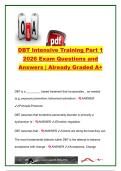
DBT Intensive Training Part 1
2026 Exam Questions and
Answers | Already Graded A+


DBT is a _________ based treatment that incorporates _ as needed

(e.g..exposure prevention; behavioral activation) - ANSWER

✔✔Principle;Protocols


DBT assumes that borderline personality disorder is primarily a

dysfunction of - ANSWER ✔✔Emotion regulation


DBT assumes that - ANSWER ✔✔clients are doing the best they can


The most fundamental dialectic within DBT is the attempt to balance

acceptance with change - ANSWER ✔✔Acceptance, Change

,The main purpose of the DBT consultation team is to: - ANSWER

✔✔Increase therapists' motivation and capabilities to deliver DBT


Please choose all of the functions of the observer in a DBT Consultation

Team meeting - ANSWER ✔✔Highlighting the dialectical tensions

that arise in the team


Describing polarization when it occurs


Identifying judgmental, non-empathic statements


Describing when members are doing more than one thing in the moment

Which of the following are the ways in which behavioral science is

incorporated into DBT? - ANSWER ✔✔A - The use of scientific

method in treatment development

B - The use of scientific method in the manner in which treatment is

conducted

C - Reliance on observation

D - The procedures of behavior therapy

, F - Reliance on evidence


Why is it important to understand the research on DBT? - ANSWER

✔✔All of the above


According to research on DBT - ANSWER ✔✔DBT is effective for

problems other than suicide and self-harm


Which of the following is an acceptance principle in DBT? - ANSWER

✔✔All things are perfect as they are


Zen is compatible with behavioral science because - ANSWER ✔✔All

of the above

Which of the following represent the dialectical worldview of DBT

regarding traditional conceptions of "truth" - ANSWER ✔✔There is no

absolute truth, nor is truth relative


Truth evolves over time and in context

When polarization occurs, it is important to search for what -

ANSWER ✔✔Synthesis


In teaching dialectical reasoning, the therapist helps the client move

from "either-or" statements or thinking to "______" statements, thus


COPYRIGHT©PROFFKERRYMARTIN 2025/2026. YEAR PUBLISHED 2026. COMPANY REGISTRATION NUMBER: 619652435. TERMS OF USE.
PRIVACY STATEMENT. ALL RIGHTS RESERVED


Información del documento

Subido en
27 de julio de 2026
Número de páginas
19
Escrito en
2025/2026
Tipo
Examen
Contiene
Preguntas y respuestas
$18.99

¿Documento equivocado? Cámbialo gratis Dentro de los 14 días posteriores a la compra y antes de descargarlo, puedes elegir otro documento. Puedes gastar el importe de nuevo.
Escrito por estudiantes que aprobaron
Inmediatamente disponible después del pago
Leer en línea o como PDF

Seller avatar
Los indicadores de reputación están sujetos a la cantidad de artículos vendidos por una tarifa y las reseñas que ha recibido por esos documentos. Hay tres niveles: Bronce, Plata y Oro. Cuanto mayor reputación, más podrás confiar en la calidad del trabajo del vendedor.
PROFFKERRYMARTIN
3.4
(53)
Vendido
267
Seguidores
9
Artículos
10856
Última venta
1 día hace


Por qué los estudiantes eligen Stuvia

Creado por compañeros estudiantes, verificado por reseñas

Calidad en la que puedes confiar: escrito por estudiantes que aprobaron y evaluado por otros que han usado estos resúmenes.

¿No estás satisfecho? Elige otro documento

¡No te preocupes! Puedes elegir directamente otro documento que se ajuste mejor a lo que buscas.

Paga como quieras, empieza a estudiar al instante

Sin suscripción, sin compromisos. Paga como estés acostumbrado con tarjeta de crédito y descarga tu documento PDF inmediatamente.

Student with book image

“Comprado, descargado y aprobado. Así de fácil puede ser.”

Alisha Student

Preguntas frecuentes