

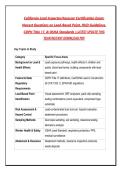
California Lead Inspector/Assessor Certification Exam:
Newest Questions on Lead-Based Paint, HUD Guidelines,
CDPH Title 17, & OSHA Standards | LATEST UPDATE THIS
YEAR INSTANT DOWNLOAD PDF
Key Topics to Study
Category Specific Focus Areas
Background on Lead & Lead exposure pathways, health effects in children and
Health Effects adults, blood lead levels, building components with lead-
based paint
Federal & State CDPH Title 17 definitions, Cal/OSHA Lead in Construction
Regulatory (8 CCR 1532.1), EPA/HUD regulations
Requirements
Lead-Based Paint Visual assessment, XRF analyzers, paint chip sampling,
Identification testing combinations (room equivalent, component type,
substrate)
Risk Assessment & Lead-contaminated dust and soil, hazard evaluation,
Hazard Control abatement procedures
Sampling Methods Dust wipe sampling, soil sampling, clearance testing,
laboratory analysis
Worker Health & Safety OSHA Lead Standard, respiratory protection, PPE,
medical surveillance
Abatement & Clearance Abatement methods, clearance inspection protocols,
waste disposal
, SECTION 1: BACKGROUND ON LEAD & HEALTH EFFECTS (Questions 1-35)
1. What is the atomic symbol for lead, and what is the origin of its Latin name?
A) Pb; plumbum meaning "liquid silver"
B) Ld; leadum meaning "heavy metal"
C) Le; leodium meaning "soft metal"
D) Pl; plumbus meaning "water pipe"
Answer: A. The atomic symbol for lead is Pb, derived from the Latin word "plumbum,"
which means "liquid silver."
2. What form of lead is most commonly used in the United States?
A) Lead-based paint
B) Lead acid batteries
C) Ammunition
D) Plumbing pipes
Answer: B. The #1 form of lead used in the United States is lead acid batteries. #2 is
ammunition, and #3 is paints and coatings.
3. Why was lead historically added to paint?
A) To reduce cost
B) For durability, mold prevention, corrosion resistance, soundproofing, and quick drying
C) To increase color variety
D) To make paint more flammable
, Answer: B. Lead was added to paint for durability and other qualities including preventing
mold growth and corrosion, soundproofing, and quick drying.
4. What is white lead?
A) A modern lead-free paint alternative
B) The major form of lead used in paint before 1950
C) A type of lead found in plumbing
D) A lead compound used in batteries
Answer: B. White lead was the major form of lead used in paint before 1950. It was the
only white paint used in European paintings until the 19th century and had a heavy
consistency with the fastest drying time.
5. Which of the following is the primary purpose of a lead inspection in a residential
building?
A) Determine the age of the building
B) Identify all sources of lead-based paint hazards
C) Assess structural integrity
D) Test water quality
Answer: B. Lead inspections are conducted specifically to locate lead-based paint hazards
that could affect occupants' health.
6. What type of building material is most commonly associated with lead exposure in
homes built before 1978?
A) Drywall
B) Vinyl flooring
, C) Lead-based paint
D) Ceramic tiles
Answer: C. Homes built before 1978 often used lead-based paints, which are the primary
source of lead exposure in older buildings.
7. Which population is most vulnerable to the health effects of lead exposure?
A) Adults over 65
B) Pregnant women
C) Children under 6 years of age
D) Teenagers
Answer: C. Children under 6 years of age are most vulnerable to lead exposure because
their developing brains and nervous systems are more sensitive to the effects of lead, and
they are more likely to ingest lead-contaminated dust through hand-to-mouth behavior.
8. What is a common pathway of lead exposure for children?
A) Inhalation of lead fumes
B) Hand-to-mouth ingestion of lead-contaminated dust
C) Absorption through intact skin
D) Drinking contaminated water
Answer: B. Hand-to-mouth ingestion of lead-contaminated dust is the most common
pathway of lead exposure for children.
9. What blood lead level is generally considered elevated in children by the CDC?
A) 1 µg/dL
Newest Questions on Lead-Based Paint, HUD Guidelines,
CDPH Title 17, & OSHA Standards | LATEST UPDATE THIS
YEAR INSTANT DOWNLOAD PDF
Key Topics to Study
Category Specific Focus Areas
Background on Lead & Lead exposure pathways, health effects in children and
Health Effects adults, blood lead levels, building components with lead-
based paint
Federal & State CDPH Title 17 definitions, Cal/OSHA Lead in Construction
Regulatory (8 CCR 1532.1), EPA/HUD regulations
Requirements
Lead-Based Paint Visual assessment, XRF analyzers, paint chip sampling,
Identification testing combinations (room equivalent, component type,
substrate)
Risk Assessment & Lead-contaminated dust and soil, hazard evaluation,
Hazard Control abatement procedures
Sampling Methods Dust wipe sampling, soil sampling, clearance testing,
laboratory analysis
Worker Health & Safety OSHA Lead Standard, respiratory protection, PPE,
medical surveillance
Abatement & Clearance Abatement methods, clearance inspection protocols,
waste disposal
, SECTION 1: BACKGROUND ON LEAD & HEALTH EFFECTS (Questions 1-35)
1. What is the atomic symbol for lead, and what is the origin of its Latin name?
A) Pb; plumbum meaning "liquid silver"
B) Ld; leadum meaning "heavy metal"
C) Le; leodium meaning "soft metal"
D) Pl; plumbus meaning "water pipe"
Answer: A. The atomic symbol for lead is Pb, derived from the Latin word "plumbum,"
which means "liquid silver."
2. What form of lead is most commonly used in the United States?
A) Lead-based paint
B) Lead acid batteries
C) Ammunition
D) Plumbing pipes
Answer: B. The #1 form of lead used in the United States is lead acid batteries. #2 is
ammunition, and #3 is paints and coatings.
3. Why was lead historically added to paint?
A) To reduce cost
B) For durability, mold prevention, corrosion resistance, soundproofing, and quick drying
C) To increase color variety
D) To make paint more flammable
, Answer: B. Lead was added to paint for durability and other qualities including preventing
mold growth and corrosion, soundproofing, and quick drying.
4. What is white lead?
A) A modern lead-free paint alternative
B) The major form of lead used in paint before 1950
C) A type of lead found in plumbing
D) A lead compound used in batteries
Answer: B. White lead was the major form of lead used in paint before 1950. It was the
only white paint used in European paintings until the 19th century and had a heavy
consistency with the fastest drying time.
5. Which of the following is the primary purpose of a lead inspection in a residential
building?
A) Determine the age of the building
B) Identify all sources of lead-based paint hazards
C) Assess structural integrity
D) Test water quality
Answer: B. Lead inspections are conducted specifically to locate lead-based paint hazards
that could affect occupants' health.
6. What type of building material is most commonly associated with lead exposure in
homes built before 1978?
A) Drywall
B) Vinyl flooring
, C) Lead-based paint
D) Ceramic tiles
Answer: C. Homes built before 1978 often used lead-based paints, which are the primary
source of lead exposure in older buildings.
7. Which population is most vulnerable to the health effects of lead exposure?
A) Adults over 65
B) Pregnant women
C) Children under 6 years of age
D) Teenagers
Answer: C. Children under 6 years of age are most vulnerable to lead exposure because
their developing brains and nervous systems are more sensitive to the effects of lead, and
they are more likely to ingest lead-contaminated dust through hand-to-mouth behavior.
8. What is a common pathway of lead exposure for children?
A) Inhalation of lead fumes
B) Hand-to-mouth ingestion of lead-contaminated dust
C) Absorption through intact skin
D) Drinking contaminated water
Answer: B. Hand-to-mouth ingestion of lead-contaminated dust is the most common
pathway of lead exposure for children.
9. What blood lead level is generally considered elevated in children by the CDC?
A) 1 µg/dL

