

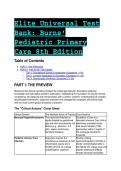
Elite Universal Test
Bank: Burns'
Pediatric Primary
Care 8th Edition
Table of Contents
● PART I: THE PREVIEW
● PART II: THE ELITE TEST BANK
○ Tier 1: Foundational Syntax & Application (Questions 1–10)
○ Tier 2: Complex Application & Simulation (Questions 11–20)
○ Tier 3: Grandmaster Synthesis (Questions 21–30)
PART I: THE PREVIEW
Mastering this clinical repository bridges the critical gap between theoretical academic
knowledge and high-stakes pediatric application, establishing the foundation for top-tier clinical
competence. By replacing rote memorization with a unified, systemic understanding of complex
physiological frameworks, diagnostic precision and management strategies will directly align
with the most current global standards of practice.
The "Critical Axioms" Cheat Sheet
Clinical Domain The Absolute Axiom of Practice Core Directive
Neonatal Hyperbilirubinemia The treatment threshold is Escalation of care to a
rigidly dictated by gestational Neonatal Intensive Care Unit is
age and strict neurotoxicity risk definitively mandated when
factors (e.g., albumin < 3.0 total serum bilirubin (TSB)
g/dL, sepsis, isoimmune approaches within 2 mg/dL of
hemolytic disease). the exchange transfusion
threshold.
Pediatric Urinary Tract Diagnosis requires the Routine voiding
Infection simultaneous presence of both cystourethrography (VCUG) is
inflammatory pyuria and ≥ strictly contraindicated after a
50,000 CFU/mL of a single first febrile UTI unless renal and
uropathogenic organism. bladder ultrasound (RBUS)
reveals structural anomalies.
,Clinical Domain The Absolute Axiom of Practice Core Directive
Adolescent Hypertension For patients ≥ 13 years, Stage 1 Hypertension in this
hypertension is defined by cohort is strictly defined as
absolute numerical values, 130/80 mm Hg to 139/89 mm
completely abandoning Hg.
pediatric percentile charts.
Acute Otitis Media (AOM) In immunocompetent children > A 48–72 hour period of watchful
6 months presenting with mild waiting with a safety-net
otalgia and temperatures < antibiotic prescription (SNAP) is
39°C, antimicrobial stewardship the gold standard.
is the highest priority.
Childhood Lead Exposure The Centers for Disease Capillary levels ≥ 3.5 µg/dL
Control and Prevention (CDC) require venous confirmation
blood lead reference value and immediately trigger
(BLRV) is strictly 3.5 µg/dL, nutritional counseling and
representing the 97.5th environmental evaluation.
percentile of pediatric
exposure.
PART II: THE ELITE TEST BANK
Tier 1: Foundational Syntax & Application (Questions 1–10)
Q1: A 4-week-old infant is brought to the primary care clinic for a routine evaluation. The
primary care provider establishes a long-term developmental tracking plan, coordinates a
referral to pediatric cardiology for a detected murmur, and subsequently administers routine
scheduled immunizations. Based on the fundamental definitions of the pediatric healthcare
delivery model, which of the following actions MOST ACCURATELY represents the provider's
execution of primary care as opposed to primary prevention? A) Administering the hepatitis B
vaccine to induce antibody production against future hepatic disease. B) Educating the
caregivers on supine sleep positioning to mitigate the risk of Sudden Infant Death Syndrome. C)
Delivering comprehensive, continuous, and coordinated longitudinal health management across
the child's lifespan. D) Performing a newborn metabolic screen to ensure the early detection and
treatment of congenital hypothyroidism.
● Answer: C (Delivering comprehensive, continuous, and coordinated longitudinal health
management across the child's lifespan.)
● Distractor Analysis:
○ A is incorrect: Immunizations are the quintessential example of primary
prevention—a specific, targeted action taken to avert the onset of a particular
disease—but they do not singularly define the holistic structural scope of primary
care.
○ B is incorrect: Anticipatory guidance regarding safe sleep environments is a
targeted preventive measure, not the overarching framework of continuous care
coordination.
○ D is incorrect: Newborn metabolic screening constitutes secondary prevention (a
public health measure aimed at early disease detection prior to symptom onset),
entirely distinct from the definition of primary care.
The Mentor's Analysis: Primary care serves as the architectural framework of healthcare
, delivery; its hallmark is the continuous, comprehensive, and coordinated management of a
patient over time. Primary prevention represents the specific tools—such as vaccines and
anticipatory guidance—utilized within that framework to intercept disease pathology before it
can initiate. Professional/Academic Intuition: Primary care is defined by longitudinal
coordination and comprehensive scope; primary prevention is defined by targeted
preemptive strikes against specific pathologies.
Q2: A 2-year-old child living in an urban residence constructed in 1965 undergoes routine
capillary blood lead screening. The laboratory result returns at 4.0 µg/dL. According to the
updated Centers for Disease Control and Prevention (CDC) guidelines, what is the MOST
APPROPRIATE interpretation and clinical response? A) The value falls below the historical
reference threshold of 5.0 µg/dL; the provider should document the finding and proceed with
standard well-child care. B) The value exceeds the updated blood lead reference value (BLRV);
the provider must order a confirmatory venous sample and initiate nutritional and environmental
counseling. C) The value indicates severe neurotoxic lead poisoning; the provider must admit
the patient immediately for intravenous chelation therapy. D) The value represents a likely false
positive inherent to capillary sampling; the provider should defer action and repeat the capillary
test at the next annual visit.
● Answer: B (The value exceeds the updated blood lead reference value (BLRV); the
provider must order a confirmatory venous sample and initiate nutritional and
environmental counseling.)
● Distractor Analysis:
○ A is incorrect: This approach relies on the outdated legacy BLRV of 5.0 µg/dL. The
2021 CDC update definitively lowered the BLRV to 3.5 µg/dL to capture the top
2.5% of exposed children.
○ C is incorrect: Pharmacological chelation therapy is strictly reserved for
dangerously high blood lead levels (typically ≥ 45 µg/dL), not for mild elevations
situated just above the BLRV threshold.
○ D is incorrect: While capillary tests are prone to false positives secondary to
epidermal lead dust contamination, the mandated protocol is to secure a
confirmatory venous sample promptly, not to delay surveillance for a year.
The Mentor's Analysis: The CDC formally lowered the BLRV to 3.5 µg/dL to reflect the 97.5th
percentile of blood lead distribution in U.S. children, reinforcing the epidemiological reality that
no safe level of lead exposure exists. Any initial capillary result ≥ 3.5 µg/dL mandates swift
venous confirmation, followed immediately by targeted nutritional defense strategies (optimizing
dietary calcium and iron) and environmental source identification. Professional/Academic
Intuition: The CDC BLRV functions as a trigger for early public health intervention, not a
threshold for acute clinical toxicity. Immediate action is required at 3.5 µg/dL.
Q3: A 14-month-old female presents with a documented fever of 39.2°C (102.5°F) without an
identifiable respiratory or gastrointestinal source. The clinician secures a sterile catheterized
urine specimen. Based on the American Academy of Pediatrics (AAP) Clinical Practice
Guideline for initial urinary tract infections in febrile infants (2–24 months), which specific
combination of laboratory findings is REQUIRED to establish a definitive diagnosis? A) Positive
leukocyte esterase on rapid dipstick testing combined with ≥ 10,000 CFU/mL of a gram-negative
uropathogen. B) The presence of pyuria on microscopic urinalysis combined with ≥ 50,000
CFU/mL of a single uropathogenic organism. C) Nitrite positivity on rapid dipstick testing
combined with ≥ 100,000 CFU/mL of mixed bacterial flora. D) An isolated fever > 39°C
combined with ≥ 100,000 CFU/mL of a single uropathogen, in the absence of pyuria.
● Answer: B (The presence of pyuria on microscopic urinalysis combined with ≥ 50,000
Bank: Burns'
Pediatric Primary
Care 8th Edition
Table of Contents
● PART I: THE PREVIEW
● PART II: THE ELITE TEST BANK
○ Tier 1: Foundational Syntax & Application (Questions 1–10)
○ Tier 2: Complex Application & Simulation (Questions 11–20)
○ Tier 3: Grandmaster Synthesis (Questions 21–30)
PART I: THE PREVIEW
Mastering this clinical repository bridges the critical gap between theoretical academic
knowledge and high-stakes pediatric application, establishing the foundation for top-tier clinical
competence. By replacing rote memorization with a unified, systemic understanding of complex
physiological frameworks, diagnostic precision and management strategies will directly align
with the most current global standards of practice.
The "Critical Axioms" Cheat Sheet
Clinical Domain The Absolute Axiom of Practice Core Directive
Neonatal Hyperbilirubinemia The treatment threshold is Escalation of care to a
rigidly dictated by gestational Neonatal Intensive Care Unit is
age and strict neurotoxicity risk definitively mandated when
factors (e.g., albumin < 3.0 total serum bilirubin (TSB)
g/dL, sepsis, isoimmune approaches within 2 mg/dL of
hemolytic disease). the exchange transfusion
threshold.
Pediatric Urinary Tract Diagnosis requires the Routine voiding
Infection simultaneous presence of both cystourethrography (VCUG) is
inflammatory pyuria and ≥ strictly contraindicated after a
50,000 CFU/mL of a single first febrile UTI unless renal and
uropathogenic organism. bladder ultrasound (RBUS)
reveals structural anomalies.
,Clinical Domain The Absolute Axiom of Practice Core Directive
Adolescent Hypertension For patients ≥ 13 years, Stage 1 Hypertension in this
hypertension is defined by cohort is strictly defined as
absolute numerical values, 130/80 mm Hg to 139/89 mm
completely abandoning Hg.
pediatric percentile charts.
Acute Otitis Media (AOM) In immunocompetent children > A 48–72 hour period of watchful
6 months presenting with mild waiting with a safety-net
otalgia and temperatures < antibiotic prescription (SNAP) is
39°C, antimicrobial stewardship the gold standard.
is the highest priority.
Childhood Lead Exposure The Centers for Disease Capillary levels ≥ 3.5 µg/dL
Control and Prevention (CDC) require venous confirmation
blood lead reference value and immediately trigger
(BLRV) is strictly 3.5 µg/dL, nutritional counseling and
representing the 97.5th environmental evaluation.
percentile of pediatric
exposure.
PART II: THE ELITE TEST BANK
Tier 1: Foundational Syntax & Application (Questions 1–10)
Q1: A 4-week-old infant is brought to the primary care clinic for a routine evaluation. The
primary care provider establishes a long-term developmental tracking plan, coordinates a
referral to pediatric cardiology for a detected murmur, and subsequently administers routine
scheduled immunizations. Based on the fundamental definitions of the pediatric healthcare
delivery model, which of the following actions MOST ACCURATELY represents the provider's
execution of primary care as opposed to primary prevention? A) Administering the hepatitis B
vaccine to induce antibody production against future hepatic disease. B) Educating the
caregivers on supine sleep positioning to mitigate the risk of Sudden Infant Death Syndrome. C)
Delivering comprehensive, continuous, and coordinated longitudinal health management across
the child's lifespan. D) Performing a newborn metabolic screen to ensure the early detection and
treatment of congenital hypothyroidism.
● Answer: C (Delivering comprehensive, continuous, and coordinated longitudinal health
management across the child's lifespan.)
● Distractor Analysis:
○ A is incorrect: Immunizations are the quintessential example of primary
prevention—a specific, targeted action taken to avert the onset of a particular
disease—but they do not singularly define the holistic structural scope of primary
care.
○ B is incorrect: Anticipatory guidance regarding safe sleep environments is a
targeted preventive measure, not the overarching framework of continuous care
coordination.
○ D is incorrect: Newborn metabolic screening constitutes secondary prevention (a
public health measure aimed at early disease detection prior to symptom onset),
entirely distinct from the definition of primary care.
The Mentor's Analysis: Primary care serves as the architectural framework of healthcare
, delivery; its hallmark is the continuous, comprehensive, and coordinated management of a
patient over time. Primary prevention represents the specific tools—such as vaccines and
anticipatory guidance—utilized within that framework to intercept disease pathology before it
can initiate. Professional/Academic Intuition: Primary care is defined by longitudinal
coordination and comprehensive scope; primary prevention is defined by targeted
preemptive strikes against specific pathologies.
Q2: A 2-year-old child living in an urban residence constructed in 1965 undergoes routine
capillary blood lead screening. The laboratory result returns at 4.0 µg/dL. According to the
updated Centers for Disease Control and Prevention (CDC) guidelines, what is the MOST
APPROPRIATE interpretation and clinical response? A) The value falls below the historical
reference threshold of 5.0 µg/dL; the provider should document the finding and proceed with
standard well-child care. B) The value exceeds the updated blood lead reference value (BLRV);
the provider must order a confirmatory venous sample and initiate nutritional and environmental
counseling. C) The value indicates severe neurotoxic lead poisoning; the provider must admit
the patient immediately for intravenous chelation therapy. D) The value represents a likely false
positive inherent to capillary sampling; the provider should defer action and repeat the capillary
test at the next annual visit.
● Answer: B (The value exceeds the updated blood lead reference value (BLRV); the
provider must order a confirmatory venous sample and initiate nutritional and
environmental counseling.)
● Distractor Analysis:
○ A is incorrect: This approach relies on the outdated legacy BLRV of 5.0 µg/dL. The
2021 CDC update definitively lowered the BLRV to 3.5 µg/dL to capture the top
2.5% of exposed children.
○ C is incorrect: Pharmacological chelation therapy is strictly reserved for
dangerously high blood lead levels (typically ≥ 45 µg/dL), not for mild elevations
situated just above the BLRV threshold.
○ D is incorrect: While capillary tests are prone to false positives secondary to
epidermal lead dust contamination, the mandated protocol is to secure a
confirmatory venous sample promptly, not to delay surveillance for a year.
The Mentor's Analysis: The CDC formally lowered the BLRV to 3.5 µg/dL to reflect the 97.5th
percentile of blood lead distribution in U.S. children, reinforcing the epidemiological reality that
no safe level of lead exposure exists. Any initial capillary result ≥ 3.5 µg/dL mandates swift
venous confirmation, followed immediately by targeted nutritional defense strategies (optimizing
dietary calcium and iron) and environmental source identification. Professional/Academic
Intuition: The CDC BLRV functions as a trigger for early public health intervention, not a
threshold for acute clinical toxicity. Immediate action is required at 3.5 µg/dL.
Q3: A 14-month-old female presents with a documented fever of 39.2°C (102.5°F) without an
identifiable respiratory or gastrointestinal source. The clinician secures a sterile catheterized
urine specimen. Based on the American Academy of Pediatrics (AAP) Clinical Practice
Guideline for initial urinary tract infections in febrile infants (2–24 months), which specific
combination of laboratory findings is REQUIRED to establish a definitive diagnosis? A) Positive
leukocyte esterase on rapid dipstick testing combined with ≥ 10,000 CFU/mL of a gram-negative
uropathogen. B) The presence of pyuria on microscopic urinalysis combined with ≥ 50,000
CFU/mL of a single uropathogenic organism. C) Nitrite positivity on rapid dipstick testing
combined with ≥ 100,000 CFU/mL of mixed bacterial flora. D) An isolated fever > 39°C
combined with ≥ 100,000 CFU/mL of a single uropathogen, in the absence of pyuria.
● Answer: B (The presence of pyuria on microscopic urinalysis combined with ≥ 50,000

