Biochemical Basis of Therapeutics
Pharmacology
What is pharmacology?
● Pharmacology: a branch of medicine focused on the uses, effects and modes of
action of drugs
● Pharmacy: the science of preparing and dispensing of medicinal drugs
● Therapeutics: a branch of medicine focused on disease treatment and the action of
remedial agents (treating symptoms of disease)
● Toxicology: a branch of medicine focused on the nature, effects and detection of
poisons
● There is an overlap between therapeutic drugs and abused drugs
What are the various mechanisms of drug action?
● Drugs are exogenous molecules that mimic/block the action of endogenous
molecules
○ Exogenous drug: a drug that is synthesised outside the body
■ An exogenously given drug may be chemically identical to an
endogenous molecule or it could be chemically distinct from a known
endogenous molecule
○ Endogenous drug: a drug that is synthesised inside the body
● Receptors have specific binding sites for a drug
● Physiological receptors- endogenous proteins which act as receptors for
endogenous chemical signalling compounds (ie hormones and neurotransmitters)
● Drugs may bind to specific sites on enzymes or ion channels, preventing them from
doing their intended function (in fewer
cases, this may stimulate the protein)
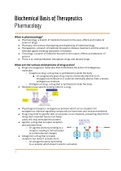
● Agonist: a drug that occupies receptors
and activates them
○ An agonist works by binding to a
receptor, leading to full activation
(a conformational change)
● Antagonist: a drug that occupies
receptors but doesn’t activate them
○ An antagonist works by binding
to a receptor which doesn’t result in activation
1
, ● The primary effect of a drug is a result of the type of binding site on the receptor
and the type of interaction of the drug with its specific binding site
○ Drug and receptor binding site interactions mediated by ionic attractions or
hydrophobic interactions are reversible
○ Drug and receptor binding site interactions mediated by covalent bonds are
irreversible
■ Interactions between the drug and binding site are in a constant state
of flux
What is the importance of the ADME of drugs?
● The time taken for a drug to act in a patient is determined by pharmacokinetics
○ Absorption controls how much drug enters the system and how quickly this
occurs
■ Absorption depends on the chemical properties of the drug
1. Molecular size
2. Lipid solubility
3. Ionisation
4. Chemical and metabolic vulnerability (ie if a drug is
metabolised quickly, less of the drug is available for absorption
■ Absorption depends on the route of administration used
1. Inhalational (gas, spray or vapour etc)
2. Intradermal (injected into the skin layer)
3. Intrathecal (injected into the membranes enclosing the spinal
cord)
■ The properties of the patient affect absorption
1. Is the patient fat or thin?
2. Has the patient just eaten or do they have an empty stomach?
3. Is the patient healthy or do they have a chronic illness?
○ Distribution affects whether the drug has a local effect or systemic effect
■ A drug may need to diffuse through tissue or be circulated in the
blood in order to have its intended effect
1. Is the drug soluble in blood?
2. Does the drug stick to proteins/cells in the blood?
3. Will the drug concentrate in fats or in aqueous compartments?
4. Does the patient have adequate circulation?
○ Drug metabolism and excretion determine how long the effects of the drug
will last
■ When a drug is metabolised, its duration of action is reduced
■ If a drug is excreted rapidly it may have a short duration of action
1. Where is the drug metabolised (if it is metabolised in the liver,
does the patient have a hepatic impairment)?
2. How is the drug excreted (if it’s via the kidneys, does the
patient have a renal impairment)?
3. Are the metabolites active?
4. Are the metabolites toxic?
2
Pharmacology
What is pharmacology?
● Pharmacology: a branch of medicine focused on the uses, effects and modes of
action of drugs
● Pharmacy: the science of preparing and dispensing of medicinal drugs
● Therapeutics: a branch of medicine focused on disease treatment and the action of
remedial agents (treating symptoms of disease)
● Toxicology: a branch of medicine focused on the nature, effects and detection of
poisons
● There is an overlap between therapeutic drugs and abused drugs
What are the various mechanisms of drug action?
● Drugs are exogenous molecules that mimic/block the action of endogenous
molecules
○ Exogenous drug: a drug that is synthesised outside the body
■ An exogenously given drug may be chemically identical to an
endogenous molecule or it could be chemically distinct from a known
endogenous molecule
○ Endogenous drug: a drug that is synthesised inside the body
● Receptors have specific binding sites for a drug
● Physiological receptors- endogenous proteins which act as receptors for
endogenous chemical signalling compounds (ie hormones and neurotransmitters)
● Drugs may bind to specific sites on enzymes or ion channels, preventing them from
doing their intended function (in fewer
cases, this may stimulate the protein)
● Agonist: a drug that occupies receptors
and activates them
○ An agonist works by binding to a
receptor, leading to full activation
(a conformational change)
● Antagonist: a drug that occupies
receptors but doesn’t activate them
○ An antagonist works by binding
to a receptor which doesn’t result in activation
1
, ● The primary effect of a drug is a result of the type of binding site on the receptor
and the type of interaction of the drug with its specific binding site
○ Drug and receptor binding site interactions mediated by ionic attractions or
hydrophobic interactions are reversible
○ Drug and receptor binding site interactions mediated by covalent bonds are
irreversible
■ Interactions between the drug and binding site are in a constant state
of flux
What is the importance of the ADME of drugs?
● The time taken for a drug to act in a patient is determined by pharmacokinetics
○ Absorption controls how much drug enters the system and how quickly this
occurs
■ Absorption depends on the chemical properties of the drug
1. Molecular size
2. Lipid solubility
3. Ionisation
4. Chemical and metabolic vulnerability (ie if a drug is
metabolised quickly, less of the drug is available for absorption
■ Absorption depends on the route of administration used
1. Inhalational (gas, spray or vapour etc)
2. Intradermal (injected into the skin layer)
3. Intrathecal (injected into the membranes enclosing the spinal
cord)
■ The properties of the patient affect absorption
1. Is the patient fat or thin?
2. Has the patient just eaten or do they have an empty stomach?
3. Is the patient healthy or do they have a chronic illness?
○ Distribution affects whether the drug has a local effect or systemic effect
■ A drug may need to diffuse through tissue or be circulated in the
blood in order to have its intended effect
1. Is the drug soluble in blood?
2. Does the drug stick to proteins/cells in the blood?
3. Will the drug concentrate in fats or in aqueous compartments?
4. Does the patient have adequate circulation?
○ Drug metabolism and excretion determine how long the effects of the drug
will last
■ When a drug is metabolised, its duration of action is reduced
■ If a drug is excreted rapidly it may have a short duration of action
1. Where is the drug metabolised (if it is metabolised in the liver,
does the patient have a hepatic impairment)?
2. How is the drug excreted (if it’s via the kidneys, does the
patient have a renal impairment)?
3. Are the metabolites active?
4. Are the metabolites toxic?
2