

Escrito por estudiantes que aprobaron Inmediatamente disponible después del pago Leer en línea o como PDF ¿Documento equivocado? Cámbialo gratis 4,6 TrustPilot
logo-home
Document preview thumbnail
Vista previa 2 fuera de 13 páginas
Examen

BIOD 171/ BIOD171 Final Exam | Complete Q&A with Verified Answers and Detailed Rationales | Essential Microbiology with Lab Comprehensive Final Exam Review | A+ Graded | Portage

Document preview thumbnail
Vista previa 2 fuera de 13 páginas

INSTANT PDF DOWNLOAD – This is the comprehensive Final Exam (Version 4) study guide for BIOD 171 Essential Microbiology with Lab at Portage Learning (Latest 2026/2027 Update) , featuring verified questions and answers with detailed rationales . Based on actual Portage Learning final exam content, this A+ Graded resource covers all modules including cell biology, microbial metabolism, microscopy and staining, bacterial cultivation and control, and virology . Key Topics & Practice Questions from Actual Exam Content Cell Biology & Macromolecules – Microbiology is the study of microbes and their biological processes ; the smallest biological unit of life is a cell ; the four main types of macromolecules are proteins, nucleic acids, lipids, and carbohydrates ; DNA stores hereditary information, while RNA deciphers and synthesizes proteins ; Protista include algae and amoeba (not yeast or bacteria) and are unable to form tissue layers ; the ribosome functions in protein synthesis ; the Golgi functions in protein modification and distribution ; the lysosome functions in waste disposal via hydrolytic enzymes . Microbial Metabolism – Catabolism is the breakdown of larger molecules into energy sources ; the anabolic process is involved during cellular growth and repair ; light reactions generate a proton concentration gradient to produce ATP ; dark reactions (Calvin Cycle) do not require darkness ; β-oxidation is responsible for catabolism of fatty acid chains ; photosynthesis equation: 6 CO₂ + 18 ATP + 12 NADPH + 12 H₂O → C₆H₁₂O₆ + 18 ADP + 12 NADP⁺ . Microscopy & Staining – A micrometer is defined as 10⁻⁶ m ; total magnification = ocular lens power × objective lens power (e.g., 60x × 10x = 600x) ; bright field microscopy is used for simple stains like methylene blue ; dark field is used for unstained samples that absorb very little light ; fluorescence microscopy shows a dark background with fluorescing bacteria ; TEM captures 2D images showing subcellular structures ; SEM captures 3D "shell" images without subcellular organelles ; acid-fast stain should be used when a sample has high resistance to decolorization . Bacterial Cultivation & Control – LB agar is a basic non-selective, non-differential media ; selective media is best for isolating slow-growing organisms like Neisseria meningitides ; a dilution streak must use a sterilized loop for each phase to establish a dilution gradient ; gram staining Gram-negative bacteria cannot retain crystal violet dye due to thin peptidoglycan and LPS . Virology – A virus is considered a microbe but NOT a microorganism ; bacteriophages infect bacteria and contain a 20-sided capsid ; HIV anti-retroviral medication inhibits the life cycle of retroviruses ; Influenza A is the most virulent subtype ; hemagglutinin (HA) proteins are targets for inhibiting viral entry ; neuraminidase (N) proteins are targets for inhibiting viral release ; the Salk vaccine is injected and contains inactivated virus ; the Sabin vaccine is oral and contains live attenuated virus ; Variola major/minor (smallpox) were eradicated in 1977 ; Poliovirus is a ~30nm single-stranded RNA virus that targets motor neurons . Bacterial Pathogens – Streptococcus is catalase negative and cannot break down peroxides ; Staphylococcus is catalase positive and ferments mannitol ; Clostridium perfringens (gas gangrene) causes muscle necrosis, swelling, fever, and gas production; toxin perforates host cell membranes causing cell lysis ; tetanus has no cure but is preventable by vaccination ; botulism in adults requires direct ingestion of pre-formed toxin ; plague variants: bubonic (swollen lymph nodes), pneumonic (respiratory), septicemic (blood) ; leprosy is caused by acid-fast rods . Vertical Keywords / Tags BIOD 171 Final Exam Version 4 Portage Essential Microbiology Final Exam Microbiology Definition Microbes Smallest Biological Unit Cell Four Major Macromolecules DNA vs RNA Roles Protista Algae Amoeba Ribosome Protein Synthesis Golgi Protein Modification Lysosome Hydrolytic Enzymes Catabolism Anabolism Photosynthesis Light Reactions Dark Reactions Microscope Total Magnification Bright Field Dark Field Fluorescence SEM TEM Electron Microscopy Acid Fast Stain Mycobacterium LB Agar Non-Selective Dilution Streak Sterilized Loop Bacteriophage Icosahedral Capsid HIV Antiretroviral Influenza Hemagglutinin Neuraminidase Salk Sabin Polio Vaccine Variola Smallpox Eradicated Poliovirus Motor Neurons Streptococcus Catalase Negative Staphylococcus Catalase Positive Clostridium perfringens Gas Gangrene Tetanus Prevention Vaccination Bubonic Pneumonic Septicemic Plague A+ Grade Microbiology Study Guide Portage Learning BIOD 171 Final Exam Version 4 Prep

Vista previa del contenido

Portage Learning


4Q · 171 DOIB
★ ★


P A Division of Geneva College
EST. 2012
ONLINE COURSES FOR COLLEGE CREDIT


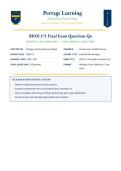
BIOD 171 Final Exam Questions Q4
E SS E N T I A L M I C R O B I O LO G Y — S U P P L E M E N TA L Q U E ST I O N S

INSTITUTION Portage Learning (Geneva College) PROGRAM Pre-Nursing / Health Sciences
COURSE CODE BIOD 171 COURSE TITLE Essential Microbiology
ACADEMIC YEAR EXAM TITLE BIOD 171 Final Exam Questions Q4
TOTAL QUESTIONS 26 Questions FORMAT Multiple Choice / Matching / True-
False


EXAMINATION INSTRUCTIONS
▸ Select the single best answer for each question.
▸ Questions randomized from source material per Component 16.
▸ Topics: Organelles, Microscopy, Virology, Bacteriology, Agar Types, Metabolism.
▸ Correct answers and rationales appear below each question.

, ESSENTIAL MICROBIOLOGY — Q4 SUPPLEMENTAL Questions 1 – 26

1. Match: Which organelle contains hydrolytic enzymes?
A. Nucleus
B. Endoplasmic Reticulum
C. Lysosomes
D. Chloroplasts
CORRECT ANSWER C — Lysosomes (contain hydrolytic enzymes for degradation)
RATIONALE Lysosomes are membrane-enclosed organelles packed with hydrolytic enzymes
that break down cellular debris, worn-out organelles, and engulfed pathogens.
Nucleus contains genetic material. ER is a series of membrane-enclosed sacs.
Chloroplasts are the site of photosynthesis.


2. How does a Scanning Electron Microscope (SEM) form an image?
A. Electrons pass through the specimen
B. Electrons reflect off the surface; samples are coated in gold to enhance reflections
C. UV light excites fluorophores
D. Laser beams scan through the specimen
CORRECT ANSWER B — Electrons reflect off (not through) the specimen surface; gold coating
enhances reflections
RATIONALE SEM forms images from electrons that interact with and reflect OFF the surface.
Samples are coated with gold to improve conductivity and enhance electron
reflection, producing detailed 3D-like surface images. TEM passes electrons
THROUGH the specimen.


Información del documento

Subido en
26 de julio de 2026
Número de páginas
13
Escrito en
2025/2026
Tipo
Examen
Contiene
Preguntas y respuestas
$12.99

¿Documento equivocado? Cámbialo gratis Dentro de los 14 días posteriores a la compra y antes de descargarlo, puedes elegir otro documento. Puedes gastar el importe de nuevo.
Escrito por estudiantes que aprobaron
Inmediatamente disponible después del pago
Leer en línea o como PDF

Seller avatar
Los indicadores de reputación están sujetos a la cantidad de artículos vendidos por una tarifa y las reseñas que ha recibido por esos documentos. Hay tres niveles: Bronce, Plata y Oro. Cuanto mayor reputación, más podrás confiar en la calidad del trabajo del vendedor.
DoctorKen
3.8
(151)
Vendido
828
Seguidores
116
Artículos
6565
Última venta
9 horas hace


Por qué los estudiantes eligen Stuvia

Creado por compañeros estudiantes, verificado por reseñas

Calidad en la que puedes confiar: escrito por estudiantes que aprobaron y evaluado por otros que han usado estos resúmenes.

¿No estás satisfecho? Elige otro documento

¡No te preocupes! Puedes elegir directamente otro documento que se ajuste mejor a lo que buscas.

Paga como quieras, empieza a estudiar al instante

Sin suscripción, sin compromisos. Paga como estés acostumbrado con tarjeta de crédito y descarga tu documento PDF inmediatamente.

Student with book image

“Comprado, descargado y aprobado. Así de fácil puede ser.”

Alisha Student

Preguntas frecuentes