

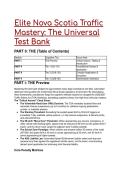
Elite Nova Scotia Traffic
Mastery: The Universal
Test Bank
PART 0: THE (Table of Contents)
Section Cognitive Tier Focus Area
PART I The Preview Critical Axioms, Tables &
Introduction
PART II Tier 1 (Q1–15) Foundational Syntax &
Application
PART II Tier 2 (Q16–35) Complex Application &
Simulation
PART II Tier 3 (Q36–60) Grandmaster Synthesis
PART I: THE Preview
Mastering this test bank bridges the gap between basic legal compliance and elite, automated
defensive driving within the modernized Nova Scotia regulatory environment. By internalizing
these frameworks, practitioners forge the cognitive reflexes required to navigate the 2026/2027
Traffic Safety Act (TSA) flawlessly, translating academic theory into high-level vehicular mastery.
The "Critical Axioms" Cheat Sheet:
● The Vulnerable Road User (VRU) Doctrine: The TSA mandates doubled fines and
automatic license suspensions (up to 6 months) for collisions injuring pedestrians,
cyclists, or roadside workers.
● The Stunting Threshold: Exceeding the posted speed limit by 50 km/h triggers an
immediate 7-day roadside vehicle seizure, a 7-day license suspension, 6 demerit points,
and a $2,422.50 fine.
● The 60 km/h "Move Over" Parameter: When approaching any service, emergency, or
utility vehicle with flashing lights, speed must be reduced to 60 km/h (or the posted limit if
lower), and the driver must vacate the adjacent lane if safely possible.
● The School Zone Paradigm: When children are present (within 30 meters of the road)
24/7/365, the speed limit is 30 km/h in zones approaching at 50 km/h, and 50 km/h in
zones approaching at higher speeds.
● The ASE Liability Law: Automated Speed Enforcement (photo radar) and stop-arm
cameras levy fines against the registered vehicle owner, not the driver, circumventing
demerit point application but enforcing strict financial liability.
Core Penalty Matrices
,Speed Overage Demerit Points Standard Fine Range
1–15 km/h 2 $237.50
16–30 km/h 3 Variable by zone
31–49 km/h 4 Variable by zone
50+ km/h (Stunting) 6 + Suspension $2,422.50
Distracted Driving (Handheld) Demerit Points Base Fine Amount
First Offense 4 $237.50
Second Offense 4 $342.50
Third+ Offense 4 $572.50
PART II: THE ELITE TEST BANK
Tier 1 - Foundational Syntax & Application
Q1: A newly licensed driver (Class 5N) is operating a vehicle at 3:00 AM without a supervising
driver. They have not filed an exemption form. Based on Nova Scotia Graduated Driver
Licensing (GDL) laws, which conclusion is the MOST ACCURATE? A) The driver is legally
permitted if traveling directly to a medical facility. B) The driver is operating legally if they
maintain a zero blood alcohol content. C) The driver is violating the mandatory midnight to 5:00
AM curfew restriction. D) The driver is permitted provided they have no passengers in the
vehicle.
● The Answer: C (The driver is violating the mandatory midnight to 5:00 AM curfew
restriction.)
● Distractor Analysis:
○ A is incorrect: Medical exceptions do not override the GDL curfew; Form APP33
employment exemptions are the only legal override for solitary driving.
○ B is incorrect: While zero BAC is required, it does not nullify the strict temporal
curfew restriction.
○ D is incorrect: Passenger restrictions limit the driver to one front-seat passenger,
but this does not grant curfew immunity.
The Mentor's Analysis: Time-of-day restrictions isolate novice drivers from high-risk nocturnal
environments. When auditing a Class 5N operator, the immediate priority is verifying temporal
compliance. By utilizing the midnight curfew parameter, you bypass the common trap of
assuming general road rules apply to GDL participants. Professional/Academic Intuition:
Class 5N privileges end at midnight unless legally documented for employment.
Q2: A driver travels 115 km/h in a posted 60 km/h zone. Based on the Motor Vehicle Act, which
action is the IMMEDIATE legal consequence? A) A 4-point demerit penalty and a standard
speeding ticket. B) A mandatory Driver Enhancement Officer interview. C) An immediate 7-day
license suspension and vehicle seizure for stunting. D) A 30-day vehicle impoundment and
mandatory defensive driving course.
● The Answer: C (An immediate 7-day license suspension and vehicle seizure for
stunting.)
● Distractor Analysis:
○ A is incorrect: Exceeding the limit by 50 km/h or more upgrades the offense from
basic speeding to stunting.
○ B is incorrect: While 6 points will trigger an interview later, the immediate roadside
, action is suspension.
○ D is incorrect: The immediate administrative vehicle seizure is 7 days, not 30.
The Mentor's Analysis: Velocity differentials exceeding 50 km/h cross the threshold from
negligence to aggressive criminality. When calculating excess speed, the immediate priority is
identifying the 50 km/h stunting trigger. By utilizing the Stunting Penalty Matrix, you bypass the
trap of processing the violation as a standard speeding infraction. Professional/Academic
Intuition: +50 km/h equals lost license, lost car, and $2,422.50.
Q3: A driver is caught texting at a red light. It is their first offense. Based on Nova Scotia's
distracted driving legislation, what is the MOST ACCURATE penalty assessment? A) A warning,
as the vehicle was not in kinetic motion. B) A fine of $237.50 and 4 demerit points. C) A fine of
$578.95 and an automatic 3-day license suspension. D) A 2-point demerit penalty and a
mandate to use hands-free technology.
● The Answer: B (A fine of $237.50 and 4 demerit points.)
● Distractor Analysis:
○ A is incorrect: The law applies to any operation on a roadway, regardless of kinetic
movement at a red light.
○ C is incorrect: This fine tier represents a third or subsequent offense, not a first
offense.
○ D is incorrect: The penalty is definitively 4 points, and hands-free mandates are not
formally enforced as a secondary administrative penalty.
The Mentor's Analysis: Cognitive distraction persists even when kinetic energy is zero. When
evaluating electronic device usage, the immediate priority is confirming the device was in the
operator's hand while in the roadway corridor. By utilizing the strict liability of Section 100D, you
bypass the trap of the "stopped vehicle" defense. Professional/Academic Intuition: If the
vehicle is in gear, the phone must disappear.
Q4: A driver approaches a school zone at 2:00 PM on a Tuesday in July. Children are playing
soccer on the field 20 meters from the road. The approaching speed limit is 50 km/h. What is
the MOST ACCURATE maximum speed permitted? A) 50 km/h, because it is summer vacation.
B) 30 km/h, because children are present within 30 meters of the roadway. C) 30 km/h, but only
if school bus lights are flashing. D) 50 km/h, provided the driver exercises extreme caution.
● The Answer: B (30 km/h, because children are present within 30 meters of the roadway.)
● Distractor Analysis:
○ A is incorrect: The law applies 24/7/365; academic calendars are irrelevant.
○ C is incorrect: The presence of children, not a school bus, triggers the speed
reduction.
○ D is incorrect: Subjective "caution" does not legally override a hard numerical speed
limit.
The Mentor's Analysis: Vulnerability parameters are dictated by biology, not the calendar.
When approaching a school zone, the immediate priority is scanning for pediatric presence
within the 30-meter operational halo. By utilizing the 24/7/365 presence rule, you bypass the
trap of assuming school zones are inactive during summer. Professional/Academic Intuition:
A child's presence makes a 50 zone a 30 zone, instantly and unconditionally.
Q5: Based on Nova Scotia winter driving regulations, which statement regarding winter tires is
the MOST ACCURATE? A) Winter tires are legally mandated from December 1st to April 15th.
B) Studded tires are permanently banned due to highway infrastructure degradation. C) Winter
tires are highly recommended but not legally mandatory. D) All-season tires are strictly
prohibited during active snowstorms.
● The Answer: C (Winter tires are highly recommended but not legally mandatory.)
Mastery: The Universal
Test Bank
PART 0: THE (Table of Contents)
Section Cognitive Tier Focus Area
PART I The Preview Critical Axioms, Tables &
Introduction
PART II Tier 1 (Q1–15) Foundational Syntax &
Application
PART II Tier 2 (Q16–35) Complex Application &
Simulation
PART II Tier 3 (Q36–60) Grandmaster Synthesis
PART I: THE Preview
Mastering this test bank bridges the gap between basic legal compliance and elite, automated
defensive driving within the modernized Nova Scotia regulatory environment. By internalizing
these frameworks, practitioners forge the cognitive reflexes required to navigate the 2026/2027
Traffic Safety Act (TSA) flawlessly, translating academic theory into high-level vehicular mastery.
The "Critical Axioms" Cheat Sheet:
● The Vulnerable Road User (VRU) Doctrine: The TSA mandates doubled fines and
automatic license suspensions (up to 6 months) for collisions injuring pedestrians,
cyclists, or roadside workers.
● The Stunting Threshold: Exceeding the posted speed limit by 50 km/h triggers an
immediate 7-day roadside vehicle seizure, a 7-day license suspension, 6 demerit points,
and a $2,422.50 fine.
● The 60 km/h "Move Over" Parameter: When approaching any service, emergency, or
utility vehicle with flashing lights, speed must be reduced to 60 km/h (or the posted limit if
lower), and the driver must vacate the adjacent lane if safely possible.
● The School Zone Paradigm: When children are present (within 30 meters of the road)
24/7/365, the speed limit is 30 km/h in zones approaching at 50 km/h, and 50 km/h in
zones approaching at higher speeds.
● The ASE Liability Law: Automated Speed Enforcement (photo radar) and stop-arm
cameras levy fines against the registered vehicle owner, not the driver, circumventing
demerit point application but enforcing strict financial liability.
Core Penalty Matrices
,Speed Overage Demerit Points Standard Fine Range
1–15 km/h 2 $237.50
16–30 km/h 3 Variable by zone
31–49 km/h 4 Variable by zone
50+ km/h (Stunting) 6 + Suspension $2,422.50
Distracted Driving (Handheld) Demerit Points Base Fine Amount
First Offense 4 $237.50
Second Offense 4 $342.50
Third+ Offense 4 $572.50
PART II: THE ELITE TEST BANK
Tier 1 - Foundational Syntax & Application
Q1: A newly licensed driver (Class 5N) is operating a vehicle at 3:00 AM without a supervising
driver. They have not filed an exemption form. Based on Nova Scotia Graduated Driver
Licensing (GDL) laws, which conclusion is the MOST ACCURATE? A) The driver is legally
permitted if traveling directly to a medical facility. B) The driver is operating legally if they
maintain a zero blood alcohol content. C) The driver is violating the mandatory midnight to 5:00
AM curfew restriction. D) The driver is permitted provided they have no passengers in the
vehicle.
● The Answer: C (The driver is violating the mandatory midnight to 5:00 AM curfew
restriction.)
● Distractor Analysis:
○ A is incorrect: Medical exceptions do not override the GDL curfew; Form APP33
employment exemptions are the only legal override for solitary driving.
○ B is incorrect: While zero BAC is required, it does not nullify the strict temporal
curfew restriction.
○ D is incorrect: Passenger restrictions limit the driver to one front-seat passenger,
but this does not grant curfew immunity.
The Mentor's Analysis: Time-of-day restrictions isolate novice drivers from high-risk nocturnal
environments. When auditing a Class 5N operator, the immediate priority is verifying temporal
compliance. By utilizing the midnight curfew parameter, you bypass the common trap of
assuming general road rules apply to GDL participants. Professional/Academic Intuition:
Class 5N privileges end at midnight unless legally documented for employment.
Q2: A driver travels 115 km/h in a posted 60 km/h zone. Based on the Motor Vehicle Act, which
action is the IMMEDIATE legal consequence? A) A 4-point demerit penalty and a standard
speeding ticket. B) A mandatory Driver Enhancement Officer interview. C) An immediate 7-day
license suspension and vehicle seizure for stunting. D) A 30-day vehicle impoundment and
mandatory defensive driving course.
● The Answer: C (An immediate 7-day license suspension and vehicle seizure for
stunting.)
● Distractor Analysis:
○ A is incorrect: Exceeding the limit by 50 km/h or more upgrades the offense from
basic speeding to stunting.
○ B is incorrect: While 6 points will trigger an interview later, the immediate roadside
, action is suspension.
○ D is incorrect: The immediate administrative vehicle seizure is 7 days, not 30.
The Mentor's Analysis: Velocity differentials exceeding 50 km/h cross the threshold from
negligence to aggressive criminality. When calculating excess speed, the immediate priority is
identifying the 50 km/h stunting trigger. By utilizing the Stunting Penalty Matrix, you bypass the
trap of processing the violation as a standard speeding infraction. Professional/Academic
Intuition: +50 km/h equals lost license, lost car, and $2,422.50.
Q3: A driver is caught texting at a red light. It is their first offense. Based on Nova Scotia's
distracted driving legislation, what is the MOST ACCURATE penalty assessment? A) A warning,
as the vehicle was not in kinetic motion. B) A fine of $237.50 and 4 demerit points. C) A fine of
$578.95 and an automatic 3-day license suspension. D) A 2-point demerit penalty and a
mandate to use hands-free technology.
● The Answer: B (A fine of $237.50 and 4 demerit points.)
● Distractor Analysis:
○ A is incorrect: The law applies to any operation on a roadway, regardless of kinetic
movement at a red light.
○ C is incorrect: This fine tier represents a third or subsequent offense, not a first
offense.
○ D is incorrect: The penalty is definitively 4 points, and hands-free mandates are not
formally enforced as a secondary administrative penalty.
The Mentor's Analysis: Cognitive distraction persists even when kinetic energy is zero. When
evaluating electronic device usage, the immediate priority is confirming the device was in the
operator's hand while in the roadway corridor. By utilizing the strict liability of Section 100D, you
bypass the trap of the "stopped vehicle" defense. Professional/Academic Intuition: If the
vehicle is in gear, the phone must disappear.
Q4: A driver approaches a school zone at 2:00 PM on a Tuesday in July. Children are playing
soccer on the field 20 meters from the road. The approaching speed limit is 50 km/h. What is
the MOST ACCURATE maximum speed permitted? A) 50 km/h, because it is summer vacation.
B) 30 km/h, because children are present within 30 meters of the roadway. C) 30 km/h, but only
if school bus lights are flashing. D) 50 km/h, provided the driver exercises extreme caution.
● The Answer: B (30 km/h, because children are present within 30 meters of the roadway.)
● Distractor Analysis:
○ A is incorrect: The law applies 24/7/365; academic calendars are irrelevant.
○ C is incorrect: The presence of children, not a school bus, triggers the speed
reduction.
○ D is incorrect: Subjective "caution" does not legally override a hard numerical speed
limit.
The Mentor's Analysis: Vulnerability parameters are dictated by biology, not the calendar.
When approaching a school zone, the immediate priority is scanning for pediatric presence
within the 30-meter operational halo. By utilizing the 24/7/365 presence rule, you bypass the
trap of assuming school zones are inactive during summer. Professional/Academic Intuition:
A child's presence makes a 50 zone a 30 zone, instantly and unconditionally.
Q5: Based on Nova Scotia winter driving regulations, which statement regarding winter tires is
the MOST ACCURATE? A) Winter tires are legally mandated from December 1st to April 15th.
B) Studded tires are permanently banned due to highway infrastructure degradation. C) Winter
tires are highly recommended but not legally mandatory. D) All-season tires are strictly
prohibited during active snowstorms.
● The Answer: C (Winter tires are highly recommended but not legally mandatory.)

