

Escrito por estudiantes que aprobaron Inmediatamente disponible después del pago Leer en línea o como PDF ¿Documento equivocado? Cámbialo gratis 4,6 TrustPilot
logo-home
Document preview thumbnail
Vista previa 2 fuera de 9 páginas
Examen

EBTM Final Exam 2026 | 120+ Exam Questions and Answers | Data Mining, Predictive Analytics, Clustering, Decision Analysis & Business Analytics

Document preview thumbnail
Vista previa 2 fuera de 9 páginas

Prepare confidently for the EBTM Final Examination with this comprehensive collection of 120+ exam-style questions and answers covering the essential concepts of Business Analytics, Data Mining, Predictive Modeling, and Decision Analysis. This study guide provides extensive coverage of data exploration and reduction, cluster analysis, hierarchical clustering, agglomerative clustering, divisive clustering, single linkage clustering, complete linkage clustering, average linkage clustering, Ward's hierarchical clustering, k-nearest neighbors (KNN), classification techniques, association rule mining, cause-and-effect modeling, leading and lagging performance measures, predictive modeling, linear prediction models, Euclidean distance calculations, spreadsheet modeling, mathematical business models, production cost analysis, revenue modeling, gross profit, operating income, net income, contribution analysis, newsvendor model, demand uncertainty, inventory optimization, expected monetary value (EMV), expected value of perfect information (EVPI), expected value of sample information (EVSI), payoff tables, decision trees, opportunity-loss (minimax regret) strategy, Bayesian probability, conditional probability, risk analysis, and business decision-making under uncertainty. The content is presented in a structured question-and-answer format that reinforces theoretical understanding while strengthening students' analytical, quantitative, and spreadsheet modeling skills required for university examinations. Designed specifically for students preparing for the EBTM Final Examination and related Business Analytics, Decision Sciences, Operations Research, and Management Science courses, this revision guide helps learners master the quantitative techniques used in modern business decision-making. The organized question-and-answer format promotes active recall, improves conceptual understanding, and strengthens practical problem-solving skills involving predictive analytics, optimization, statistical learning, and managerial decision analysis. It is an excellent resource for classroom revision, independent study, midterm and final examination preparation, and comprehensive review of analytical business models. The content aligns closely with internationally recognized business analytics and decision science frameworks and complements leading university textbooks on predictive analytics, data mining, spreadsheet modeling, operations research, and managerial decision-making. It serves as an excellent companion for undergraduate and graduate business programs by reinforcing both conceptual knowledge and practical analytical techniques used in business intelligence and data-driven decision-making. References (APA 7th Edition) Evans, J. R. (2023). Business Analytics: Methods, Models, and Decisions (3rd ed.). Pearson. Shmueli, G., Bruce, P. C., Gedeck, P., & Patel, N. R. (2023). Data Mining for Business Analytics: Concepts, Techniques, and Applications (4th ed.). Wiley. Albright, S. C., & Winston, W. L. (2024). Business Analytics: Data Analysis and Decision Making (8th ed.). Cengage Learning. Hillier, F. S., & Hillier, M. S. (2021). Introduction to Management Science: A Modeling and Case Studies Approach with Spreadsheets (7th ed.). McGraw-Hill Education. Relevant Students: EBTM Students, Business Analytics Students, Business Intelligence Students, Data Analytics Students, Operations Research Students, Decision Science Students, Management Science Students, Operations Management Students, MBA Students, Business Administration Students, Industrial Engineering Students, Undergraduate Business Students, Graduate Business Students. Keywords EBTM Final Exam, EBTM, Business Analytics, Data Mining, Predictive Analytics, Predictive Modeling, Data Exploration, Data Reduction, Cluster Analysis, Hierarchical Clustering, Agglomerative Clustering, Divisive Clustering, Single Linkage, Complete Linkage, Average Linkage, Ward Hierarchical Clustering, K Nearest Neighbors, KNN, Classification, Association Rules, Cause and Effect Modeling, Leading Indicators, Lagging Indicators, Euclidean Distance, Spreadsheet Modeling, Business Modeling, Mathematical Models, Linear Prediction Model, Revenue Analysis, Cost Analysis, Gross Profit, Net Income, Operating Income, Decision Analysis, Decision Trees, Payoff Table, Newsvendor Model, Demand Forecasting, Inventory Optimization, Expected Monetary Value, EMV, Expected Value of Perfect Information, EVPI, Expected Value of Sample Information, EVSI, Bayesian Analysis, Conditional Probability, Risk Analysis, Business Intelligence, Exam Questions, Practice Questions, Revision Notes, Study Guide

Vista previa del contenido

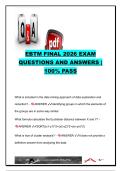
EBTM FINAL 2026 EXAM
QUESTIONS AND ANSWERS |
100% PASS


What is included in the data mining approach of data exploration and

reduction? - ANSWER ✔✔identifying groups in which the elements of

the groups are in some way similar

What formula calculates the Euclidean distance between X and Y? -

ANSWER ✔✔SQRT((x1-y1)^2+(x2-y2)^2+(xn-yn)^2)


What is true of cluster analysis? - ANSWER ✔✔It does not provide a

definitive answer from analyzing the data.

, What is true of hierarchical clustering? - ANSWER ✔✔The data are

not partitioned into a particular cluster in a single step.

In the average linkage clustering, the distance between two clusters is

defined as the average of distances between all pairs of objects, where

each pair is made up of one object from each group. - ANSWER

✔✔True


In what method is the distance between groups defined as the distance

between the closest pair of objects, where only pairs consisting of one

object from each group are considered? - ANSWER ✔✔single

linkage clustering

What is the distance between two clusters in a complete linkage

clustering? - ANSWER ✔✔the distance between the most distant pair

of objects, one from each group

What is the first stage of joining clusters in agglomerative hierarchical

clustering? - ANSWER ✔✔Joining two clusters that are closest to

each other

What is true of divisive clustering methods that makes them different

from agglomerative clustering methods? - ANSWER ✔✔They

separate n objects successively into finer groupings

Información del documento

Subido en
26 de julio de 2026
Número de páginas
9
Escrito en
2025/2026
Tipo
Examen
Contiene
Preguntas y respuestas
$18.99

¿Documento equivocado? Cámbialo gratis Dentro de los 14 días posteriores a la compra y antes de descargarlo, puedes elegir otro documento. Puedes gastar el importe de nuevo.
Escrito por estudiantes que aprobaron
Inmediatamente disponible después del pago
Leer en línea o como PDF

Seller avatar
Los indicadores de reputación están sujetos a la cantidad de artículos vendidos por una tarifa y las reseñas que ha recibido por esos documentos. Hay tres niveles: Bronce, Plata y Oro. Cuanto mayor reputación, más podrás confiar en la calidad del trabajo del vendedor.
NinjaNerd
3.4
(76)
Vendido
396
Seguidores
6
Artículos
15309
Última venta
1 día hace


Por qué los estudiantes eligen Stuvia

Creado por compañeros estudiantes, verificado por reseñas

Calidad en la que puedes confiar: escrito por estudiantes que aprobaron y evaluado por otros que han usado estos resúmenes.

¿No estás satisfecho? Elige otro documento

¡No te preocupes! Puedes elegir directamente otro documento que se ajuste mejor a lo que buscas.

Paga como quieras, empieza a estudiar al instante

Sin suscripción, sin compromisos. Paga como estés acostumbrado con tarjeta de crédito y descarga tu documento PDF inmediatamente.

Student with book image

“Comprado, descargado y aprobado. Así de fácil puede ser.”

Alisha Student

Preguntas frecuentes
