

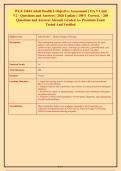
WGU D444 Adult Health 1 Objective Assessment | OA V1 and
V2 - Questions and Answers | 2026 Update | 100% Correct. - 208
Questions and Answers Already Graded A+ Premium Exam
Tested And Verified
Subject Area Adult Health 1 - Medical-Surgical Nursing
Description This examination assesses mastery of evidence-based nursing care for adult
patients with common acute and chronic health conditions, including
cardiovascular, respiratory, renal, neurological, endocrine, gastrointestinal, and
musculoskeletal disorders. Emphasis is placed on clinical reasoning,
pharmacologic management, and the application of current guidelines from the
American Heart Association, American Association of Critical-Care Nurses, and
other national bodies.
Expected Grade A+
Total Questions 208
Duration 3 hours
Learning Outcomes 1. Apply the nursing process to manage care of adults with acute and chronic
illness across the lifespan.
2. Interpret clinical data to prioritize interventions in emergent and non-emergent
situations.
3. Evaluate the impact of pharmacologic, nutritional, and technological therapies
on patient outcomes.
4. Integrate evidence-based guidelines for prevention, diagnosis, and management
of adult health problems.
Accreditation This examination follows the academic standards of the Commission on
Collegiate Nursing Education (CCNE) and the National League for Nursing
(NLN) for baccalaureate nursing programs.
Page 1
,1. A patient with chronic systolic heart failure (LVEF 35%) on metoprolol
succinate presents with acute dyspnea. Vital signs: BP 92/58 mm Hg, HR 54
bpm, respiratory rate 28. Crackles half-way up lung fields. Which intervention
is most appropriate regarding the beta-blocker?
Answer: Withhold the beta-blocker
In acute decompensated heart failure with hemodynamic instability (SBP <
90-100, bradycardia), beta-blockers should be temporarily withheld. Continuing
(A) may worsen hypotension; IV beta-agonist (C) is not indicated; doubling dose
(D) is dangerous.
2. A patient with acute onset left-sided weakness, facial droop, and aphasia.
Last known well 2.5 hours ago. History: hypertension, diabetes, no recent
surgery or bleeding. BP 198/112 mm Hg, glucose 120 mg/dL, INR 1.1. Which
finding contraindicates administration of alteplase?
Answer: Blood pressure 198/112 mm Hg
Elevated blood pressure (systolic >185 or diastolic >110) is a contraindication to
alteplase. Glucose >50 and INR 1.7 are acceptable. Onset within 3 hours is within
window. Other options are not contraindications.
3. A patient with diabetic ketoacidosis (glucose 450 mg/dL, pH 7.2, serum
ketones positive) receives 0.9% normal saline 20 mL/kg over the first hour.
After two hours, glucose is 260 mg/dL. Which adjustment should be made?
Answer: Add D5W to existing NS infusion
When glucose falls to 250 mg/dL, dextrose 5% should be added to IV fluids to
prevent hypoglycemia while continuing insulin until ketoacidosis resolves.
Continuing NS alone (A) risks hypoglycemia; switching to hypotonic saline (B)
without dextrose is not recommended; delaying insulin (D) is inappropriate.
4. A patient with acute pancreatitis reports severe epigastric pain radiating to
the back. Which analgesic is preferred?
Answer: Fentanyl
Fentanyl causes least spasm of the sphincter of Oddi, making it preferred in
pancreatitis. Morphine (A) may exacerbate sphincter spasm. Meperidine (B) is no
longer recommended due to neurotoxicity. Ketorolac (D) may worsen renal
impairment and increase bleeding risk.
Page 2
,5. A patient without thromboembolic risk factors undergoes elective total knee
replacement. According to current AAOS/ACCP guidelines, which
pharmacologic prophylaxis is recommended as first-line?
Answer: Aspirin 325 mg twice daily
For patients with no additional VTE risk factors, AAOS and CHEST recommend
aspirin 325 mg twice daily as an effective and safe option with lower bleeding
risk. Warfarin, enoxaparin, and apixaban are alternatives but not preferred
first-line in low-risk patients.
6. A patient in hypovolemic shock from trauma requires crystalloid
resuscitation. Which fluid is preferred for initial resuscitation?
Answer: Lactated Ringer's solution
Balanced crystalloids (e.g., Lactated Ringer's) are preferred over normal saline
due to lower risk of hyperchloremic metabolic acidosis and acute kidney injury
(SMART trial). D5W (C) is hypotonic and can cause hyponatremia; hypertonic
saline (D) is for specific scenarios like increased intracranial pressure.
7. A patient receiving total parenteral nutrition for 3 days due to bowel
obstruction develops paresthesias, weakness, and confusion. Which lab
abnormality is most likely?
Answer: Hypophosphatemia
Refeeding syndrome, typically occurring 24-72 hours after initiating nutrition in
malnourished patients, is characterized by profound hypophosphatemia due to
cellular uptake. Hyperglycemia (A) is common but not the cause of these
symptoms; hyponatremia (C) and hyperkalemia (D) are not characteristic.
8. A patient on chronic oral morphine 30 mg every 8 hours for cancer pain is
admitted for abdominal surgery. Which postoperative pain management plan
is most appropriate?
Answer: Continue home morphine and add PCA with hydromorphone
In opioid-tolerant patients, baseline opioids should be continued to prevent
withdrawal, and supplemental short-acting opioids (e.g., PCA hydromorphone)
are added for acute pain. Withdrawal (A, C) risks withdrawal and inadequate
control; non-opioids alone (D) are insufficient.
Page 3
, 9. A patient with acute decompensated heart failure presents with a blood
pressure of 90/58 mmHg and cool extremities. Which intervention is most
appropriate?
Answer: Start intravenous dobutamine
In acute decompensated HF with hypotension and hypoperfusion, inotropic
therapy (e.g., dobutamine) is indicated to improve cardiac output. Diuretics may
worsen hypotension; beta-blockers are contraindicated in acute decompensation;
vasodilators are avoided due to low BP.
10. A mechanically ventilated patient with severe ARDS (PaO2/FiO2 100) is at
risk for ventilator-induced lung injury. Which strategy is recommended to
minimize this risk?
Answer: Tidal volume 6 mL/kg ideal body weight with high PEEP
Low tidal volume ventilation (6 mL/kg) and adequate PEEP are lung-protective
strategies proven to reduce mortality in ARDS. Higher tidal volumes cause
volutrauma, and PEEP prevents alveolar collapse.
11. A patient with oliguria has a BUN-to-creatinine ratio of 25:1 and urine
sodium <20 mEq/L. What is the most likely cause of the acute kidney injury?
Answer: Prerenal azotemia
A high BUN:Cr ratio >20 and low urine sodium suggest prerenal etiology due to
hypoperfusion. Acute tubular necrosis typically presents with isosthenuria and
higher urine sodium.
12. In managing diabetic ketoacidosis, after initial fluid resuscitation and
insulin infusion, at what serum potassium level should potassium be added to
intravenous fluids?
Answer: When serum potassium is <5.5 mEq/L
Insulin drives potassium intracellularly, risking hypokalemia. Potassium
replacement is initiated when serum K <5.5 mEq/L (some guidelines use <5.3) to
maintain normal levels, and withheld if K <3.5 until corrected.
Page 4
V2 - Questions and Answers | 2026 Update | 100% Correct. - 208
Questions and Answers Already Graded A+ Premium Exam
Tested And Verified
Subject Area Adult Health 1 - Medical-Surgical Nursing
Description This examination assesses mastery of evidence-based nursing care for adult
patients with common acute and chronic health conditions, including
cardiovascular, respiratory, renal, neurological, endocrine, gastrointestinal, and
musculoskeletal disorders. Emphasis is placed on clinical reasoning,
pharmacologic management, and the application of current guidelines from the
American Heart Association, American Association of Critical-Care Nurses, and
other national bodies.
Expected Grade A+
Total Questions 208
Duration 3 hours
Learning Outcomes 1. Apply the nursing process to manage care of adults with acute and chronic
illness across the lifespan.
2. Interpret clinical data to prioritize interventions in emergent and non-emergent
situations.
3. Evaluate the impact of pharmacologic, nutritional, and technological therapies
on patient outcomes.
4. Integrate evidence-based guidelines for prevention, diagnosis, and management
of adult health problems.
Accreditation This examination follows the academic standards of the Commission on
Collegiate Nursing Education (CCNE) and the National League for Nursing
(NLN) for baccalaureate nursing programs.
Page 1
,1. A patient with chronic systolic heart failure (LVEF 35%) on metoprolol
succinate presents with acute dyspnea. Vital signs: BP 92/58 mm Hg, HR 54
bpm, respiratory rate 28. Crackles half-way up lung fields. Which intervention
is most appropriate regarding the beta-blocker?
Answer: Withhold the beta-blocker
In acute decompensated heart failure with hemodynamic instability (SBP <
90-100, bradycardia), beta-blockers should be temporarily withheld. Continuing
(A) may worsen hypotension; IV beta-agonist (C) is not indicated; doubling dose
(D) is dangerous.
2. A patient with acute onset left-sided weakness, facial droop, and aphasia.
Last known well 2.5 hours ago. History: hypertension, diabetes, no recent
surgery or bleeding. BP 198/112 mm Hg, glucose 120 mg/dL, INR 1.1. Which
finding contraindicates administration of alteplase?
Answer: Blood pressure 198/112 mm Hg
Elevated blood pressure (systolic >185 or diastolic >110) is a contraindication to
alteplase. Glucose >50 and INR 1.7 are acceptable. Onset within 3 hours is within
window. Other options are not contraindications.
3. A patient with diabetic ketoacidosis (glucose 450 mg/dL, pH 7.2, serum
ketones positive) receives 0.9% normal saline 20 mL/kg over the first hour.
After two hours, glucose is 260 mg/dL. Which adjustment should be made?
Answer: Add D5W to existing NS infusion
When glucose falls to 250 mg/dL, dextrose 5% should be added to IV fluids to
prevent hypoglycemia while continuing insulin until ketoacidosis resolves.
Continuing NS alone (A) risks hypoglycemia; switching to hypotonic saline (B)
without dextrose is not recommended; delaying insulin (D) is inappropriate.
4. A patient with acute pancreatitis reports severe epigastric pain radiating to
the back. Which analgesic is preferred?
Answer: Fentanyl
Fentanyl causes least spasm of the sphincter of Oddi, making it preferred in
pancreatitis. Morphine (A) may exacerbate sphincter spasm. Meperidine (B) is no
longer recommended due to neurotoxicity. Ketorolac (D) may worsen renal
impairment and increase bleeding risk.
Page 2
,5. A patient without thromboembolic risk factors undergoes elective total knee
replacement. According to current AAOS/ACCP guidelines, which
pharmacologic prophylaxis is recommended as first-line?
Answer: Aspirin 325 mg twice daily
For patients with no additional VTE risk factors, AAOS and CHEST recommend
aspirin 325 mg twice daily as an effective and safe option with lower bleeding
risk. Warfarin, enoxaparin, and apixaban are alternatives but not preferred
first-line in low-risk patients.
6. A patient in hypovolemic shock from trauma requires crystalloid
resuscitation. Which fluid is preferred for initial resuscitation?
Answer: Lactated Ringer's solution
Balanced crystalloids (e.g., Lactated Ringer's) are preferred over normal saline
due to lower risk of hyperchloremic metabolic acidosis and acute kidney injury
(SMART trial). D5W (C) is hypotonic and can cause hyponatremia; hypertonic
saline (D) is for specific scenarios like increased intracranial pressure.
7. A patient receiving total parenteral nutrition for 3 days due to bowel
obstruction develops paresthesias, weakness, and confusion. Which lab
abnormality is most likely?
Answer: Hypophosphatemia
Refeeding syndrome, typically occurring 24-72 hours after initiating nutrition in
malnourished patients, is characterized by profound hypophosphatemia due to
cellular uptake. Hyperglycemia (A) is common but not the cause of these
symptoms; hyponatremia (C) and hyperkalemia (D) are not characteristic.
8. A patient on chronic oral morphine 30 mg every 8 hours for cancer pain is
admitted for abdominal surgery. Which postoperative pain management plan
is most appropriate?
Answer: Continue home morphine and add PCA with hydromorphone
In opioid-tolerant patients, baseline opioids should be continued to prevent
withdrawal, and supplemental short-acting opioids (e.g., PCA hydromorphone)
are added for acute pain. Withdrawal (A, C) risks withdrawal and inadequate
control; non-opioids alone (D) are insufficient.
Page 3
, 9. A patient with acute decompensated heart failure presents with a blood
pressure of 90/58 mmHg and cool extremities. Which intervention is most
appropriate?
Answer: Start intravenous dobutamine
In acute decompensated HF with hypotension and hypoperfusion, inotropic
therapy (e.g., dobutamine) is indicated to improve cardiac output. Diuretics may
worsen hypotension; beta-blockers are contraindicated in acute decompensation;
vasodilators are avoided due to low BP.
10. A mechanically ventilated patient with severe ARDS (PaO2/FiO2 100) is at
risk for ventilator-induced lung injury. Which strategy is recommended to
minimize this risk?
Answer: Tidal volume 6 mL/kg ideal body weight with high PEEP
Low tidal volume ventilation (6 mL/kg) and adequate PEEP are lung-protective
strategies proven to reduce mortality in ARDS. Higher tidal volumes cause
volutrauma, and PEEP prevents alveolar collapse.
11. A patient with oliguria has a BUN-to-creatinine ratio of 25:1 and urine
sodium <20 mEq/L. What is the most likely cause of the acute kidney injury?
Answer: Prerenal azotemia
A high BUN:Cr ratio >20 and low urine sodium suggest prerenal etiology due to
hypoperfusion. Acute tubular necrosis typically presents with isosthenuria and
higher urine sodium.
12. In managing diabetic ketoacidosis, after initial fluid resuscitation and
insulin infusion, at what serum potassium level should potassium be added to
intravenous fluids?
Answer: When serum potassium is <5.5 mEq/L
Insulin drives potassium intracellularly, risking hypokalemia. Potassium
replacement is initiated when serum K <5.5 mEq/L (some guidelines use <5.3) to
maintain normal levels, and withheld if K <3.5 until corrected.
Page 4

