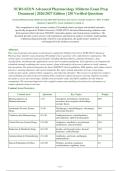
NURS 6521N Advanced Pharmacology Midterm Exam Prep
Document | 2026/2027 Edition | 250 Verified Questions
Advanced Pharmacology Midterm Exam 2026-2027 Questions and Answers Already Graded A+. 100% Verified
Solutions | Updated Per Latest Guidelines | Graded A+
This comprehensive study resource contains 250 multiple-choice questions with detailed rationales,
specifically designed for Walden University's NURS 6521N Advanced Pharmacology midterm exam.
Each question reflects the latest 2026/2027 curriculum updates and clinical practice guidelines. The
document provides correct answers with explanations and distractor analyses to enhance understanding
of pharmacological principles. Ideal for exam preparation, this guide ensures students are
well-prepared for the midterm assessment.
Abstract:
This exam preparation document is meticulously compiled for Walden University's NURS 6521N Advanced
Pharmacology midterm exam, featuring 250 multiple-choice questions with comprehensive explanations. The
content spans core pharmacological principles including pharmacokinetics, pharmacodynamics, drug
classifications, and therapeutic applications across diverse patient populations. Each question is accompanied by
a detailed rationale explaining the correct answer, along with analysis of incorrect options to clarify common
misconceptions. The material integrates the latest 2026/2027 clinical guidelines, FDA updates, and evidence-based
practices, ensuring alignment with current standards. Key topics include autonomic nervous system drugs,
cardiovascular agents, antimicrobials, analgesics, and endocrine therapies. This resource is designed to reinforce
critical thinking and clinical decision-making skills essential for advanced practice nursing. Students can utilize
this guide to assess their knowledge, identify areas for further study, and build confidence for the midterm
examination. The structured approach with weighted content areas facilitates focused review and mastery of
complex pharmacological concepts.
Content Area Overview:
Content Area Questions Key Topics Weight
Pharmacokinetics & 1-50 Absorption, distribution, metabolism, 20%
Pharmacodynamics excretion; dose-response relationships;
receptor theory
Autonomic Nervous System 51-90 Cholinergics, anticholinergics, adrenergics, 16%
Drugs adrenergic blockers
Cardiovascular Pharmacology 91-140 Antihypertensives, antiarrhythmics, 20%
anticoagulants, lipid-lowering agents
Central Nervous System Drugs 141-180 Analgesics, anesthetics, psychotropic 16%
medications, anticonvulsants
Endocrine & Metabolic Drugs 181-210 Insulin, oral hypoglycemics, thyroid 12%
hormones, corticosteroids
Antimicrobials & Chemotherapy 211-240 Antibiotics, antivirals, antifungals, 12%
antineoplastics
Special Populations & Ethics 241-250 Pediatric, geriatric, pregnancy 4%
considerations; regulatory issues
Page 1
,Q1. A patient with hypoalbuminemia is prescribed a drug that is 99% protein-bound with a volume
of distribution (Vd) of 5 L. Which pharmacokinetic change is expected initially?
A. Decreased peak concentration and prolonged half-life
B. Increased free fraction and increased volume of distribution
C. Reduced clearance and increased risk of toxicity
D. No change in free fraction due to rapid redistribution
Correct Answer: B. Increased free fraction and increased volume of distribution
Rationale: Hypoalbuminemia reduces protein binding, increasing the free fraction of the drug. Since the
drug has a low Vd, more free drug distributes out, increasing Vd. This initially increases the free fraction
available for action and elimination, potentially altering half-life. Option B correctly describes increased
free fraction and Vd.
Why Wrong:
A - Peak concentration may initially increase due to reduced binding, and half-life may change
unpredictably, not necessarily prolonged.
C - Clearance may increase initially with higher free fraction, not reduce; toxicity risk may increase
but the primary initial effect is distribution.
D - Free fraction increases significantly, and redistribution does not nullify this effect.
Reference: Lehne, R.A. (2026). Pharmacology for Nursing Care, 12th Ed., Ch. 4
Q2. Two drugs, X and Y, produce the same maximal response. Drug X has an ED50 of 10 mg and
Drug Y has an ED50 of 50 mg. Which statement is correct?
A. Drug X is more potent but not necessarily safer.
B. Drug Y has greater intrinsic activity.
C. Drug X has a higher therapeutic index.
D. Drug Y is more efficacious at low doses.
Correct Answer: A. Drug X is more potent but not necessarily safer.
Rationale: Potency refers to the dose required to produce a given effect; a lower ED50 indicates higher
potency. Both drugs have the same efficacy (maximal response). Safety (therapeutic index) is not
determined by potency. Option A is correct: Drug X is more potent, but potency does not predict safety.
Why Wrong:
B - Intrinsic activity relates to efficacy, and since both achieve the same maximal response, their
intrinsic activities are equal.
C - Therapeutic index is the ratio of toxic to effective doses; ED50 alone does not indicate safety.
D - At low doses, Drug Y is less effective due to lower potency; both have equal efficacy at
maximum.
Reference: Lehne, R.A. (2026). Pharmacology for Nursing Care, 12th Ed., Ch. 3
Page 2
,Q3. A patient with open-angle glaucoma has inadequate intraocular pressure (IOP) reduction on a
topical beta-blocker. Which additive mechanism would most effectively lower IOP by directly
increasing uveoscleral outflow?
A. Cholinergic agonist (e.g., pilocarpine)
B. Prostaglandin analog (e.g., latanoprost)
C. Alpha-2 adrenergic agonist (e.g., brimonidine)
D. Carbonic anhydrase inhibitor (e.g., dorzolamide)
Correct Answer: B. Prostaglandin analog (e.g., latanoprost)
Rationale: Prostaglandin analogs (e.g., latanoprost) lower IOP primarily by increasing uveoscleral
outflow. Cholinergic agonists increase trabecular outflow, alpha-2 agonists decrease aqueous humor
production and increase uveoscleral outflow but not as potently as prostaglandins, and carbonic
anhydrase inhibitors decrease production.
Why Wrong:
A - Pilocarpine increases trabecular outflow, not uveoscleral.
C - Brimonidine has a dual mechanism but is less effective on uveoscleral outflow than
prostaglandins.
D - Dorzolamide decreases aqueous humor production, not outflow.
Reference: Lehne, R.A. (2026). Pharmacology for Nursing Care, 12th Ed., Ch. 21
Q4. A patient with heart failure with reduced ejection fraction (HFrEF) is already on an ACE
inhibitor, beta-blocker, and spironolactone. Despite optimal dosing, symptoms persist. Which
addition is guideline-directed for further morbidity and mortality reduction?
A. Digoxin
B. Ivabradine
C. Sacubitril/valsartan
D. Hydralazine/isosorbide dinitrate
Correct Answer: B. Ivabradine
Rationale: In HFrEF patients on standard triple therapy who remain symptomatic, ivabradine is
recommended if heart rate is 70 bpm and sinus rhythm. Sacubitril/valsartan replaces ACE inhibitor, not
added. Digoxin may reduce symptoms but not mortality. Hydralazine/isosorbide dinitrate is for African
Americans or if ACE/ARB not tolerated.
Why Wrong:
A - Digoxin improves symptoms but has no clear mortality benefit.
C - Sacubitril/valsartan should replace ACE inhibitor, not be added.
D - Hydralazine/isosorbide dinitrate is a second-line alternative, not first addition when on
ACE/ARB.
Reference: Yancy, C.W. et al. (2026). ACC/AHA/HFSA Heart Failure Guidelines Update
Page 3
, Q5. A patient with Parkinson's disease experiences wearing-off phenomena with
levodopa/carbidopa. Which adjunctive therapy reduces levodopa metabolism by inhibiting
catechol-O-methyltransferase (COMT) in peripheral tissues?
A. Selegiline
B. Entacapone
C. Ropinirole
D. Amantadine
Correct Answer: B. Entacapone
Rationale: Entacapone is a COMT inhibitor that reduces peripheral metabolism of levodopa, increasing
its central availability and reducing off time. Selegiline is an MAO-B inhibitor, ropinirole is a dopamine
agonist, and amantadine increases dopamine release; they do not primarily alter levodopa metabolism
via COMT.
Why Wrong:
A - Selegiline inhibits MAO-B, not COMT.
C - Ropinirole is a dopamine agonist, not a COMT inhibitor.
D - Amantadine has anticholinergic and glutamate-blocking effects, not COMT inhibition.
Reference: Lehne, R.A. (2026). Pharmacology for Nursing Care, 12th Ed., Ch. 29
Q6. A patient with MRSA osteomyelitis has a creatinine clearance of 35 mL/min. Which antibiotic
requires careful dose adjustment and monitoring due to its primarily renal elimination and
association with nephrotoxicity?
A. Linezolid
B. Vancomycin
C. Daptomycin
D. Ceftaroline
Correct Answer: B. Vancomycin
Rationale: Vancomycin is primarily excreted renally and is nephrotoxic; dose adjustment is required in
renal impairment. Linezolid is non-renal clearance, daptomycin requires dose adjustment but is less
nephrotoxic, and ceftaroline also requires adjustment but vancomycin is the classic example with
nephrotoxicity concern.
Why Wrong:
A - Linezolid is eliminated by non-renal mechanisms and does not require significant renal dose
adjustment.
C - Daptomycin is renally excreted but associated with myopathy, not primarily nephrotoxicity.
D - Ceftaroline is renally excreted but has a better renal safety profile than vancomycin.
Reference: Lehne, R.A. (2026). Pharmacology for Nursing Care, 12th Ed., Ch. 88
Page 4
Document | 2026/2027 Edition | 250 Verified Questions
Advanced Pharmacology Midterm Exam 2026-2027 Questions and Answers Already Graded A+. 100% Verified
Solutions | Updated Per Latest Guidelines | Graded A+
This comprehensive study resource contains 250 multiple-choice questions with detailed rationales,
specifically designed for Walden University's NURS 6521N Advanced Pharmacology midterm exam.
Each question reflects the latest 2026/2027 curriculum updates and clinical practice guidelines. The
document provides correct answers with explanations and distractor analyses to enhance understanding
of pharmacological principles. Ideal for exam preparation, this guide ensures students are
well-prepared for the midterm assessment.
Abstract:
This exam preparation document is meticulously compiled for Walden University's NURS 6521N Advanced
Pharmacology midterm exam, featuring 250 multiple-choice questions with comprehensive explanations. The
content spans core pharmacological principles including pharmacokinetics, pharmacodynamics, drug
classifications, and therapeutic applications across diverse patient populations. Each question is accompanied by
a detailed rationale explaining the correct answer, along with analysis of incorrect options to clarify common
misconceptions. The material integrates the latest 2026/2027 clinical guidelines, FDA updates, and evidence-based
practices, ensuring alignment with current standards. Key topics include autonomic nervous system drugs,
cardiovascular agents, antimicrobials, analgesics, and endocrine therapies. This resource is designed to reinforce
critical thinking and clinical decision-making skills essential for advanced practice nursing. Students can utilize
this guide to assess their knowledge, identify areas for further study, and build confidence for the midterm
examination. The structured approach with weighted content areas facilitates focused review and mastery of
complex pharmacological concepts.
Content Area Overview:
Content Area Questions Key Topics Weight
Pharmacokinetics & 1-50 Absorption, distribution, metabolism, 20%
Pharmacodynamics excretion; dose-response relationships;
receptor theory
Autonomic Nervous System 51-90 Cholinergics, anticholinergics, adrenergics, 16%
Drugs adrenergic blockers
Cardiovascular Pharmacology 91-140 Antihypertensives, antiarrhythmics, 20%
anticoagulants, lipid-lowering agents
Central Nervous System Drugs 141-180 Analgesics, anesthetics, psychotropic 16%
medications, anticonvulsants
Endocrine & Metabolic Drugs 181-210 Insulin, oral hypoglycemics, thyroid 12%
hormones, corticosteroids
Antimicrobials & Chemotherapy 211-240 Antibiotics, antivirals, antifungals, 12%
antineoplastics
Special Populations & Ethics 241-250 Pediatric, geriatric, pregnancy 4%
considerations; regulatory issues
Page 1
,Q1. A patient with hypoalbuminemia is prescribed a drug that is 99% protein-bound with a volume
of distribution (Vd) of 5 L. Which pharmacokinetic change is expected initially?
A. Decreased peak concentration and prolonged half-life
B. Increased free fraction and increased volume of distribution
C. Reduced clearance and increased risk of toxicity
D. No change in free fraction due to rapid redistribution
Correct Answer: B. Increased free fraction and increased volume of distribution
Rationale: Hypoalbuminemia reduces protein binding, increasing the free fraction of the drug. Since the
drug has a low Vd, more free drug distributes out, increasing Vd. This initially increases the free fraction
available for action and elimination, potentially altering half-life. Option B correctly describes increased
free fraction and Vd.
Why Wrong:
A - Peak concentration may initially increase due to reduced binding, and half-life may change
unpredictably, not necessarily prolonged.
C - Clearance may increase initially with higher free fraction, not reduce; toxicity risk may increase
but the primary initial effect is distribution.
D - Free fraction increases significantly, and redistribution does not nullify this effect.
Reference: Lehne, R.A. (2026). Pharmacology for Nursing Care, 12th Ed., Ch. 4
Q2. Two drugs, X and Y, produce the same maximal response. Drug X has an ED50 of 10 mg and
Drug Y has an ED50 of 50 mg. Which statement is correct?
A. Drug X is more potent but not necessarily safer.
B. Drug Y has greater intrinsic activity.
C. Drug X has a higher therapeutic index.
D. Drug Y is more efficacious at low doses.
Correct Answer: A. Drug X is more potent but not necessarily safer.
Rationale: Potency refers to the dose required to produce a given effect; a lower ED50 indicates higher
potency. Both drugs have the same efficacy (maximal response). Safety (therapeutic index) is not
determined by potency. Option A is correct: Drug X is more potent, but potency does not predict safety.
Why Wrong:
B - Intrinsic activity relates to efficacy, and since both achieve the same maximal response, their
intrinsic activities are equal.
C - Therapeutic index is the ratio of toxic to effective doses; ED50 alone does not indicate safety.
D - At low doses, Drug Y is less effective due to lower potency; both have equal efficacy at
maximum.
Reference: Lehne, R.A. (2026). Pharmacology for Nursing Care, 12th Ed., Ch. 3
Page 2
,Q3. A patient with open-angle glaucoma has inadequate intraocular pressure (IOP) reduction on a
topical beta-blocker. Which additive mechanism would most effectively lower IOP by directly
increasing uveoscleral outflow?
A. Cholinergic agonist (e.g., pilocarpine)
B. Prostaglandin analog (e.g., latanoprost)
C. Alpha-2 adrenergic agonist (e.g., brimonidine)
D. Carbonic anhydrase inhibitor (e.g., dorzolamide)
Correct Answer: B. Prostaglandin analog (e.g., latanoprost)
Rationale: Prostaglandin analogs (e.g., latanoprost) lower IOP primarily by increasing uveoscleral
outflow. Cholinergic agonists increase trabecular outflow, alpha-2 agonists decrease aqueous humor
production and increase uveoscleral outflow but not as potently as prostaglandins, and carbonic
anhydrase inhibitors decrease production.
Why Wrong:
A - Pilocarpine increases trabecular outflow, not uveoscleral.
C - Brimonidine has a dual mechanism but is less effective on uveoscleral outflow than
prostaglandins.
D - Dorzolamide decreases aqueous humor production, not outflow.
Reference: Lehne, R.A. (2026). Pharmacology for Nursing Care, 12th Ed., Ch. 21
Q4. A patient with heart failure with reduced ejection fraction (HFrEF) is already on an ACE
inhibitor, beta-blocker, and spironolactone. Despite optimal dosing, symptoms persist. Which
addition is guideline-directed for further morbidity and mortality reduction?
A. Digoxin
B. Ivabradine
C. Sacubitril/valsartan
D. Hydralazine/isosorbide dinitrate
Correct Answer: B. Ivabradine
Rationale: In HFrEF patients on standard triple therapy who remain symptomatic, ivabradine is
recommended if heart rate is 70 bpm and sinus rhythm. Sacubitril/valsartan replaces ACE inhibitor, not
added. Digoxin may reduce symptoms but not mortality. Hydralazine/isosorbide dinitrate is for African
Americans or if ACE/ARB not tolerated.
Why Wrong:
A - Digoxin improves symptoms but has no clear mortality benefit.
C - Sacubitril/valsartan should replace ACE inhibitor, not be added.
D - Hydralazine/isosorbide dinitrate is a second-line alternative, not first addition when on
ACE/ARB.
Reference: Yancy, C.W. et al. (2026). ACC/AHA/HFSA Heart Failure Guidelines Update
Page 3
, Q5. A patient with Parkinson's disease experiences wearing-off phenomena with
levodopa/carbidopa. Which adjunctive therapy reduces levodopa metabolism by inhibiting
catechol-O-methyltransferase (COMT) in peripheral tissues?
A. Selegiline
B. Entacapone
C. Ropinirole
D. Amantadine
Correct Answer: B. Entacapone
Rationale: Entacapone is a COMT inhibitor that reduces peripheral metabolism of levodopa, increasing
its central availability and reducing off time. Selegiline is an MAO-B inhibitor, ropinirole is a dopamine
agonist, and amantadine increases dopamine release; they do not primarily alter levodopa metabolism
via COMT.
Why Wrong:
A - Selegiline inhibits MAO-B, not COMT.
C - Ropinirole is a dopamine agonist, not a COMT inhibitor.
D - Amantadine has anticholinergic and glutamate-blocking effects, not COMT inhibition.
Reference: Lehne, R.A. (2026). Pharmacology for Nursing Care, 12th Ed., Ch. 29
Q6. A patient with MRSA osteomyelitis has a creatinine clearance of 35 mL/min. Which antibiotic
requires careful dose adjustment and monitoring due to its primarily renal elimination and
association with nephrotoxicity?
A. Linezolid
B. Vancomycin
C. Daptomycin
D. Ceftaroline
Correct Answer: B. Vancomycin
Rationale: Vancomycin is primarily excreted renally and is nephrotoxic; dose adjustment is required in
renal impairment. Linezolid is non-renal clearance, daptomycin requires dose adjustment but is less
nephrotoxic, and ceftaroline also requires adjustment but vancomycin is the classic example with
nephrotoxicity concern.
Why Wrong:
A - Linezolid is eliminated by non-renal mechanisms and does not require significant renal dose
adjustment.
C - Daptomycin is renally excreted but associated with myopathy, not primarily nephrotoxicity.
D - Ceftaroline is renally excreted but has a better renal safety profile than vancomycin.
Reference: Lehne, R.A. (2026). Pharmacology for Nursing Care, 12th Ed., Ch. 88
Page 4