

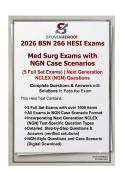
, BSN 266 HESI MED-SURG PRACTICE EXAM
NGN-Style Case Scenarios & Questions
Updated for 2026 | 200 Questions with Answers &
Expert Rationales
EXAM STRUCTURE
This comprehensive practice exam is designed to mirror
the BSN 266 HESI Medical-Surgical
Examination with Next Generation NCLEX (NGN)-
style questions. The exam includes:
• Case Scenarios with multiple question types
• Multiple Choice questions
• Select All That Apply (SATA)
• Drag and Drop (Cloze) items
• Matrix/Grid questions
• Prioritization and Delegation items
Content Areas Covered:
• Cardiovascular System
• Respiratory System
• Endocrine System
,• Renal/Urinary System
• Gastrointestinal System
• Neurological System
• Musculoskeletal System
• Hematological/Immunological Systems
• Fluid & Electrolyte Balance
• Infection Control & Sepsis
• Perioperative & Postoperative Care
• Pain Management
• Prioritization & Clinical Judgment
SECTION 1: CARDIOVASCULAR SYSTEM (Questions 1-
35)
CASE SCENARIO 1: Decompensated Heart Failure
(HFrEF)
Patient Presentation: Mr. J.T., 68 years old, is admitted
with worsening shortness of breath, orthopnea (needs 4
pillows to sleep), and 3+ pitting edema in both legs. He
has gained 8 lbs in the past 5 days. Past medical history:
hypertension, type 2 diabetes, CKD stage 3. Vital signs: HR
112 bpm (irregular), BP 158/92 mm Hg, RR 28 breaths/min,
, SpO2 88% on room air. Lungs have crackles bilaterally in
the bases. ECG shows atrial fibrillation. BNP > 1800 pg/mL.
Question 1 (NGN – Prioritization)
Which intervention should the nurse implement FIRST?
A) Administer furosemide 40 mg IV push as prescribed
B) Place the patient in high-Fowler's position
C) Apply oxygen at 2 L/min via nasal cannula
D) Obtain a stat chest x-ray
Answer: B
Expert Rationale: The priority is airway and breathing.
High-Fowler's position uses gravity to reduce venous
return, decrease pulmonary congestion, and improve gas
exchange immediately—before oxygen or diuretics can
take effect. Oxygen can be applied simultaneously, but
positioning is the fastest intervention to improve
ventilation.
Question 2 (NGN – Recognizing Cues)
NGN-Style Case Scenarios & Questions
Updated for 2026 | 200 Questions with Answers &
Expert Rationales
EXAM STRUCTURE
This comprehensive practice exam is designed to mirror
the BSN 266 HESI Medical-Surgical
Examination with Next Generation NCLEX (NGN)-
style questions. The exam includes:
• Case Scenarios with multiple question types
• Multiple Choice questions
• Select All That Apply (SATA)
• Drag and Drop (Cloze) items
• Matrix/Grid questions
• Prioritization and Delegation items
Content Areas Covered:
• Cardiovascular System
• Respiratory System
• Endocrine System
,• Renal/Urinary System
• Gastrointestinal System
• Neurological System
• Musculoskeletal System
• Hematological/Immunological Systems
• Fluid & Electrolyte Balance
• Infection Control & Sepsis
• Perioperative & Postoperative Care
• Pain Management
• Prioritization & Clinical Judgment
SECTION 1: CARDIOVASCULAR SYSTEM (Questions 1-
35)
CASE SCENARIO 1: Decompensated Heart Failure
(HFrEF)
Patient Presentation: Mr. J.T., 68 years old, is admitted
with worsening shortness of breath, orthopnea (needs 4
pillows to sleep), and 3+ pitting edema in both legs. He
has gained 8 lbs in the past 5 days. Past medical history:
hypertension, type 2 diabetes, CKD stage 3. Vital signs: HR
112 bpm (irregular), BP 158/92 mm Hg, RR 28 breaths/min,
, SpO2 88% on room air. Lungs have crackles bilaterally in
the bases. ECG shows atrial fibrillation. BNP > 1800 pg/mL.
Question 1 (NGN – Prioritization)
Which intervention should the nurse implement FIRST?
A) Administer furosemide 40 mg IV push as prescribed
B) Place the patient in high-Fowler's position
C) Apply oxygen at 2 L/min via nasal cannula
D) Obtain a stat chest x-ray
Answer: B
Expert Rationale: The priority is airway and breathing.
High-Fowler's position uses gravity to reduce venous
return, decrease pulmonary congestion, and improve gas
exchange immediately—before oxygen or diuretics can
take effect. Oxygen can be applied simultaneously, but
positioning is the fastest intervention to improve
ventilation.
Question 2 (NGN – Recognizing Cues)

