
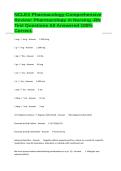
NCLEX Pharmacology-Comprehensive
Review: Pharmacology in Nursing -RN
Test Questions All Answered 100%
Correct.
1 mg = ? mcg - Answer 1,000 mcg
1 g = ? mg - Answer 1,000 mg
1 kg = ? lbs - Answer 2.2 lbs
1 gr = ? mg - Answer 60 mg
1 oz = ? mL - Answer 30 mL
1 L = ? mL - Answer 1,000 mL
1 tsp = ? mL - Answer 5 mL
1 tbsp = ? mL - Answer 15 mL
1 tbsp = ? tsp - Answer 3 tsp
37.0 degrees Celsius = ? degrees Fahrenheit - Answer 98.6 degrees Fahrenheit
Formula to find Celsius - Answer C=(F-32)x(5/9)
Formula to find Fahrenheit - Answer F=(Cx9/5)+32
Adverse Reaction - Answer Negative effects experienced by a client as a result of a specific
medication; may be hazardous, tolerated, or subside with continued use
RN must assess before administering medications to a pt. (3) - Answer 1. Allergies and
adverse effects
,2. Current medication regimen for potential interactions
3. Physiologic status compared to baseline assessment data
6 Rights of Medication Administration - Answer 1. Right client
2. Right medication
3. Right dose
4. Right time
5. Right route
6. Right documentation
Average time to draw peak levels: Oral (PO) - Answer 1-2 hours after administration
Average time to draw peak levels: Intramuscular (IM) - Answer 1 hour after administration
Average time to draw peak levels: Intravenous (IV) - Answer 30 minutes
Trough Level - Answer Reflect the lowest concentration or residual level and are usually
obtained within 15 minutes prior to administration of the next scheduled dose
Culture and Sensitivity - Answer Cultures are obtained to detect the presence of pathogens
within the specimen collected. If a culture produces organisms, testing is performed in the
laboratory to identify the appropriate antibiotic therapy. Begin antibiotic therapy after obtaining
lab sample.
Guidelines for Safe IV Administration (5) - Answer 1. Review medication guidelines for
precautions related to IV administration for compatibility, rate of admin., necessity of infusion
pump, and serious adverse reactions
2. Never administer medications through tubing being used for blood administration
3. Implement standard precautions when performing and IV site change
4. Fluids should be infused within 24 hours to prevent infection (discard unused portion)
5. Maintain patency of IV access
Prevent Infiltration of IV site (3) - Answer 1. Use smallest catheter for prescribed therapy
2. Stabilize port-access
3. Assess blood return
Treatment for Infiltrated IV (5) - Answer 1. Stop infusion
,2. Remove peripheral catheters
3. Apply cold compress
4. Elevate extremity
5. Insert new catheter into opposite extremity
Prevent Extravasation of IV (1) - Answer 1. Know vesicant potential before giving med.
Treatment for Extravasated IV (5) - Answer 1. Stop infusion
2. Discontinue administration set
3. Aspirate drug if possible
4. Apply cold compress
5. Document condition of site (may photograph)
Infiltration - Answer When IV fluid or medication leaks into surrounding tissue
Extravasation - Answer Leakage of IV fluid or medication into the extravascular tissue around
the site of infusion
Phlebitis/Thrombophlebitis - Answer Inflammatory process that causes a blood clot to form
able block one or more vein
Prevent Phlebitis/Thrombophlebitis (3) - Answer 1. Rotate site every 72h-96h
2. Secure catheter
3. Use aseptic technique
Treatment for Phlebitis/Thrombophlebitis at IV site (4) - Answer 1. Stop infusion
2. Remove peripheral catheters
3. Apply heat compress
4. Insert new catheter in opposite extremity
Hematoma - Answer Localized bleeding outside of blood vessels
Prevent Hematoma at IV site (2) - Answer 1. Avoid veins not easily seen or palpated
2. Obtain hemostasis after insertion
, Treatment for Hematoma at IV site (3) - Answer 1. Remove IV device
2. Apply light pressure if bleeding
3. Monitor for signs of phlebitis
Prevention of IV Catheter Embolus (1) - Answer 1. Do not reinsert stylet needle into catheter
Treatment of IV Catheter Embolus (2) - Answer 1. Immediately apply tourniquet high on
extremity to limit venous flow
2. Prepare for removal under X-ray
Treatment of Air Embolism in Central Venous Catheter (2) - Answer 1. Place client in left
lateral Trendelenburg position
2. Administer oxygen
Treatment of Lumen Occlusion in Central Venous Catheter - Answer Use 10mL syringe with a
pulsing motion
Treatment of Bloodstream Infection in Central Venous Catheter (4) - Answer 1. Change entire
infusion system
2. Notify provider
3. Obtain cultures
4. Administer antibiotics
Intervention of Catheter Occlusions in PICC Line (5) - Answer 1. Prevent kinks
2. Reposition arm
3. Confirm blood return
4. Flush catheter between meds.
5. Administer approved Antithrombolytic
Intervention for Dislodged Catheter in PICC Line (3) - Answer 1. Assess blood return
2. Assess for discomfort in jaw, chest, or ears
3. Contact provider
Total Parenteral Nutrition (TPN) - Answer Hypertonic solution containing dextrose, proteins,
electrolytes, minerals, trace elements, and insulin prescribed according to the client's needs and
administered via central venous device (PICC Line, Subclavian, or Internal Jugular Vein)|
c
Review: Pharmacology in Nursing -RN
Test Questions All Answered 100%
Correct.
1 mg = ? mcg - Answer 1,000 mcg
1 g = ? mg - Answer 1,000 mg
1 kg = ? lbs - Answer 2.2 lbs
1 gr = ? mg - Answer 60 mg
1 oz = ? mL - Answer 30 mL
1 L = ? mL - Answer 1,000 mL
1 tsp = ? mL - Answer 5 mL
1 tbsp = ? mL - Answer 15 mL
1 tbsp = ? tsp - Answer 3 tsp
37.0 degrees Celsius = ? degrees Fahrenheit - Answer 98.6 degrees Fahrenheit
Formula to find Celsius - Answer C=(F-32)x(5/9)
Formula to find Fahrenheit - Answer F=(Cx9/5)+32
Adverse Reaction - Answer Negative effects experienced by a client as a result of a specific
medication; may be hazardous, tolerated, or subside with continued use
RN must assess before administering medications to a pt. (3) - Answer 1. Allergies and
adverse effects
,2. Current medication regimen for potential interactions
3. Physiologic status compared to baseline assessment data
6 Rights of Medication Administration - Answer 1. Right client
2. Right medication
3. Right dose
4. Right time
5. Right route
6. Right documentation
Average time to draw peak levels: Oral (PO) - Answer 1-2 hours after administration
Average time to draw peak levels: Intramuscular (IM) - Answer 1 hour after administration
Average time to draw peak levels: Intravenous (IV) - Answer 30 minutes
Trough Level - Answer Reflect the lowest concentration or residual level and are usually
obtained within 15 minutes prior to administration of the next scheduled dose
Culture and Sensitivity - Answer Cultures are obtained to detect the presence of pathogens
within the specimen collected. If a culture produces organisms, testing is performed in the
laboratory to identify the appropriate antibiotic therapy. Begin antibiotic therapy after obtaining
lab sample.
Guidelines for Safe IV Administration (5) - Answer 1. Review medication guidelines for
precautions related to IV administration for compatibility, rate of admin., necessity of infusion
pump, and serious adverse reactions
2. Never administer medications through tubing being used for blood administration
3. Implement standard precautions when performing and IV site change
4. Fluids should be infused within 24 hours to prevent infection (discard unused portion)
5. Maintain patency of IV access
Prevent Infiltration of IV site (3) - Answer 1. Use smallest catheter for prescribed therapy
2. Stabilize port-access
3. Assess blood return
Treatment for Infiltrated IV (5) - Answer 1. Stop infusion
,2. Remove peripheral catheters
3. Apply cold compress
4. Elevate extremity
5. Insert new catheter into opposite extremity
Prevent Extravasation of IV (1) - Answer 1. Know vesicant potential before giving med.
Treatment for Extravasated IV (5) - Answer 1. Stop infusion
2. Discontinue administration set
3. Aspirate drug if possible
4. Apply cold compress
5. Document condition of site (may photograph)
Infiltration - Answer When IV fluid or medication leaks into surrounding tissue
Extravasation - Answer Leakage of IV fluid or medication into the extravascular tissue around
the site of infusion
Phlebitis/Thrombophlebitis - Answer Inflammatory process that causes a blood clot to form
able block one or more vein
Prevent Phlebitis/Thrombophlebitis (3) - Answer 1. Rotate site every 72h-96h
2. Secure catheter
3. Use aseptic technique
Treatment for Phlebitis/Thrombophlebitis at IV site (4) - Answer 1. Stop infusion
2. Remove peripheral catheters
3. Apply heat compress
4. Insert new catheter in opposite extremity
Hematoma - Answer Localized bleeding outside of blood vessels
Prevent Hematoma at IV site (2) - Answer 1. Avoid veins not easily seen or palpated
2. Obtain hemostasis after insertion
, Treatment for Hematoma at IV site (3) - Answer 1. Remove IV device
2. Apply light pressure if bleeding
3. Monitor for signs of phlebitis
Prevention of IV Catheter Embolus (1) - Answer 1. Do not reinsert stylet needle into catheter
Treatment of IV Catheter Embolus (2) - Answer 1. Immediately apply tourniquet high on
extremity to limit venous flow
2. Prepare for removal under X-ray
Treatment of Air Embolism in Central Venous Catheter (2) - Answer 1. Place client in left
lateral Trendelenburg position
2. Administer oxygen
Treatment of Lumen Occlusion in Central Venous Catheter - Answer Use 10mL syringe with a
pulsing motion
Treatment of Bloodstream Infection in Central Venous Catheter (4) - Answer 1. Change entire
infusion system
2. Notify provider
3. Obtain cultures
4. Administer antibiotics
Intervention of Catheter Occlusions in PICC Line (5) - Answer 1. Prevent kinks
2. Reposition arm
3. Confirm blood return
4. Flush catheter between meds.
5. Administer approved Antithrombolytic
Intervention for Dislodged Catheter in PICC Line (3) - Answer 1. Assess blood return
2. Assess for discomfort in jaw, chest, or ears
3. Contact provider
Total Parenteral Nutrition (TPN) - Answer Hypertonic solution containing dextrose, proteins,
electrolytes, minerals, trace elements, and insulin prescribed according to the client's needs and
administered via central venous device (PICC Line, Subclavian, or Internal Jugular Vein)|
c

