

CHAMBERLAIN
PMHNP.
CHAMBERLAIN UNIVERSITY · COLLEGE OF NURSING
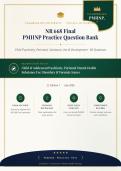
NR 668 Final
PMHNP Practice Question Bank
Child Psychiatry, Perinatal, Substance Use & Development · 66 Questions
E X A M I N AT I O N F O C U S :
Child & Adolescent Psychiatry, Perinatal Mental Health
Substance Use Disorders & Forensic Issues
Edition 1 · July 2026
EXAM FOCUSED DETAILED HIGH-YIELD CONFIDENCE
RATIONALES CONTENT BUILDER
Questions aligned with
NR 668 Final standards Clear explanations for Focus on tested PMHNP Practice smarter and pass
every answer clinical concepts with confidence
P r e pa r e · P r a c t i c e · Pa s s
Excellence in Psychiatric-Mental Health Nursing
,NR 668 FINAL · CHAMBERLAIN UNIVERSITY TABLE OF CONTENTS
Table of Contents
1. Instructions for Use 3
2. Questions 1–66 — NR 668 Final Exam Review 3
3. Seller Appreciation 8
NR 668 · Chamberlain University College of Nursing Page 2
,NR 668 FINAL GUIDE INSTRUCTIONS & PRACTICE QUESTIONS 1–66
How to Use This Guide
Read each stem, select your answer, then review the rationale. Correct answers are distributed
across all four letter positions. Covers child & adolescent psychiatry, perinatal mental health,
substance use disorders, developmental disorders, forensic issues, and psychopharmacology for
the NR 668 Final Exam.
Questions 1–33: Child Psychiatry, Development & Perinatal Mental Health
1 An 8-year-old boy with leukemia displays flat affect, irritability, angry
acting out, and physical aggression toward his brother. What approach
should the PMHNP take?
A Provide toys and allow the child to play
B Conduct a structured clinical interview without toys
C Interview the parents separately from the child
D Begin with direct questioning about his feelings
Correct Answer: A. Play is the language of children — providing toys and
allowing play creates safety, builds rapport, and enables the child to express
emotions nonverbally. This is developmentally appropriate interviewing technique.
Rationale: B, C, D are more appropriate for older children or adults. Play therapy
principles should guide the initial approach with school-age children, especially
those facing medical trauma.
, 2 Which eating disorder is considered ego syntonic?
A Anorexia Nervosa
B Bulimia Nervosa
C Binge Eating Disorder
D Avoidant/Restrictive Food Intake Disorder
Correct Answer: A. Anorexia nervosa is ego syntonic — the patient's behaviors,
feelings, and values align with their self-image. They view restriction as desirable
and consistent with their identity, making treatment particularly challenging.
Rationale: B, C, D are typically ego dystonic — patients recognize the behaviors as
problematic and distressing. The ego-syntonic nature of anorexia contributes to
high rates of treatment refusal and relapse.
3 A 30-year-old G1P0,1 depressed pregnant woman has become oddly
related, neglecting self-care, sleeping excessively, eating minimally, and
worrying about pregnancy loss. Which medication is least harmful in
pregnancy?
A Sertraline
B Paroxetine
C Fluoxetine
D Venlafaxine
Correct Answer: A. Sertraline is considered the safest SSRI in pregnancy — it has
the lowest placental transfer and the most extensive safety data. It is the first-line
recommendation for depression during pregnancy and lactation.
Rationale: B has been associated with cardiac defects. C and D have less
pregnancy data. Untreated maternal depression also carries significant risks to
both mother and fetus.
PMHNP.
CHAMBERLAIN UNIVERSITY · COLLEGE OF NURSING
NR 668 Final
PMHNP Practice Question Bank
Child Psychiatry, Perinatal, Substance Use & Development · 66 Questions
E X A M I N AT I O N F O C U S :
Child & Adolescent Psychiatry, Perinatal Mental Health
Substance Use Disorders & Forensic Issues
Edition 1 · July 2026
EXAM FOCUSED DETAILED HIGH-YIELD CONFIDENCE
RATIONALES CONTENT BUILDER
Questions aligned with
NR 668 Final standards Clear explanations for Focus on tested PMHNP Practice smarter and pass
every answer clinical concepts with confidence
P r e pa r e · P r a c t i c e · Pa s s
Excellence in Psychiatric-Mental Health Nursing
,NR 668 FINAL · CHAMBERLAIN UNIVERSITY TABLE OF CONTENTS
Table of Contents
1. Instructions for Use 3
2. Questions 1–66 — NR 668 Final Exam Review 3
3. Seller Appreciation 8
NR 668 · Chamberlain University College of Nursing Page 2
,NR 668 FINAL GUIDE INSTRUCTIONS & PRACTICE QUESTIONS 1–66
How to Use This Guide
Read each stem, select your answer, then review the rationale. Correct answers are distributed
across all four letter positions. Covers child & adolescent psychiatry, perinatal mental health,
substance use disorders, developmental disorders, forensic issues, and psychopharmacology for
the NR 668 Final Exam.
Questions 1–33: Child Psychiatry, Development & Perinatal Mental Health
1 An 8-year-old boy with leukemia displays flat affect, irritability, angry
acting out, and physical aggression toward his brother. What approach
should the PMHNP take?
A Provide toys and allow the child to play
B Conduct a structured clinical interview without toys
C Interview the parents separately from the child
D Begin with direct questioning about his feelings
Correct Answer: A. Play is the language of children — providing toys and
allowing play creates safety, builds rapport, and enables the child to express
emotions nonverbally. This is developmentally appropriate interviewing technique.
Rationale: B, C, D are more appropriate for older children or adults. Play therapy
principles should guide the initial approach with school-age children, especially
those facing medical trauma.
, 2 Which eating disorder is considered ego syntonic?
A Anorexia Nervosa
B Bulimia Nervosa
C Binge Eating Disorder
D Avoidant/Restrictive Food Intake Disorder
Correct Answer: A. Anorexia nervosa is ego syntonic — the patient's behaviors,
feelings, and values align with their self-image. They view restriction as desirable
and consistent with their identity, making treatment particularly challenging.
Rationale: B, C, D are typically ego dystonic — patients recognize the behaviors as
problematic and distressing. The ego-syntonic nature of anorexia contributes to
high rates of treatment refusal and relapse.
3 A 30-year-old G1P0,1 depressed pregnant woman has become oddly
related, neglecting self-care, sleeping excessively, eating minimally, and
worrying about pregnancy loss. Which medication is least harmful in
pregnancy?
A Sertraline
B Paroxetine
C Fluoxetine
D Venlafaxine
Correct Answer: A. Sertraline is considered the safest SSRI in pregnancy — it has
the lowest placental transfer and the most extensive safety data. It is the first-line
recommendation for depression during pregnancy and lactation.
Rationale: B has been associated with cardiac defects. C and D have less
pregnancy data. Untreated maternal depression also carries significant risks to
both mother and fetus.

