

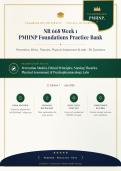
CHAMBERLAIN
PMHNP.
CHAMBERLAIN UNIVERSITY · COLLEGE OF NURSING
NR 668 Week 1
PMHNP Foundations Practice Bank
Prevention, Ethics, Theories, Physical Assessment & Labs · 96 Questions
E X A M I N AT I O N F O C U S :
Prevention Models, Ethical Principles, Nursing Theories
Physical Assessment & Psychopharmacology Labs
Edition 1 · July 2026
EXAM FOCUSED DETAILED HIGH-YIELD CONFIDENCE
RATIONALES CONTENT BUILDER
Questions aligned with
NR 668 Week 1 objectives Clear explanations for Focus on foundational Practice smarter and pass
every answer PMHNP concepts with confidence
P r e pa r e · P r a c t i c e · Pa s s
Excellence in Psychiatric-Mental Health Nursing
,NR 668 WEEK 1 · CHAMBERLAIN UNIVERSITY TABLE OF CONTENTS
Table of Contents
1. Instructions for Use 3
2. Questions 1–50 — Prevention, Ethics, Theories & Leadership 3
3. Questions 51–96 — Physical Assessment, Labs & Psychopharmacology 6
4. Seller Appreciation 9
NR 668 · Chamberlain University College of Nursing Page 2
,NR 668 WEEK 1 GUIDE INSTRUCTIONS & PRACTICE QUESTIONS 1–96
How to Use This Guide
Read each stem, select your answer, then review the rationale. Correct answers are distributed
across all four letter positions. Covers prevention models, ethical principles, nursing theories,
developmental theorists, physical assessment, lab values, and psychopharmacology for NR 668
Week 1.
Questions 1–50: Prevention, Ethics, Theories & Leadership
1 Primary Prevention is best defined as:
A Prevent the occurrence of new cases — e.g., stress management classes
B Screening and early identification — e.g., phone hotlines
C Prevent recurrence and disability — e.g., rehabilitation
D Universal measures like childhood immunizations only
Correct Answer: A. Primary prevention aims to prevent new cases from occurring
— intervening before the disease develops. Stress management classes,
immunizations, and health education are examples.
Rationale: B is secondary prevention. C is tertiary prevention. D is one type of
primary prevention but not the definition. Primary = prevent onset.
2 Secondary Prevention includes:
A Screening, early identification, and treatment — e.g., phone hotlines
B Preventing new cases from occurring
C Rehabilitation and social skills training
D Seat belt laws and helmet requirements
Correct Answer: A. Secondary prevention focuses on early detection and prompt
treatment to reduce severity and duration. Phone hotlines, screening programs,
and early intervention services are examples.
Rationale: B is primary prevention. C is tertiary. D is universal primary prevention.
Secondary = early identification and treatment.
, 3 Tertiary Prevention aims to:
A Prevent recurrence and prevent disability — e.g., rehabilitation, social skills
training
B Prevent new cases through education
C Screen for early signs of illness
D Immunize the population against disease
Correct Answer: A. Tertiary prevention focuses on reducing disability, preventing
relapse, and restoring function in those already diagnosed. Rehabilitation, social
skills training, and relapse prevention are examples.
Rationale: B is primary. C is secondary. D is primary. Tertiary = minimize
consequences and prevent recurrence.
4 Universal Prevention examples include:
A Childhood immunizations, seat belt laws, helmets, access to health care
B Interventions aimed at those coming back from war
C Early treatment for those whose symptoms have begun
D Rehabilitation programs for chronic conditions
Correct Answer: A. Universal prevention targets the entire population regardless
of risk — immunizations, safety laws, and healthcare access benefit everyone and
prevent disease broadly.
Rationale: B is selective prevention. C is indicated prevention. D is tertiary.
Universal = everyone.
PMHNP.
CHAMBERLAIN UNIVERSITY · COLLEGE OF NURSING
NR 668 Week 1
PMHNP Foundations Practice Bank
Prevention, Ethics, Theories, Physical Assessment & Labs · 96 Questions
E X A M I N AT I O N F O C U S :
Prevention Models, Ethical Principles, Nursing Theories
Physical Assessment & Psychopharmacology Labs
Edition 1 · July 2026
EXAM FOCUSED DETAILED HIGH-YIELD CONFIDENCE
RATIONALES CONTENT BUILDER
Questions aligned with
NR 668 Week 1 objectives Clear explanations for Focus on foundational Practice smarter and pass
every answer PMHNP concepts with confidence
P r e pa r e · P r a c t i c e · Pa s s
Excellence in Psychiatric-Mental Health Nursing
,NR 668 WEEK 1 · CHAMBERLAIN UNIVERSITY TABLE OF CONTENTS
Table of Contents
1. Instructions for Use 3
2. Questions 1–50 — Prevention, Ethics, Theories & Leadership 3
3. Questions 51–96 — Physical Assessment, Labs & Psychopharmacology 6
4. Seller Appreciation 9
NR 668 · Chamberlain University College of Nursing Page 2
,NR 668 WEEK 1 GUIDE INSTRUCTIONS & PRACTICE QUESTIONS 1–96
How to Use This Guide
Read each stem, select your answer, then review the rationale. Correct answers are distributed
across all four letter positions. Covers prevention models, ethical principles, nursing theories,
developmental theorists, physical assessment, lab values, and psychopharmacology for NR 668
Week 1.
Questions 1–50: Prevention, Ethics, Theories & Leadership
1 Primary Prevention is best defined as:
A Prevent the occurrence of new cases — e.g., stress management classes
B Screening and early identification — e.g., phone hotlines
C Prevent recurrence and disability — e.g., rehabilitation
D Universal measures like childhood immunizations only
Correct Answer: A. Primary prevention aims to prevent new cases from occurring
— intervening before the disease develops. Stress management classes,
immunizations, and health education are examples.
Rationale: B is secondary prevention. C is tertiary prevention. D is one type of
primary prevention but not the definition. Primary = prevent onset.
2 Secondary Prevention includes:
A Screening, early identification, and treatment — e.g., phone hotlines
B Preventing new cases from occurring
C Rehabilitation and social skills training
D Seat belt laws and helmet requirements
Correct Answer: A. Secondary prevention focuses on early detection and prompt
treatment to reduce severity and duration. Phone hotlines, screening programs,
and early intervention services are examples.
Rationale: B is primary prevention. C is tertiary. D is universal primary prevention.
Secondary = early identification and treatment.
, 3 Tertiary Prevention aims to:
A Prevent recurrence and prevent disability — e.g., rehabilitation, social skills
training
B Prevent new cases through education
C Screen for early signs of illness
D Immunize the population against disease
Correct Answer: A. Tertiary prevention focuses on reducing disability, preventing
relapse, and restoring function in those already diagnosed. Rehabilitation, social
skills training, and relapse prevention are examples.
Rationale: B is primary. C is secondary. D is primary. Tertiary = minimize
consequences and prevent recurrence.
4 Universal Prevention examples include:
A Childhood immunizations, seat belt laws, helmets, access to health care
B Interventions aimed at those coming back from war
C Early treatment for those whose symptoms have begun
D Rehabilitation programs for chronic conditions
Correct Answer: A. Universal prevention targets the entire population regardless
of risk — immunizations, safety laws, and healthcare access benefit everyone and
prevent disease broadly.
Rationale: B is selective prevention. C is indicated prevention. D is tertiary.
Universal = everyone.

