

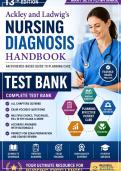
, Test Bank For Ackley and Ladwig's Nursing Diagnosis
Handbook 13th Edition: An Evidence-Based Guide to Planning
Care by Mary Beth Flynn Makic - 248 Questions
This exam assesses mastery of the nursing process and critical thinking frameworks as applied to complex clinical
scenarios. Questions require synthesis of assessment, diagnosis, planning, implementation, and evaluation within
evidence-based practice, reflecting the depth expected in top-tier US nursing programs. It contains 248
multiple-choice questions, each with four distractors and a fully worked rationale that explains why the keyed
answer is correct. Content is organized into 10 focused sections: Nursing Process and Critical Thinking,
Assessment and Diagnosis, Outcome Identification and Planning, Implementation and Evaluation,
Evidence-Based Practice and Research, Psychosocial and Cultural Considerations, Safety and Infection Control,
Pharmacological and Physiological Interventions, Health Promotion and Maintenance, Care of Specific
Populations (e.g., Pediatric, Geriatric, Perioperative). Targeted learning outcomes include: Apply critical thinking
to analyze patient data and formulate nursing diagnoses.; Differentiate between subjective and objective data in
clinical decision-making.; Evaluate the effectiveness of nursing interventions using outcome criteria.; Synthesize
evidence-based practice with individualized patient care planning.. Every item has been reviewed for clinical
accuracy, current guidelines, and clarity so that students can study with confidence and self-correct as they work
through the bank. Use it as a high-yield review immediately before the exam, or as a structured practice tool
during the unit - the rationales double as concise teaching notes. The recommended writing time is 3 hours, with a
Section 1: Nursing Process and Critical Thinking (Questions 1-25)
1 A nurse is analyzing a patient's assessment data and identifies several cues.
Which step of the nursing process involves interpreting these cues to
determine if a problem exists?
A) Assessment
B) Diagnosis
C) Planning
D) Implementation
Answer: B
Rationale: The diagnosis phase involves clinical reasoning to interpret
assessment data and identify patient problems. Assessment is data collection,
planning sets goals, and implementation is executing interventions.
2 When a nurse questions the validity of a patient's reported pain level due to
observed behaviors, which critical thinking attitude is being demonstrated?
A) Integrity
B) Perseverance
C) Humility
D) Fairness
,Answer: A
Rationale: Integrity involves seeking the truth and questioning inconsistencies.
Perseverance is persistence, humility is recognizing limitations, and fairness is
treating all equally.
3 A nurse is evaluating a patient's response to a new medication. Which
outcome statement indicates that the evaluation phase is complete?
A) Patient will report decreased pain within 30 minutes.
B) Patient reported pain level 3/10 after medication.
C) Administer analgesic as prescribed.
D) Assess pain level every 2 hours.
Answer: B
Rationale: Evaluation requires measurable data to determine if goals are met.
Option A is a goal, C is an intervention, D is an assessment. Only B provides
actual patient response data.
4 Which of the following best distinguishes a nursing diagnosis from a medical
diagnosis?
A) Nursing diagnoses focus on pathophysiological states; medical diagnoses
focus on patient responses.
B) Nursing diagnoses are derived from collaborative problems; medical
diagnoses are independent.
C) Nursing diagnoses describe human responses to health conditions; medical
diagnoses identify diseases.
D) Nursing diagnoses are always acute; medical diagnoses are chronic.
Answer: C
Rationale: NANDA-I defines nursing diagnoses as clinical judgments about
human responses to health conditions, whereas medical diagnoses identify
specific diseases. The other options reverse or misrepresent these definitions.
5 A nurse is developing a care plan for a patient with impaired mobility.
Which component is essential for the planning phase?
A) Cluster related assessment data.
B) Identify patient-centered goals and expected outcomes.
C) Implement interventions to prevent complications.
D) Evaluate the patient's response to interventions.
, Answer: B
Rationale: The planning phase involves setting goals and outcomes. Clustering
data is part of diagnosis, implementation is the doing phase, and evaluation is
the final step.
6 A nurse is using a clinical practice guideline to update a patient's plan of
care. This action reflects which component of evidence-based practice?
A) Patient preferences
B) Clinical expertise
C) Best research evidence
D) Nursing theory
Answer: C
Rationale: Clinical practice guidelines are synthesized from research evidence.
Patient preferences and clinical expertise are separate components. Nursing
theory may inform but is not the primary evidence source.
7 During a patient interview, the nurse notes that the patient's nonverbal cues
contradict verbal statements. According to the nursing process, how should
the nurse proceed?
A) Document the discrepancy and move to diagnosis.
B) Validate the data with the patient to clarify meaning.
C) Ignore nonverbal cues as less reliable.
D) Assume the verbal statement is accurate.
Answer: B
Rationale: Data validation is critical to ensure accuracy before proceeding. The
nurse should seek clarification from the patient. Ignoring or assuming could
lead to incorrect diagnoses.
8 Which critical thinking skill is most essential when a nurse must prioritize
multiple nursing diagnoses?
A) Inductive reasoning
B) Deductive reasoning
C) Clinical reasoning
D) Reflective thinking
Answer: C
Rationale: Clinical reasoning involves prioritizing based on urgency and patient
Handbook 13th Edition: An Evidence-Based Guide to Planning
Care by Mary Beth Flynn Makic - 248 Questions
This exam assesses mastery of the nursing process and critical thinking frameworks as applied to complex clinical
scenarios. Questions require synthesis of assessment, diagnosis, planning, implementation, and evaluation within
evidence-based practice, reflecting the depth expected in top-tier US nursing programs. It contains 248
multiple-choice questions, each with four distractors and a fully worked rationale that explains why the keyed
answer is correct. Content is organized into 10 focused sections: Nursing Process and Critical Thinking,
Assessment and Diagnosis, Outcome Identification and Planning, Implementation and Evaluation,
Evidence-Based Practice and Research, Psychosocial and Cultural Considerations, Safety and Infection Control,
Pharmacological and Physiological Interventions, Health Promotion and Maintenance, Care of Specific
Populations (e.g., Pediatric, Geriatric, Perioperative). Targeted learning outcomes include: Apply critical thinking
to analyze patient data and formulate nursing diagnoses.; Differentiate between subjective and objective data in
clinical decision-making.; Evaluate the effectiveness of nursing interventions using outcome criteria.; Synthesize
evidence-based practice with individualized patient care planning.. Every item has been reviewed for clinical
accuracy, current guidelines, and clarity so that students can study with confidence and self-correct as they work
through the bank. Use it as a high-yield review immediately before the exam, or as a structured practice tool
during the unit - the rationales double as concise teaching notes. The recommended writing time is 3 hours, with a
Section 1: Nursing Process and Critical Thinking (Questions 1-25)
1 A nurse is analyzing a patient's assessment data and identifies several cues.
Which step of the nursing process involves interpreting these cues to
determine if a problem exists?
A) Assessment
B) Diagnosis
C) Planning
D) Implementation
Answer: B
Rationale: The diagnosis phase involves clinical reasoning to interpret
assessment data and identify patient problems. Assessment is data collection,
planning sets goals, and implementation is executing interventions.
2 When a nurse questions the validity of a patient's reported pain level due to
observed behaviors, which critical thinking attitude is being demonstrated?
A) Integrity
B) Perseverance
C) Humility
D) Fairness
,Answer: A
Rationale: Integrity involves seeking the truth and questioning inconsistencies.
Perseverance is persistence, humility is recognizing limitations, and fairness is
treating all equally.
3 A nurse is evaluating a patient's response to a new medication. Which
outcome statement indicates that the evaluation phase is complete?
A) Patient will report decreased pain within 30 minutes.
B) Patient reported pain level 3/10 after medication.
C) Administer analgesic as prescribed.
D) Assess pain level every 2 hours.
Answer: B
Rationale: Evaluation requires measurable data to determine if goals are met.
Option A is a goal, C is an intervention, D is an assessment. Only B provides
actual patient response data.
4 Which of the following best distinguishes a nursing diagnosis from a medical
diagnosis?
A) Nursing diagnoses focus on pathophysiological states; medical diagnoses
focus on patient responses.
B) Nursing diagnoses are derived from collaborative problems; medical
diagnoses are independent.
C) Nursing diagnoses describe human responses to health conditions; medical
diagnoses identify diseases.
D) Nursing diagnoses are always acute; medical diagnoses are chronic.
Answer: C
Rationale: NANDA-I defines nursing diagnoses as clinical judgments about
human responses to health conditions, whereas medical diagnoses identify
specific diseases. The other options reverse or misrepresent these definitions.
5 A nurse is developing a care plan for a patient with impaired mobility.
Which component is essential for the planning phase?
A) Cluster related assessment data.
B) Identify patient-centered goals and expected outcomes.
C) Implement interventions to prevent complications.
D) Evaluate the patient's response to interventions.
, Answer: B
Rationale: The planning phase involves setting goals and outcomes. Clustering
data is part of diagnosis, implementation is the doing phase, and evaluation is
the final step.
6 A nurse is using a clinical practice guideline to update a patient's plan of
care. This action reflects which component of evidence-based practice?
A) Patient preferences
B) Clinical expertise
C) Best research evidence
D) Nursing theory
Answer: C
Rationale: Clinical practice guidelines are synthesized from research evidence.
Patient preferences and clinical expertise are separate components. Nursing
theory may inform but is not the primary evidence source.
7 During a patient interview, the nurse notes that the patient's nonverbal cues
contradict verbal statements. According to the nursing process, how should
the nurse proceed?
A) Document the discrepancy and move to diagnosis.
B) Validate the data with the patient to clarify meaning.
C) Ignore nonverbal cues as less reliable.
D) Assume the verbal statement is accurate.
Answer: B
Rationale: Data validation is critical to ensure accuracy before proceeding. The
nurse should seek clarification from the patient. Ignoring or assuming could
lead to incorrect diagnoses.
8 Which critical thinking skill is most essential when a nurse must prioritize
multiple nursing diagnoses?
A) Inductive reasoning
B) Deductive reasoning
C) Clinical reasoning
D) Reflective thinking
Answer: C
Rationale: Clinical reasoning involves prioritizing based on urgency and patient

