

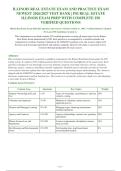
ILLINOIS REAL ESTATE EXAM AND PRACTICE EXAM
NEWEST 2026/2027 TEST BANK | PSI REAL ESTATE
ILLINOIS EXAM PREP WITH COMPLETE 250
VERIFIED QUESTIONS
Illinois Real Estate Exam 2026-2027 Questions and Answers Already Graded A+. 100% Verified Solutions | Updated
Per Latest PSI Guidelines | Graded A+
This comprehensive test bank contains 250 verified questions covering all major topics for the Illinois
Real Estate Exam administered by PSI. Each question is accompanied by a detailed rationale and
explanation to reinforce learning. Updated for the 2026/2027 academic year, this resource aligns with
the latest state licensing requirements and industry standards. Ideal for self-study or classroom review,
it ensures thorough preparation for exam success.
Abstract:
This test bank is meticulously curated for candidates preparing for the Illinois Real Estate Exam under the PSI
testing system. It comprises 250 verified questions that mirror the format and difficulty of the actual exam. Each
question is designed to test knowledge across key domains: property ownership, land use controls, valuation,
financing, agency, contracts, and Illinois-specific regulations. Detailed answer rationales provide not only the
correct answer but also explain why other options are incorrect, promoting deeper understanding. The content is
aligned with the 2026/2027 academic year and incorporates the latest legal updates, including changes to
disclosure requirements and fair housing laws. This resource is essential for achieving a high score and obtaining
a real estate license in Illinois.
Content Area Overview:
Content Area Questions Key Topics Weight
Property Ownership and Land 1-50 Types of ownership, encumbrances, land use 20%
Use controls, zoning
Valuation and Appraisal 51-90 Methods of valuation, market analysis, 16%
appraisal process
Finance and Mortgage Lending 91-140 Mortgage types, financing instruments, 20%
lending regulations
Agency and Contracts 141-190 Agency relationships, contract law, purchase 20%
agreements
Illinois License Law and 191-230 License requirements, disciplinary actions, 16%
Regulations trust accounts
Fair Housing and Environmental 231-250 Fair housing laws, lead-based paint, 8%
Issues environmental hazards
Page 1
,Q1. A buyer and seller sign a purchase agreement that includes a financing contingency requiring
the buyer to apply for a mortgage within 5 days. The buyer applies on day 6. The seller, unaware of
the delay, accepts a backup offer and signs a second contract. Which contract is enforceable under
Illinois law?
A. The first contract, because the buyer substantially performed
B. The second contract, because the first contract is void for failure of condition precedent
C. Both contracts are void due to the seller's bad faith
D. Only the first contract is enforceable because the seller had constructive notice of the delay
Correct Answer: B. The second contract, because the first contract is void for failure of condition
precedent
Rationale: The financing contingency is a condition precedent. Failure to timely apply makes the first
contract voidable at the seller's option. The seller's acceptance of a backup offer is permissible if the
contingency lapses. The second contract is valid if the first is voided.
Why Wrong:
A - Substantial performance does not apply to strict time contingencies in Illinois real estate
contracts.
C - The seller acted in good faith; the first contract was voidable due to buyer's breach.
D - Constructive notice is irrelevant; the seller had no duty to monitor buyer's application.
Reference: Illinois Real Estate License Act, 225 ILCS 455; Illinois Contract Law
Q2. Under the Illinois Residential Real Property Disclosure Act, which of the following defects must
a seller disclose if known?
A. A prior methamphetamine contamination that was professionally remediated
B. A neighbor's pending nuisance lawsuit against the property owner
C. The property's location in a designated floodplain
D. A minor roof leak that was repaired two years ago
Correct Answer: A. A prior methamphetamine contamination that was professionally remediated
Rationale: Illinois law requires disclosure of methamphetamine contamination regardless of remediation.
Lawsuits by neighbors and floodplain status are not required disclosures under the Act. Minor repairs
with no current defect need not be disclosed.
Why Wrong:
B - Neighbor lawsuits are not property defects required to be disclosed under the Act.
C - Floodplain status is not a required disclosure under Illinois law.
D - Past repairs with no current defect are not required to be disclosed.
Reference: 765 ILCS 77/ Residential Real Property Disclosure Act
Page 2
,Q3. A licensed Illinois real estate broker is representing a seller in a transaction. The broker learns
that the buyer is a close relative of the broker's spouse. What is the broker's obligation under the
Illinois Real Estate License Act?
A. No disclosure is required because the relationship is not direct
B. The broker must disclose the relationship to the seller in writing before the buyer makes an offer
C. The broker must withdraw from the transaction due to conflict of interest
D. The broker may proceed without disclosure if the price is at market value
Correct Answer: B. The broker must disclose the relationship to the seller in writing before the
buyer makes an offer
Rationale: Illinois law mandates disclosure of any familial or close personal relationship that could
affect the broker's impartiality. Written disclosure to the seller before the offer protects all parties.
Withdrawal is not mandatory if disclosure is made.
Why Wrong:
A - Indirect relationships still require disclosure under the License Act.
C - Disclosure, not withdrawal, is the required remedy.
D - Market price does not negate the duty to disclose.
Reference: 225 ILCS 455/ Illinois Real Estate License Act, Section 10
Q4. In an Illinois real estate closing, the buyer's lender requires a survey. The survey reveals a
2-foot encroachment of the neighbor's fence onto the subject property. Which document is most
likely to address this issue?
A. Title insurance policy
B. ALTA survey
C. Owner's affidavit
D. Zoning compliance letter
Correct Answer: A. Title insurance policy
Rationale: Title insurance typically insures against encroachments and defects in title. The ALTA survey
identifies the encroachment, but the title policy provides coverage and resolution. Owner's affidavit and
zoning letter do not directly address encroachments.
Why Wrong:
B - The survey identifies the problem but does not resolve it; title insurance does.
C - Owner's affidavit is a sworn statement, not a remedy for encroachments.
D - Zoning compliance letters address land use, not boundary disputes.
Reference: Illinois Title Insurance Act; ALTA Survey Standards
Page 3
, Q5. A landlord in Illinois rents a commercial property to a tenant for a 5-year term. The lease
contains a provision that the landlord may terminate the lease if the tenant fails to pay rent. After 2
years, the tenant pays rent late for three consecutive months. The landlord gives notice of
termination. Is the termination valid?
A. Yes, because the lease allows termination for nonpayment
B. No, because late payment is not nonpayment
C. Yes, if the lease defines late payment as a default
D. No, because the landlord must first give a cure period
Correct Answer: C. Yes, if the lease defines late payment as a default
Rationale: Under Illinois law, a lease provision must clearly define what constitutes a default. If the lease
specifically lists late payment as a default triggering termination, the landlord may terminate. Otherwise,
late payment alone may not be sufficient.
Why Wrong:
A - Nonpayment and late payment are distinct; termination requires explicit language.
B - Late payment can be default if the lease so states.
D - A cure period is required only if the lease or statute mandates it.
Reference: Illinois Commercial Real Estate Leasing; 765 ILCS 705
Q6. A buyer and seller enter into a written agreement for the sale of a single-family home in Illinois.
The contract provides that the buyer will pay $300,000, with a $10,000 earnest money deposit. The
buyer fails to close, and the seller retains the earnest money as liquidated damages. Under Illinois
law, which is correct?
A. The seller may keep the earnest money only if actual damages exceed $10,000
B. The liquidated damages clause is enforceable if reasonable and not a penalty
C. The seller must return the earnest money because the buyer's failure was not willful
D. The buyer may sue to recover the earnest money because it is a penalty per se
Correct Answer: B. The liquidated damages clause is enforceable if reasonable and not a penalty
Rationale: Illinois courts enforce liquidated damages clauses if the amount is reasonable in light of
anticipated or actual harm, and the actual damages are difficult to ascertain. The clause is not
automatically a penalty; reasonableness is key.
Why Wrong:
A - Liquidated damages do not require proof of actual damages; they replace them.
C - Willfulness is not a factor for liquidated damages enforcement.
D - The clause is not per se a penalty; it must be evaluated for reasonableness.
Reference: Illinois Liquidated Damages Law; Lake County v. Water Treatment, 2016
Page 4
NEWEST 2026/2027 TEST BANK | PSI REAL ESTATE
ILLINOIS EXAM PREP WITH COMPLETE 250
VERIFIED QUESTIONS
Illinois Real Estate Exam 2026-2027 Questions and Answers Already Graded A+. 100% Verified Solutions | Updated
Per Latest PSI Guidelines | Graded A+
This comprehensive test bank contains 250 verified questions covering all major topics for the Illinois
Real Estate Exam administered by PSI. Each question is accompanied by a detailed rationale and
explanation to reinforce learning. Updated for the 2026/2027 academic year, this resource aligns with
the latest state licensing requirements and industry standards. Ideal for self-study or classroom review,
it ensures thorough preparation for exam success.
Abstract:
This test bank is meticulously curated for candidates preparing for the Illinois Real Estate Exam under the PSI
testing system. It comprises 250 verified questions that mirror the format and difficulty of the actual exam. Each
question is designed to test knowledge across key domains: property ownership, land use controls, valuation,
financing, agency, contracts, and Illinois-specific regulations. Detailed answer rationales provide not only the
correct answer but also explain why other options are incorrect, promoting deeper understanding. The content is
aligned with the 2026/2027 academic year and incorporates the latest legal updates, including changes to
disclosure requirements and fair housing laws. This resource is essential for achieving a high score and obtaining
a real estate license in Illinois.
Content Area Overview:
Content Area Questions Key Topics Weight
Property Ownership and Land 1-50 Types of ownership, encumbrances, land use 20%
Use controls, zoning
Valuation and Appraisal 51-90 Methods of valuation, market analysis, 16%
appraisal process
Finance and Mortgage Lending 91-140 Mortgage types, financing instruments, 20%
lending regulations
Agency and Contracts 141-190 Agency relationships, contract law, purchase 20%
agreements
Illinois License Law and 191-230 License requirements, disciplinary actions, 16%
Regulations trust accounts
Fair Housing and Environmental 231-250 Fair housing laws, lead-based paint, 8%
Issues environmental hazards
Page 1
,Q1. A buyer and seller sign a purchase agreement that includes a financing contingency requiring
the buyer to apply for a mortgage within 5 days. The buyer applies on day 6. The seller, unaware of
the delay, accepts a backup offer and signs a second contract. Which contract is enforceable under
Illinois law?
A. The first contract, because the buyer substantially performed
B. The second contract, because the first contract is void for failure of condition precedent
C. Both contracts are void due to the seller's bad faith
D. Only the first contract is enforceable because the seller had constructive notice of the delay
Correct Answer: B. The second contract, because the first contract is void for failure of condition
precedent
Rationale: The financing contingency is a condition precedent. Failure to timely apply makes the first
contract voidable at the seller's option. The seller's acceptance of a backup offer is permissible if the
contingency lapses. The second contract is valid if the first is voided.
Why Wrong:
A - Substantial performance does not apply to strict time contingencies in Illinois real estate
contracts.
C - The seller acted in good faith; the first contract was voidable due to buyer's breach.
D - Constructive notice is irrelevant; the seller had no duty to monitor buyer's application.
Reference: Illinois Real Estate License Act, 225 ILCS 455; Illinois Contract Law
Q2. Under the Illinois Residential Real Property Disclosure Act, which of the following defects must
a seller disclose if known?
A. A prior methamphetamine contamination that was professionally remediated
B. A neighbor's pending nuisance lawsuit against the property owner
C. The property's location in a designated floodplain
D. A minor roof leak that was repaired two years ago
Correct Answer: A. A prior methamphetamine contamination that was professionally remediated
Rationale: Illinois law requires disclosure of methamphetamine contamination regardless of remediation.
Lawsuits by neighbors and floodplain status are not required disclosures under the Act. Minor repairs
with no current defect need not be disclosed.
Why Wrong:
B - Neighbor lawsuits are not property defects required to be disclosed under the Act.
C - Floodplain status is not a required disclosure under Illinois law.
D - Past repairs with no current defect are not required to be disclosed.
Reference: 765 ILCS 77/ Residential Real Property Disclosure Act
Page 2
,Q3. A licensed Illinois real estate broker is representing a seller in a transaction. The broker learns
that the buyer is a close relative of the broker's spouse. What is the broker's obligation under the
Illinois Real Estate License Act?
A. No disclosure is required because the relationship is not direct
B. The broker must disclose the relationship to the seller in writing before the buyer makes an offer
C. The broker must withdraw from the transaction due to conflict of interest
D. The broker may proceed without disclosure if the price is at market value
Correct Answer: B. The broker must disclose the relationship to the seller in writing before the
buyer makes an offer
Rationale: Illinois law mandates disclosure of any familial or close personal relationship that could
affect the broker's impartiality. Written disclosure to the seller before the offer protects all parties.
Withdrawal is not mandatory if disclosure is made.
Why Wrong:
A - Indirect relationships still require disclosure under the License Act.
C - Disclosure, not withdrawal, is the required remedy.
D - Market price does not negate the duty to disclose.
Reference: 225 ILCS 455/ Illinois Real Estate License Act, Section 10
Q4. In an Illinois real estate closing, the buyer's lender requires a survey. The survey reveals a
2-foot encroachment of the neighbor's fence onto the subject property. Which document is most
likely to address this issue?
A. Title insurance policy
B. ALTA survey
C. Owner's affidavit
D. Zoning compliance letter
Correct Answer: A. Title insurance policy
Rationale: Title insurance typically insures against encroachments and defects in title. The ALTA survey
identifies the encroachment, but the title policy provides coverage and resolution. Owner's affidavit and
zoning letter do not directly address encroachments.
Why Wrong:
B - The survey identifies the problem but does not resolve it; title insurance does.
C - Owner's affidavit is a sworn statement, not a remedy for encroachments.
D - Zoning compliance letters address land use, not boundary disputes.
Reference: Illinois Title Insurance Act; ALTA Survey Standards
Page 3
, Q5. A landlord in Illinois rents a commercial property to a tenant for a 5-year term. The lease
contains a provision that the landlord may terminate the lease if the tenant fails to pay rent. After 2
years, the tenant pays rent late for three consecutive months. The landlord gives notice of
termination. Is the termination valid?
A. Yes, because the lease allows termination for nonpayment
B. No, because late payment is not nonpayment
C. Yes, if the lease defines late payment as a default
D. No, because the landlord must first give a cure period
Correct Answer: C. Yes, if the lease defines late payment as a default
Rationale: Under Illinois law, a lease provision must clearly define what constitutes a default. If the lease
specifically lists late payment as a default triggering termination, the landlord may terminate. Otherwise,
late payment alone may not be sufficient.
Why Wrong:
A - Nonpayment and late payment are distinct; termination requires explicit language.
B - Late payment can be default if the lease so states.
D - A cure period is required only if the lease or statute mandates it.
Reference: Illinois Commercial Real Estate Leasing; 765 ILCS 705
Q6. A buyer and seller enter into a written agreement for the sale of a single-family home in Illinois.
The contract provides that the buyer will pay $300,000, with a $10,000 earnest money deposit. The
buyer fails to close, and the seller retains the earnest money as liquidated damages. Under Illinois
law, which is correct?
A. The seller may keep the earnest money only if actual damages exceed $10,000
B. The liquidated damages clause is enforceable if reasonable and not a penalty
C. The seller must return the earnest money because the buyer's failure was not willful
D. The buyer may sue to recover the earnest money because it is a penalty per se
Correct Answer: B. The liquidated damages clause is enforceable if reasonable and not a penalty
Rationale: Illinois courts enforce liquidated damages clauses if the amount is reasonable in light of
anticipated or actual harm, and the actual damages are difficult to ascertain. The clause is not
automatically a penalty; reasonableness is key.
Why Wrong:
A - Liquidated damages do not require proof of actual damages; they replace them.
C - Willfulness is not a factor for liquidated damages enforcement.
D - The clause is not per se a penalty; it must be evaluated for reasonableness.
Reference: Illinois Liquidated Damages Law; Lake County v. Water Treatment, 2016
Page 4

