

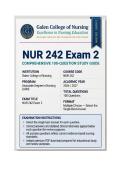
,NUR 242 Exam 2 – Med-Surg Concepts – Actual
Q&A (GCN) (Updated PDF)
1. The nurse is assessing a client with fluid volume overload. Which finding is
expected?
A) Thready pulse and poor skin turgor
B) Bounding pulse and distended neck veins
C) Dry mucous membranes and hypotension
D) Metabolic acidosis and weight loss
Correct Answer: B) Bounding pulse and distended neck veins
Rationale: Fluid volume excess increases vascular volume, leading to bounding
pulses and jugular venous distention. Thready pulse, dry mucosa, and weight
loss indicate fluid volume deficit.
2. A client with an ileostomy is at highest risk for which fluid imbalance?
A) Fluid volume overload
B) Metabolic alkalosis
C) Hyperkalemia
D) Dehydration
Correct Answer: D) Dehydration
,Rationale: Ileostomy output is liquid and rich in electrolytes; large volumes can
cause rapid fluid and electrolyte loss, leading to dehydration and hypovolemia.
Fluid restriction is not indicated.
3. What is the most reliable indicator of a client's fluid status?
A) Daily weights on the same scale at the same time
B) Skin turgor over the sternum
C) Thirst and blood pressure changes
D) Urine output every 8 hours
Correct Answer: A) Daily weights on the same scale at the same time
Rationale: Daily weights provide an accurate, objective measure of fluid
balance; 1 kg change equals approximately 1 liter of fluid. Skin turgor and thirst
are less reliable, especially in older adults.
4. A client's serum potassium is 2.9 mEq/L. The nurse should monitor for which
ECG change?
A) Peaked T waves and widened QRS
B) ST elevation and prominent R waves
C) ST depression, flat T wave, and U wave
D) Shortened QT interval and bradycardia
Correct Answer: C) ST depression, flat T wave, and U wave
, Rationale: Hypokalemia causes characteristic ECG changes: ST segment
depression, flattened or inverted T waves, and prominent U waves.
Hyperkalemia causes peaked T waves.
5. A client with hyperkalemia has a serum potassium of 6.2 mEq/L. Which ECG
finding is expected?
A) Prominent U waves
B) Flat T waves and ST depression
C) Prolonged PR interval
D) Tall, peaked T waves
Correct Answer: D) Tall, peaked T waves
Rationale: Hyperkalemia initially produces tall, peaked T waves as the earliest
ECG change. As potassium rises, the QRS widens, and eventually ventricular
fibrillation may occur.
6. The nurse is preparing to administer IV potassium. Which action is essential?
A) Administer by rapid IV push
B) Verify that urine output is at least 30 mL/hr
C) Give undiluted via a central line
D) Mix with 5% dextrose only
Correct Answer: B) Verify that urine output is at least 30 mL/hr
Q&A (GCN) (Updated PDF)
1. The nurse is assessing a client with fluid volume overload. Which finding is
expected?
A) Thready pulse and poor skin turgor
B) Bounding pulse and distended neck veins
C) Dry mucous membranes and hypotension
D) Metabolic acidosis and weight loss
Correct Answer: B) Bounding pulse and distended neck veins
Rationale: Fluid volume excess increases vascular volume, leading to bounding
pulses and jugular venous distention. Thready pulse, dry mucosa, and weight
loss indicate fluid volume deficit.
2. A client with an ileostomy is at highest risk for which fluid imbalance?
A) Fluid volume overload
B) Metabolic alkalosis
C) Hyperkalemia
D) Dehydration
Correct Answer: D) Dehydration
,Rationale: Ileostomy output is liquid and rich in electrolytes; large volumes can
cause rapid fluid and electrolyte loss, leading to dehydration and hypovolemia.
Fluid restriction is not indicated.
3. What is the most reliable indicator of a client's fluid status?
A) Daily weights on the same scale at the same time
B) Skin turgor over the sternum
C) Thirst and blood pressure changes
D) Urine output every 8 hours
Correct Answer: A) Daily weights on the same scale at the same time
Rationale: Daily weights provide an accurate, objective measure of fluid
balance; 1 kg change equals approximately 1 liter of fluid. Skin turgor and thirst
are less reliable, especially in older adults.
4. A client's serum potassium is 2.9 mEq/L. The nurse should monitor for which
ECG change?
A) Peaked T waves and widened QRS
B) ST elevation and prominent R waves
C) ST depression, flat T wave, and U wave
D) Shortened QT interval and bradycardia
Correct Answer: C) ST depression, flat T wave, and U wave
, Rationale: Hypokalemia causes characteristic ECG changes: ST segment
depression, flattened or inverted T waves, and prominent U waves.
Hyperkalemia causes peaked T waves.
5. A client with hyperkalemia has a serum potassium of 6.2 mEq/L. Which ECG
finding is expected?
A) Prominent U waves
B) Flat T waves and ST depression
C) Prolonged PR interval
D) Tall, peaked T waves
Correct Answer: D) Tall, peaked T waves
Rationale: Hyperkalemia initially produces tall, peaked T waves as the earliest
ECG change. As potassium rises, the QRS widens, and eventually ventricular
fibrillation may occur.
6. The nurse is preparing to administer IV potassium. Which action is essential?
A) Administer by rapid IV push
B) Verify that urine output is at least 30 mL/hr
C) Give undiluted via a central line
D) Mix with 5% dextrose only
Correct Answer: B) Verify that urine output is at least 30 mL/hr

