Test Bank for
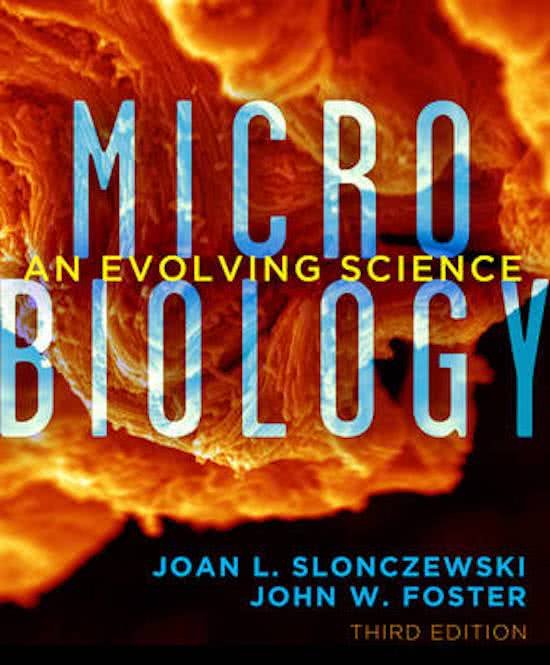
Microbiology AN EVOLVING
SCIENCE, 4th Edition, John
W. Foster, Joan L.
Slonczewski, ISBN-10:
0393614034, ISBN-13:
9780393614039
,
, CHAPTER 2: Observing the Microbial Cell
MULTIPLE CHOICE
1. Chlamydia trachomatis transmits infection to a new cell via
a. a membrane vesicle. d. host membranes.
b. elementary bodies. e. the human cell.
c. amoeba.
ANS: B DIF: Easy REF: 2.Intro
OBJ: 2.1d Identify the type(s) of microscopy needed to view a particular specimen
MSC: Remembering
2. The part of the human eye that is MOST involved in resolving an image is the
a. iris. d. retina.
b. lens. e. cornea.
c. optic nerve.
ANS: D DIF: Easy REF: 2.1
OBJ: 2.1a Explain how the structure of the human eye dictates the resolution of objects
MSC: Remembering
3. A ball-shaped microbe is referred to as a
a. bacillus. d. strepto.
b. coccus. e. spirochete.
c. vibrio.
ANS: B DIF: Easy REF: 2.1
OBJ: 2.1c Describe and identify bacterial morphologies (e.g., bacilli, cocci, and spirochetes)
MSC: Remembering
4. Resolution is the smallest distance by which two objects can be and still be .
a. magnified; seen d. distinguished; separated
b. separated; distinguished e. magnified; distinguished
c. magnified; separated
ANS: B DIF: Medium REF: 2.1
OBJ: 2.1b Differentiate between resolution and detection MSC: Remembering
5. 400 nm is equivalent to
a. 4.0 105 m. d. 4.0 108 m.
b. 4.0 106 m. e. 4.0 109 m.
c. 4.0 107 m.
ANS: C DIF: Medium REF: 2.1
OBJ: 2.1a Explain how the structure of the human eye dictates the resolution of objects
MSC: Applying
6. Which of these series arranges microbes from smallest to largest?
a. virus bacterium red blood cell paramecium
b. virus red blood cell bacterium paramecium
c. bacterium virus paramecium red blood cell
d. bacterium virus red blood cell paramecium
e. paramecium red blood cell bacterium virus
Microbiology AN EVOLVING
SCIENCE, 4th Edition, John
W. Foster, Joan L.
Slonczewski, ISBN-10:
0393614034, ISBN-13:
9780393614039
,
, CHAPTER 2: Observing the Microbial Cell
MULTIPLE CHOICE
1. Chlamydia trachomatis transmits infection to a new cell via
a. a membrane vesicle. d. host membranes.
b. elementary bodies. e. the human cell.
c. amoeba.
ANS: B DIF: Easy REF: 2.Intro
OBJ: 2.1d Identify the type(s) of microscopy needed to view a particular specimen
MSC: Remembering
2. The part of the human eye that is MOST involved in resolving an image is the
a. iris. d. retina.
b. lens. e. cornea.
c. optic nerve.
ANS: D DIF: Easy REF: 2.1
OBJ: 2.1a Explain how the structure of the human eye dictates the resolution of objects
MSC: Remembering
3. A ball-shaped microbe is referred to as a
a. bacillus. d. strepto.
b. coccus. e. spirochete.
c. vibrio.
ANS: B DIF: Easy REF: 2.1
OBJ: 2.1c Describe and identify bacterial morphologies (e.g., bacilli, cocci, and spirochetes)
MSC: Remembering
4. Resolution is the smallest distance by which two objects can be and still be .
a. magnified; seen d. distinguished; separated
b. separated; distinguished e. magnified; distinguished
c. magnified; separated
ANS: B DIF: Medium REF: 2.1
OBJ: 2.1b Differentiate between resolution and detection MSC: Remembering
5. 400 nm is equivalent to
a. 4.0 105 m. d. 4.0 108 m.
b. 4.0 106 m. e. 4.0 109 m.
c. 4.0 107 m.
ANS: C DIF: Medium REF: 2.1
OBJ: 2.1a Explain how the structure of the human eye dictates the resolution of objects
MSC: Applying
6. Which of these series arranges microbes from smallest to largest?
a. virus bacterium red blood cell paramecium
b. virus red blood cell bacterium paramecium
c. bacterium virus paramecium red blood cell
d. bacterium virus red blood cell paramecium
e. paramecium red blood cell bacterium virus