

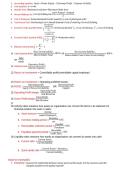
1. Accounting equation: Asset=Owner Equity −Drawing+ Profit −Expence+ Libility
2. Cost equation: y=a+bx
3. Reorder level: Maximum Lead time∗Maximum Order leve l
unit∗Annual−demand
4. Annual Holding Cost: Cost of holding one
2
5. Cost of Ordering:( Annual demand/reorder quantity )∗cost of placing an order
6. Total Annual Cost: Purchasing Cost∗Annual demand+Cost of ordering +Cost of Holding
7. Economic order quantity (EOQ):
√
2∗D∗C 0
Ch
(D=Annual demand, C 0 =Cost of Ordering , C h =Cost of Holding
√) (
2∗D∗C0
)
8. Economic Batch Quantity (EBQ): D (P =Production Units )
C h 1−
ρ
(
n
ⅈ
9. Effective interest Rate: 1− −1
n
Non Current liability Non Current liability❑
10. Capital gearing Ratio: ∗100 % OR ∗100 %
Sharre Holder Fund Sharre holder Fund + NonCurrent liability
Debt
OR
equity
Operatin g Profit❑
11. Interest cover:
Interest Expense❑
12. Return on Investment = Controllable profit/controllable capital employed
or
13. Return on Investment = Operating profit/Net assets
Operating profit Operating Profit
14. ROCE : OR
equity + Noncurrent liability Capital
Operating Profit
15. Operating Profit Margin:
Sale Renvenue
Gross Profit
16. Gross Profit Margin:
Sale Revenue
17.
18. Activity ratios measure how easily an organization can convert the items in its statement of
financial position into cash or sales:
revenue
a. Asset turnover =
capita l Employed❑
Inventory
b. Inventory holding period = ∗365
cos
Payable
c. Receivables collection period = ∗365
Purchases
Recevable
d. Payables payment period = ∗365
credi t Sale❑
19. Liquidity ratios measure how easily an organisation can convert its assets into cash:
Current Asset ❑
a. Current ratio =
Current liability
Current Assets−Inventory ❑
b. Quick (acid) ratio =
Current Liability ❑
Value for money(3E):
Economy: measures the relationship between money spent and the inputs. Are the resources used the
cheapest possible for the quality required?
2. Cost equation: y=a+bx
3. Reorder level: Maximum Lead time∗Maximum Order leve l
unit∗Annual−demand
4. Annual Holding Cost: Cost of holding one
2
5. Cost of Ordering:( Annual demand/reorder quantity )∗cost of placing an order
6. Total Annual Cost: Purchasing Cost∗Annual demand+Cost of ordering +Cost of Holding
7. Economic order quantity (EOQ):
√
2∗D∗C 0
Ch
(D=Annual demand, C 0 =Cost of Ordering , C h =Cost of Holding
√) (
2∗D∗C0
)
8. Economic Batch Quantity (EBQ): D (P =Production Units )
C h 1−
ρ
(
n
ⅈ
9. Effective interest Rate: 1− −1
n
Non Current liability Non Current liability❑
10. Capital gearing Ratio: ∗100 % OR ∗100 %
Sharre Holder Fund Sharre holder Fund + NonCurrent liability
Debt
OR
equity
Operatin g Profit❑
11. Interest cover:
Interest Expense❑
12. Return on Investment = Controllable profit/controllable capital employed
or
13. Return on Investment = Operating profit/Net assets
Operating profit Operating Profit
14. ROCE : OR
equity + Noncurrent liability Capital
Operating Profit
15. Operating Profit Margin:
Sale Renvenue
Gross Profit
16. Gross Profit Margin:
Sale Revenue
17.
18. Activity ratios measure how easily an organization can convert the items in its statement of
financial position into cash or sales:
revenue
a. Asset turnover =
capita l Employed❑
Inventory
b. Inventory holding period = ∗365
cos
Payable
c. Receivables collection period = ∗365
Purchases
Recevable
d. Payables payment period = ∗365
credi t Sale❑
19. Liquidity ratios measure how easily an organisation can convert its assets into cash:
Current Asset ❑
a. Current ratio =
Current liability
Current Assets−Inventory ❑
b. Quick (acid) ratio =
Current Liability ❑
Value for money(3E):
Economy: measures the relationship between money spent and the inputs. Are the resources used the
cheapest possible for the quality required?

