

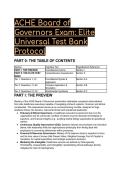
ACHE Board of
Governors Exam: Elite
Universal Test Bank
Protocol
PART 0: THE TABLE OF CONTENTS
Section Cognitive Tier Page/Section Reference
PART I: THE PREVIEW Foundational Axioms Section I
PART II: THE ELITE TEST Comprehensive Assessment Section II
BANK
Tier 1: Questions 1–10 Foundational Syntax & Section II.A
Application
Tier 2: Questions 11–20 Complex Application & Section II.B
Simulation
Tier 3: Questions 21–30 Grandmaster Synthesis Section II.C
PART I: THE PREVIEW
Mastery of the ACHE Board of Governors examination delineates competent administrators
from elite healthcare executives capable of navigating profound systemic, financial, and ethical
complexities. This assessment serves as an uncompromising crucible, designed to forge
academic theory into decisive, real-world clinical and operational leadership.
● Fiduciary & Ethical Supremacy: A healthcare executive's paramount duty is to the
organization and its community; conflicts of interest must be disclosed immediately to
superiors, and financial integrity (e.g., avoiding double billing) supersedes all operational
metrics.
● Continuous Quality Improvement (CQI): Systemic failures are prioritized over individual
blame; elite leadership shifts the organizational philosophy from finding fault with
employees to uncovering deficiencies within processes.
● Financial & Resource Governance: Mastery of the balance sheet (a snapshot in time)
and the time value of money (Net Present Value, Weighted Average Cost of Capital) is
mandatory for capital expenditure and strategic expansion decisions.
● Marketing the Intangible: Healthcare services are defined by Heterogeneity,
Perishability, Inseparability, and Intangibility; standardizing clinical pathways directly
mitigates the risks of heterogeneity.
,PART II: THE ELITE TEST BANK
Section II.A: Tier 1 - Foundational Syntax & Application
Q1: A senior healthcare executive discovers an ongoing operational failure where the
organization has been systematically double billing a major third-party payer for outpatient
diagnostic services. The executive does not directly benefit financially from this error. Based on
the principles of Professionalism and Ethics, which conclusion is the MOST ACCURATE
regarding this scenario? A) An ethical dilemma that requires immediate reporting to the federal
government to secure whistleblower protections. B) A systemic quality improvement issue that
should be delegated to the billing department without executive intervention. C) An actual
conflict of interest, even absent a direct economic benefit to the healthcare executive. D) A
legacy accounting error that can be resolved through an internal audit at the end of the fiscal
quarter.
● The Answer: C (An actual conflict of interest, even absent a direct economic benefit to
the healthcare executive.)
● Distractor Analysis:
○ A is incorrect: While reporting may eventually be required by compliance laws,
defining the inherent nature of the executive's complacency is the immediate issue;
whistleblowing is a subsequent action, not the primary ethical definition.
○ B is incorrect: Delegating the issue ignores the executive's fiduciary duty and
compliance oversight mandates.
○ D is incorrect: Delaying action for a quarterly audit violates the mandate for
immediate ethical transparency and organizational compliance.
The Mentor's Analysis: Tolerance of fraudulent practices compromises the fundamental
fiduciary duty of the executive, regardless of personal enrichment. When facing organizational
non-compliance, the immediate priority is transparent acknowledgment and cessation of the
practice. By utilizing strict Compliance Verification, the executive bypasses the common trap of
passive complicity. The broader implication is that regulatory bodies do not distinguish between
active fraud and executive negligence; both incur catastrophic institutional liability.
Professional/Academic Intuition: Knowing of ongoing organizational fraud and permitting
it to continue constitutes an immediate, actual conflict of interest.
Q2: During the transition to a comprehensive Continuous Quality Improvement (CQI) model, a
hospital administrator notices that department managers frequently reprimand nursing staff for
medication delays. Based on the principles of Quality and Performance Improvement, what is
the FIRST required shift in management philosophy? A) Implementing strict punitive measures
for staff who fail to meet time-based metrics. B) Reassigning all clinical staff to ensure a diverse
distribution of competencies. C) Transitioning from finding fault with employees to finding
problems in processes. D) Increasing the operational budget to hire additional per-diem nursing
staff.
● The Answer: C (Transitioning from finding fault with employees to finding problems in
processes.)
● Distractor Analysis:
○ A is incorrect: Punitive measures are the antithesis of CQI methodology and foster
a culture of concealed errors.
○ B is incorrect: Reassigning staff treats the symptom without analyzing the root
, workflow deficiency.
○ D is incorrect: Throwing capital at an undefined operational bottleneck is an
outdated, highly inefficient legacy management reflex.
The Mentor's Analysis: Human error in healthcare is overwhelmingly a symptom of flawed
systemic design rather than individual incompetence. When facing repeated operational failures,
the immediate priority is root-cause process analysis. By utilizing Systems Thinking, leadership
bypasses the common trap of localized blame. The second-order effect of this shift is the
cultivation of psychological safety, which directly increases the internal reporting of near-miss
events, thereby averting future catastrophic clinical failures. Professional/Academic Intuition:
True quality improvement demands that leaders interrogate the process before they
interrogate the personnel.
Q3: The Chief Executive Officer is reviewing the financial viability of a new outpatient surgical
wing. To evaluate the profitability of this capital investment while accounting for the time value of
money, which specific evaluation technique is the MOST APPROPRIATE? A) The Accounting
Rate of Return. B) The Payback Period calculation. C) The Net Present Value (NPV). D) The
Current Ratio analysis.
● The Answer: C (The Net Present Value (NPV).)
● Distractor Analysis:
○ A is incorrect: The Accounting Rate of Return is a valid financial metric but critically
fails to adjust for the time value of money.
○ B is incorrect: The Payback Period calculates how long it takes to recoup an
investment but ignores the profitability of cash flows occurring after the payback
point and does not discount for time.
○ D is incorrect: The Current Ratio is a measure of short-term liquidity, not long-term
capital investment profitability.
The Mentor's Analysis: Capital investments in healthcare require rigorous economic
evaluation that respects the depreciation of currency value over time. When facing long-term
capital deployments, the immediate priority is establishing the true economic yield. By utilizing
the Net Present Value, analysts bypass the common trap of overvaluing distant future cash
flows. As inflation and capital costs fluctuate, NPV remains the singular anchor for determining
whether a project creates or destroys institutional wealth over its lifecycle.
Professional/Academic Intuition: Economic evaluation techniques for capital budgeting
must fundamentally incorporate discounted cash flows.
Q4: A healthcare system is preparing its annual financial disclosures. The Chief Financial
Officer (CFO) is asked to provide a specific report that offers a "snapshot" of the organization's
financial condition at a single, distinct point in time. Which financial document is the MOST
ACCURATE fulfillment of this request? A) The Statement of Cash Flows. B) The Statement of
Retained Earnings. C) The Balance Sheet. D) The Income Statement.
● The Answer: C (The Balance Sheet.)
● Distractor Analysis:
○ A is incorrect: The Statement of Cash Flows tracks the inflow and outflow of liquidity
over a period of time, not a single point.
○ B is incorrect: The Statement of Retained Earnings details changes in equity over a
continuous accounting period.
○ D is incorrect: The Income Statement measures revenue and expenses over a
specific operational timeframe (e.g., a fiscal year).
The Mentor's Analysis: Financial reporting is divided into documents that measure flow over
time and those that measure state at a specific moment. When facing demands for current
Governors Exam: Elite
Universal Test Bank
Protocol
PART 0: THE TABLE OF CONTENTS
Section Cognitive Tier Page/Section Reference
PART I: THE PREVIEW Foundational Axioms Section I
PART II: THE ELITE TEST Comprehensive Assessment Section II
BANK
Tier 1: Questions 1–10 Foundational Syntax & Section II.A
Application
Tier 2: Questions 11–20 Complex Application & Section II.B
Simulation
Tier 3: Questions 21–30 Grandmaster Synthesis Section II.C
PART I: THE PREVIEW
Mastery of the ACHE Board of Governors examination delineates competent administrators
from elite healthcare executives capable of navigating profound systemic, financial, and ethical
complexities. This assessment serves as an uncompromising crucible, designed to forge
academic theory into decisive, real-world clinical and operational leadership.
● Fiduciary & Ethical Supremacy: A healthcare executive's paramount duty is to the
organization and its community; conflicts of interest must be disclosed immediately to
superiors, and financial integrity (e.g., avoiding double billing) supersedes all operational
metrics.
● Continuous Quality Improvement (CQI): Systemic failures are prioritized over individual
blame; elite leadership shifts the organizational philosophy from finding fault with
employees to uncovering deficiencies within processes.
● Financial & Resource Governance: Mastery of the balance sheet (a snapshot in time)
and the time value of money (Net Present Value, Weighted Average Cost of Capital) is
mandatory for capital expenditure and strategic expansion decisions.
● Marketing the Intangible: Healthcare services are defined by Heterogeneity,
Perishability, Inseparability, and Intangibility; standardizing clinical pathways directly
mitigates the risks of heterogeneity.
,PART II: THE ELITE TEST BANK
Section II.A: Tier 1 - Foundational Syntax & Application
Q1: A senior healthcare executive discovers an ongoing operational failure where the
organization has been systematically double billing a major third-party payer for outpatient
diagnostic services. The executive does not directly benefit financially from this error. Based on
the principles of Professionalism and Ethics, which conclusion is the MOST ACCURATE
regarding this scenario? A) An ethical dilemma that requires immediate reporting to the federal
government to secure whistleblower protections. B) A systemic quality improvement issue that
should be delegated to the billing department without executive intervention. C) An actual
conflict of interest, even absent a direct economic benefit to the healthcare executive. D) A
legacy accounting error that can be resolved through an internal audit at the end of the fiscal
quarter.
● The Answer: C (An actual conflict of interest, even absent a direct economic benefit to
the healthcare executive.)
● Distractor Analysis:
○ A is incorrect: While reporting may eventually be required by compliance laws,
defining the inherent nature of the executive's complacency is the immediate issue;
whistleblowing is a subsequent action, not the primary ethical definition.
○ B is incorrect: Delegating the issue ignores the executive's fiduciary duty and
compliance oversight mandates.
○ D is incorrect: Delaying action for a quarterly audit violates the mandate for
immediate ethical transparency and organizational compliance.
The Mentor's Analysis: Tolerance of fraudulent practices compromises the fundamental
fiduciary duty of the executive, regardless of personal enrichment. When facing organizational
non-compliance, the immediate priority is transparent acknowledgment and cessation of the
practice. By utilizing strict Compliance Verification, the executive bypasses the common trap of
passive complicity. The broader implication is that regulatory bodies do not distinguish between
active fraud and executive negligence; both incur catastrophic institutional liability.
Professional/Academic Intuition: Knowing of ongoing organizational fraud and permitting
it to continue constitutes an immediate, actual conflict of interest.
Q2: During the transition to a comprehensive Continuous Quality Improvement (CQI) model, a
hospital administrator notices that department managers frequently reprimand nursing staff for
medication delays. Based on the principles of Quality and Performance Improvement, what is
the FIRST required shift in management philosophy? A) Implementing strict punitive measures
for staff who fail to meet time-based metrics. B) Reassigning all clinical staff to ensure a diverse
distribution of competencies. C) Transitioning from finding fault with employees to finding
problems in processes. D) Increasing the operational budget to hire additional per-diem nursing
staff.
● The Answer: C (Transitioning from finding fault with employees to finding problems in
processes.)
● Distractor Analysis:
○ A is incorrect: Punitive measures are the antithesis of CQI methodology and foster
a culture of concealed errors.
○ B is incorrect: Reassigning staff treats the symptom without analyzing the root
, workflow deficiency.
○ D is incorrect: Throwing capital at an undefined operational bottleneck is an
outdated, highly inefficient legacy management reflex.
The Mentor's Analysis: Human error in healthcare is overwhelmingly a symptom of flawed
systemic design rather than individual incompetence. When facing repeated operational failures,
the immediate priority is root-cause process analysis. By utilizing Systems Thinking, leadership
bypasses the common trap of localized blame. The second-order effect of this shift is the
cultivation of psychological safety, which directly increases the internal reporting of near-miss
events, thereby averting future catastrophic clinical failures. Professional/Academic Intuition:
True quality improvement demands that leaders interrogate the process before they
interrogate the personnel.
Q3: The Chief Executive Officer is reviewing the financial viability of a new outpatient surgical
wing. To evaluate the profitability of this capital investment while accounting for the time value of
money, which specific evaluation technique is the MOST APPROPRIATE? A) The Accounting
Rate of Return. B) The Payback Period calculation. C) The Net Present Value (NPV). D) The
Current Ratio analysis.
● The Answer: C (The Net Present Value (NPV).)
● Distractor Analysis:
○ A is incorrect: The Accounting Rate of Return is a valid financial metric but critically
fails to adjust for the time value of money.
○ B is incorrect: The Payback Period calculates how long it takes to recoup an
investment but ignores the profitability of cash flows occurring after the payback
point and does not discount for time.
○ D is incorrect: The Current Ratio is a measure of short-term liquidity, not long-term
capital investment profitability.
The Mentor's Analysis: Capital investments in healthcare require rigorous economic
evaluation that respects the depreciation of currency value over time. When facing long-term
capital deployments, the immediate priority is establishing the true economic yield. By utilizing
the Net Present Value, analysts bypass the common trap of overvaluing distant future cash
flows. As inflation and capital costs fluctuate, NPV remains the singular anchor for determining
whether a project creates or destroys institutional wealth over its lifecycle.
Professional/Academic Intuition: Economic evaluation techniques for capital budgeting
must fundamentally incorporate discounted cash flows.
Q4: A healthcare system is preparing its annual financial disclosures. The Chief Financial
Officer (CFO) is asked to provide a specific report that offers a "snapshot" of the organization's
financial condition at a single, distinct point in time. Which financial document is the MOST
ACCURATE fulfillment of this request? A) The Statement of Cash Flows. B) The Statement of
Retained Earnings. C) The Balance Sheet. D) The Income Statement.
● The Answer: C (The Balance Sheet.)
● Distractor Analysis:
○ A is incorrect: The Statement of Cash Flows tracks the inflow and outflow of liquidity
over a period of time, not a single point.
○ B is incorrect: The Statement of Retained Earnings details changes in equity over a
continuous accounting period.
○ D is incorrect: The Income Statement measures revenue and expenses over a
specific operational timeframe (e.g., a fiscal year).
The Mentor's Analysis: Financial reporting is divided into documents that measure flow over
time and those that measure state at a specific moment. When facing demands for current

