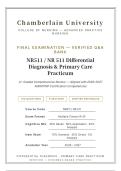
Chamberlain University
C OL L EG E OF NU RSI NG — A DVA NC ED PRAC TI C E
NURSING
F I N A L E X A M I N AT I O N — V E R I F I E D Q & A
BANK
NR511 / NR 511 Differential
Diagnosis & Primary Care
Practicum
A+ Graded Comprehensive Review — Aligned with 2026–2027
AGNP/FNP Certification Competencies
100 QUESTIONS 9 SECTIONS VERIFIED RATIONALES
Course Code NR511 / NR 511
Ex am Format Multiple Choice (A–D)
Cognitive Mix 30% Recall · 50% Application · 20%
Analysis
Item Style 75% Scenario · 20% Direct · 5%
Analysis
Academic Year 2026 – 2027
D I F F E R E N T I A L D I AG N O S I S · P R I M A R Y C A R E P R AC T I C U M
VERIFIED — EVIDENCE-BASED PRACTICE
,NR511 — Differential Diagnosis & Primary Care Practicum Final Exam Q&A | 2026–2027
NR511 / NR 511 Final Exam — Q & A (Latest )
Differential Diagnosis & Primary Care Practicum — Verified Answers with Comprehensive Rationales
Examination Structure: 100 multiple-choice questions across nine content domains, aligned with Chamberlain
University NR511 curriculum standards and AGNP/FNP certification competencies. Cognitive level distribution: 30%
recall, 50% application, 20% analysis. Item style: 75% scenario-based, 20% direct recall, 5% clinical analysis. Each
question includes a verified answer and a 2–3 sentence primary care rationale citing evidence-based guidelines
(ACC/AHA, USPSTF, CDC, GINA, GOLD, ATS/IDSA).
Section 1: Clinical Decision-Making and Differential Diagnosis Fundamentals
Questions 1–15 · 15 items
Q1: A 45-year-old female presents with fatigue. The NP orders a screening test with a sensitivity of 95%. The
patient tests negative. Which principle best explains why the NP can confidently rule out the disease?
A. Highly specific tests rule out disease (SpPin)
B. Highly sensitive tests rule out disease (SnNout) [CORRECT]
C. Negative predictive value is unaffected by prevalence
D. Likelihood ratio negative must be greater than 10
Correct Answer: B
Rationale:
A highly sensitive test, when negative, effectively rules OUT disease (SnNout). Sensitivity is the proportion of people with the
disease who test positive; with 95% sensitivity, only 5% of diseased patients are missed, making a negative result highly
reassuring for excluding the condition.
Q2: Which statement best describes the relationship between disease prevalence and predictive values?
A. PPV increases and NPV decreases as prevalence increases [CORRECT]
B. PPV decreases and NPV increases as prevalence increases
C. Both PPV and NPV increase as prevalence increases
D. Both PPV and NPV are independent of prevalence
Correct Answer: A
Rationale:
Positive predictive value (PPV) increases with higher disease prevalence because a positive result is more likely to be a true
positive. Conversely, negative predictive value (NPV) decreases as prevalence rises because a negative result is more likely to
be a false negative in a population where disease is common.
Q3: A diagnostic test has a likelihood ratio positive (LR+) of 15. How should the NP interpret this value?
A. The test has weak diagnostic value
B. The test is strong evidence for ruling in disease [CORRECT]
C. The test is strong evidence for ruling out disease
D. The LR+ must be less than 0.1 to be clinically useful
Correct Answer: B
Rationale:
A likelihood ratio positive (LR+) greater than 10 represents a strong test result that significantly increases the probability of
disease, providing strong evidence for ruling IN the diagnosis. Likelihood ratios are not affected by disease prevalence,
making them particularly useful across varied clinical settings.
Chamberlain University • Advanced Practice Nursing Page 1
, NR511 — Differential Diagnosis & Primary Care Practicum Final Exam Q&A | 2026–2027
Q4: An NP is developing a differential diagnosis for a patient with acute onset dyspnea. Which approach
represents the most appropriate initial step?
A. Order an immediate CT pulmonary angiogram
B. Generate a broad list of possibilities, then narrow based on history and exam [CORRECT]
C. Begin empiric treatment for the most likely diagnosis
D. Consult cardiology before further evaluation
Correct Answer: B
Rationale:
The differential diagnosis process begins with generating a broad list of potential conditions, then systematically narrowing
based on focused history, physical examination, and targeted diagnostic testing. This structured approach minimizes premature
closure and ensures life-threatening etiologies such as PE, heart failure, and pneumothorax are appropriately considered.
Q5: Which of the following is the most common reason for a patient to visit a primary care provider in the United
States?
A. Hypertension follow-up
B. Upper respiratory infection [CORRECT]
C. Routine health maintenance
D. Low back pain
Correct Answer: B
Rationale:
Upper respiratory infection (URI) is the most common reason for patient visits to primary care providers. This high frequency
highlights the importance of evidence-based antibiotic stewardship, as most URIs are viral and require symptomatic
management rather than antimicrobial therapy.
Q6: When considering the choice between a 'best initial test' and a 'most accurate test,' which principle is most
correct?
A. The most accurate test is always the best initial test
B. The best initial test is usually cheap, quick, and safe [CORRECT]
C. The best initial test should have the highest specificity possible
D. Cost should never factor into test selection
Correct Answer: B
Rationale:
The best initial test is typically inexpensive, rapid, safe, and reasonably sensitive to guide further workup. The most accurate
test, such as angiography or biopsy, is reserved for confirmation when initial testing is inconclusive or when the pretest
probability is high enough to warrant definitive diagnosis.
Q7: A test has a specificity of 98%. The result is positive. Applying the SpPin principle, what is the correct
interpretation?
A. The disease is definitively present
B. A highly specific test, when positive, rules IN disease [CORRECT]
C. A highly specific test, when positive, rules OUT disease
D. Specificity cannot guide clinical interpretation
Correct Answer: B
Rationale:
SpPin states that a highly Specific test, when Positive, rules IN the disease. With 98% specificity, only 2% of healthy
individuals test positive, so a positive result strongly supports the presence of disease. However, the NP must still integrate
pretest probability and clinical context.
Chamberlain University • Advanced Practice Nursing Page 2
C OL L EG E OF NU RSI NG — A DVA NC ED PRAC TI C E
NURSING
F I N A L E X A M I N AT I O N — V E R I F I E D Q & A
BANK
NR511 / NR 511 Differential
Diagnosis & Primary Care
Practicum
A+ Graded Comprehensive Review — Aligned with 2026–2027
AGNP/FNP Certification Competencies
100 QUESTIONS 9 SECTIONS VERIFIED RATIONALES
Course Code NR511 / NR 511
Ex am Format Multiple Choice (A–D)
Cognitive Mix 30% Recall · 50% Application · 20%
Analysis
Item Style 75% Scenario · 20% Direct · 5%
Analysis
Academic Year 2026 – 2027
D I F F E R E N T I A L D I AG N O S I S · P R I M A R Y C A R E P R AC T I C U M
VERIFIED — EVIDENCE-BASED PRACTICE
,NR511 — Differential Diagnosis & Primary Care Practicum Final Exam Q&A | 2026–2027
NR511 / NR 511 Final Exam — Q & A (Latest )
Differential Diagnosis & Primary Care Practicum — Verified Answers with Comprehensive Rationales
Examination Structure: 100 multiple-choice questions across nine content domains, aligned with Chamberlain
University NR511 curriculum standards and AGNP/FNP certification competencies. Cognitive level distribution: 30%
recall, 50% application, 20% analysis. Item style: 75% scenario-based, 20% direct recall, 5% clinical analysis. Each
question includes a verified answer and a 2–3 sentence primary care rationale citing evidence-based guidelines
(ACC/AHA, USPSTF, CDC, GINA, GOLD, ATS/IDSA).
Section 1: Clinical Decision-Making and Differential Diagnosis Fundamentals
Questions 1–15 · 15 items
Q1: A 45-year-old female presents with fatigue. The NP orders a screening test with a sensitivity of 95%. The
patient tests negative. Which principle best explains why the NP can confidently rule out the disease?
A. Highly specific tests rule out disease (SpPin)
B. Highly sensitive tests rule out disease (SnNout) [CORRECT]
C. Negative predictive value is unaffected by prevalence
D. Likelihood ratio negative must be greater than 10
Correct Answer: B
Rationale:
A highly sensitive test, when negative, effectively rules OUT disease (SnNout). Sensitivity is the proportion of people with the
disease who test positive; with 95% sensitivity, only 5% of diseased patients are missed, making a negative result highly
reassuring for excluding the condition.
Q2: Which statement best describes the relationship between disease prevalence and predictive values?
A. PPV increases and NPV decreases as prevalence increases [CORRECT]
B. PPV decreases and NPV increases as prevalence increases
C. Both PPV and NPV increase as prevalence increases
D. Both PPV and NPV are independent of prevalence
Correct Answer: A
Rationale:
Positive predictive value (PPV) increases with higher disease prevalence because a positive result is more likely to be a true
positive. Conversely, negative predictive value (NPV) decreases as prevalence rises because a negative result is more likely to
be a false negative in a population where disease is common.
Q3: A diagnostic test has a likelihood ratio positive (LR+) of 15. How should the NP interpret this value?
A. The test has weak diagnostic value
B. The test is strong evidence for ruling in disease [CORRECT]
C. The test is strong evidence for ruling out disease
D. The LR+ must be less than 0.1 to be clinically useful
Correct Answer: B
Rationale:
A likelihood ratio positive (LR+) greater than 10 represents a strong test result that significantly increases the probability of
disease, providing strong evidence for ruling IN the diagnosis. Likelihood ratios are not affected by disease prevalence,
making them particularly useful across varied clinical settings.
Chamberlain University • Advanced Practice Nursing Page 1
, NR511 — Differential Diagnosis & Primary Care Practicum Final Exam Q&A | 2026–2027
Q4: An NP is developing a differential diagnosis for a patient with acute onset dyspnea. Which approach
represents the most appropriate initial step?
A. Order an immediate CT pulmonary angiogram
B. Generate a broad list of possibilities, then narrow based on history and exam [CORRECT]
C. Begin empiric treatment for the most likely diagnosis
D. Consult cardiology before further evaluation
Correct Answer: B
Rationale:
The differential diagnosis process begins with generating a broad list of potential conditions, then systematically narrowing
based on focused history, physical examination, and targeted diagnostic testing. This structured approach minimizes premature
closure and ensures life-threatening etiologies such as PE, heart failure, and pneumothorax are appropriately considered.
Q5: Which of the following is the most common reason for a patient to visit a primary care provider in the United
States?
A. Hypertension follow-up
B. Upper respiratory infection [CORRECT]
C. Routine health maintenance
D. Low back pain
Correct Answer: B
Rationale:
Upper respiratory infection (URI) is the most common reason for patient visits to primary care providers. This high frequency
highlights the importance of evidence-based antibiotic stewardship, as most URIs are viral and require symptomatic
management rather than antimicrobial therapy.
Q6: When considering the choice between a 'best initial test' and a 'most accurate test,' which principle is most
correct?
A. The most accurate test is always the best initial test
B. The best initial test is usually cheap, quick, and safe [CORRECT]
C. The best initial test should have the highest specificity possible
D. Cost should never factor into test selection
Correct Answer: B
Rationale:
The best initial test is typically inexpensive, rapid, safe, and reasonably sensitive to guide further workup. The most accurate
test, such as angiography or biopsy, is reserved for confirmation when initial testing is inconclusive or when the pretest
probability is high enough to warrant definitive diagnosis.
Q7: A test has a specificity of 98%. The result is positive. Applying the SpPin principle, what is the correct
interpretation?
A. The disease is definitively present
B. A highly specific test, when positive, rules IN disease [CORRECT]
C. A highly specific test, when positive, rules OUT disease
D. Specificity cannot guide clinical interpretation
Correct Answer: B
Rationale:
SpPin states that a highly Specific test, when Positive, rules IN the disease. With 98% specificity, only 2% of healthy
individuals test positive, so a positive result strongly supports the presence of disease. However, the NP must still integrate
pretest probability and clinical context.
Chamberlain University • Advanced Practice Nursing Page 2