

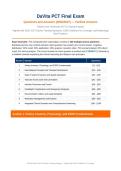
DaVita PCT Final Exam
Questions and Answers (2026/2027) — Verified Answers
Patient Care Technician (PCT) Training Program
Aligned with 2026–2027 DaVita Training Standards, CMS Conditions for Coverage, and Nephrology
Best Practices
Exam Overview: This comprehensive examination consists of 100 multiple-choice questions
distributed across nine content domains. Each question has exactly one correct answer. Cognitive
distribution: 30% recall, 50% application, 20% analysis. Question style: 75% scenario-based, 20% direct
recall, 5% clinical analysis. The correct answer for each question is marked with [CORRECT], followed by
a detailed rationale explaining the clinical reasoning and dialysis care principles.
Section Domain Questions
1 Kidney Anatomy, Physiology, and ESRD Fundamentals Q1 - Q15
2 Hemodialysis Principles and Transport Mechanisms Q16 - Q30
3 Water Treatment Systems and Quality Standards Q31 - Q40
4 Vascular Access Care and Cannulation Q41 - Q55
5 Infection Prevention and Control Q56 - Q65
6 Intradialytic Complications and Emergency Response Q66 - Q80
7 Documentation, Safety, and Legal Standards Q81 - Q88
8 Medication Management and Nutrition Q89 - Q95
9 Integrated Clinical Scenarios and Comprehensive Reasoning Q96 - Q100
Section 1: Kidney Anatomy, Physiology, and ESRD Fundamentals
DaVita Patient Care Technician Training Program | Aligned with CMS Conditions for Coverage
,DaVita PCT Final Exam | 2026/2027 Verified Answers Page 2
Q1: The basic structural and functional unit of the kidney is the nephron. Approximately how
many nephrons does each kidney contain?
A. Approximately 100,000
B. Approximately 500,000
C. Approximately 1,000,000 [CORRECT]
D. Approximately 5,000,000
Correct Answer: C
Rationale: Each kidney contains approximately one million nephrons, which serve as the basic structural
and functional units responsible for filtration, reabsorption, and secretion. Once nephrons are damaged and
lost they cannot regenerate, making preservation of remaining nephron function a priority in chronic kidney
disease (CKD) management and reinforcing why nephrology teams emphasize blood pressure and glycemic
control to slow progression.
Q2: A patient with CKD asks the PCT why they require erythropoietin (EPO) injections. Which
endocrine function of the kidney is being replaced by this medication?
A. Renin secretion for blood pressure regulation
B. Erythropoietin production for red blood cell formation [CORRECT]
C. Activation of vitamin D for calcium absorption
D. Bicarbonate buffering for acid-base balance
Correct Answer: B
Rationale: The kidneys produce erythropoietin (EPO), a hormone that stimulates the bone marrow to
produce red blood cells. In ESRD the damaged kidneys cannot produce adequate EPO, leading to
normocytic anemia. Recombinant EPO injections (epoetin alfa, darbepoetin) replace this endocrine function
and are essential in managing renal anemia, which if untreated contributes to fatigue, LVH, and reduced
quality of life.
Q3: A patient asks the PCT why they must take a calcitriol (active vitamin D) supplement.
Which kidney function has been impaired by ESRD?
A. Excretory function for fluid balance
B. Endocrine function activating vitamin D [CORRECT]
C. Filtration of urea and creatinine
D. Regulation of blood pressure via renin
Correct Answer: B
Rationale: The kidneys convert inactive 25-hydroxyvitamin D to its active form, calcitriol
(1,25-dihydroxyvitamin D), which is essential for intestinal calcium absorption and bone mineralization. In
ESRD this activation is impaired, contributing to CKD-MBD (chronic kidney disease-mineral and bone
disorder). Supplementation with active vitamin D analogs helps prevent hypocalcemia, secondary
hyperparathyroidism, and renal osteodystrophy.
DaVita Patient Care Technician Training Program | Aligned with CMS Conditions for Coverage
,DaVita PCT Final Exam | 2026/2027 Verified Answers Page 3
Q4: At what GFR level is a patient considered to have end-stage renal disease (ESRD)
requiring dialysis or transplant?
A. GFR less than 90 mL/min/1.73m²
B. GFR less than 60 mL/min/1.73m²
C. GFR less than 30 mL/min/1.73m²
D. GFR less than 15 mL/min/1.73m² [CORRECT]
Correct Answer: D
Rationale: ESRD is defined as a GFR less than 15 mL/min/1.73m², at which point the kidneys can no longer
sustain life without renal replacement therapy (dialysis or transplant). This corresponds to Stage 5 CKD.
Patients typically experience uremic symptoms, fluid overload, electrolyte imbalances, and metabolic
acidosis requiring initiation of dialysis. Earlier stages (1-4) focus on slowing progression and managing
complications.
Q5: A patient with ESRD has elevated phosphorus, low calcium, and elevated PTH on routine
labs. These findings are characteristic of which condition?
A. Left ventricular hypertrophy (LVH)
B. CKD-MBD (chronic kidney disease-mineral and bone disorder) [CORRECT]
C. Renal anemia
D. Hyperkalemia
Correct Answer: B
Rationale: CKD-MBD is a systemic disorder characterized by abnormalities in calcium, phosphorus, PTH,
and vitamin D metabolism. The failing kidneys cannot excrete phosphorus or activate vitamin D, leading to
hypocalcemia, which triggers elevated PTH (secondary hyperparathyroidism). This causes bone disease
(renal osteodystrophy), vascular calcification, and increased cardiovascular mortality. Management includes
phosphate binders, vitamin D analogs, and dietary phosphorus restriction.
Q6: Which of the following is NOT an excretory function of the kidneys?
A. Fluid balance via ultrafiltration
B. Electrolyte balance via diffusion
C. Erythropoietin production [CORRECT]
D. Waste removal of urea and creatinine
Correct Answer: C
Rationale: Excretory functions include fluid balance (ultrafiltration), electrolyte balance (diffusion), acid-base
balance (bicarbonate buffering), and waste removal (urea, creatinine). Erythropoietin production is an
endocrine function, not excretory. The distinction is clinically important because dialysis can replace
excretory functions but cannot replace endocrine functions, which require medication supplementation
(EPO, calcitriol) for the lifetime of the ESRD patient.
DaVita Patient Care Technician Training Program | Aligned with CMS Conditions for Coverage
, DaVita PCT Final Exam | 2026/2027 Verified Answers Page 4
Q7: A patient reports extreme muscle weakness and the ECG shows peaked T waves. The
PCT suspects hyperkalemia. Which excretory function of the kidney is most directly failing?
A. Acid-base balance via bicarbonate buffering
B. Electrolyte balance, specifically potassium excretion [CORRECT]
C. Fluid balance via ultrafiltration
D. Waste removal of urea
Correct Answer: B
Rationale: The kidneys regulate electrolyte balance, including potassium excretion through the distal tubule.
In ESRD, the inability to excrete potassium leads to hyperkalemia, which presents with muscle weakness
and potentially lethal cardiac arrhythmias (peaked T waves, widened QRS). This is a medical emergency
requiring immediate intervention: calcium gluconate for cardiac membrane stabilization, insulin/glucose for
cellular shift, and emergent dialysis for definitive removal.
Q8: Which hormone, secreted by the juxtaglomerular cells of the kidney, is part of the RAAS
system and helps regulate blood pressure?
A. Erythropoietin
B. Calcitriol
C. Renin [CORRECT]
D. Insulin
Correct Answer: C
Rationale: Renin is secreted by the juxtaglomerular cells of the kidney in response to low blood pressure,
low sodium, or sympathetic stimulation. It initiates the RAAS cascade by converting angiotensinogen to
angiotensin I, which is then converted to angiotensin II (a potent vasoconstrictor) and stimulates aldosterone
release (sodium and water retention). In ESRD, dysregulation of this system contributes to hypertension, a
major cardiovascular risk factor in dialysis patients.
Q9: A patient with ESRD has thickening of the heart’s lower left pumping chamber (LVH)
detected on echocardiogram. What is the most significant clinical risk associated with this
condition?
A. Increased risk of bone fractures
B. Increased risk of ischemic heart disease, arrhythmia, MI, and sudden death [CORRECT]
C. Increased risk of peritonitis
D. Increased risk of vascular access infection
Correct Answer: B
Rationale: Left ventricular hypertrophy (LVH) is thickening of the heart’s lower left pumping chamber,
commonly seen in dialysis patients due to chronic fluid overload, hypertension, anemia, and AVF shunting.
LVH leads to ischemic heart disease, arrhythmias, myocardial infarction, and sudden cardiac death—the
leading cause of mortality in dialysis patients. Strict fluid and blood pressure management and anemia
correction are essential to reduce cardiovascular risk.
DaVita Patient Care Technician Training Program | Aligned with CMS Conditions for Coverage
Questions and Answers (2026/2027) — Verified Answers
Patient Care Technician (PCT) Training Program
Aligned with 2026–2027 DaVita Training Standards, CMS Conditions for Coverage, and Nephrology
Best Practices
Exam Overview: This comprehensive examination consists of 100 multiple-choice questions
distributed across nine content domains. Each question has exactly one correct answer. Cognitive
distribution: 30% recall, 50% application, 20% analysis. Question style: 75% scenario-based, 20% direct
recall, 5% clinical analysis. The correct answer for each question is marked with [CORRECT], followed by
a detailed rationale explaining the clinical reasoning and dialysis care principles.
Section Domain Questions
1 Kidney Anatomy, Physiology, and ESRD Fundamentals Q1 - Q15
2 Hemodialysis Principles and Transport Mechanisms Q16 - Q30
3 Water Treatment Systems and Quality Standards Q31 - Q40
4 Vascular Access Care and Cannulation Q41 - Q55
5 Infection Prevention and Control Q56 - Q65
6 Intradialytic Complications and Emergency Response Q66 - Q80
7 Documentation, Safety, and Legal Standards Q81 - Q88
8 Medication Management and Nutrition Q89 - Q95
9 Integrated Clinical Scenarios and Comprehensive Reasoning Q96 - Q100
Section 1: Kidney Anatomy, Physiology, and ESRD Fundamentals
DaVita Patient Care Technician Training Program | Aligned with CMS Conditions for Coverage
,DaVita PCT Final Exam | 2026/2027 Verified Answers Page 2
Q1: The basic structural and functional unit of the kidney is the nephron. Approximately how
many nephrons does each kidney contain?
A. Approximately 100,000
B. Approximately 500,000
C. Approximately 1,000,000 [CORRECT]
D. Approximately 5,000,000
Correct Answer: C
Rationale: Each kidney contains approximately one million nephrons, which serve as the basic structural
and functional units responsible for filtration, reabsorption, and secretion. Once nephrons are damaged and
lost they cannot regenerate, making preservation of remaining nephron function a priority in chronic kidney
disease (CKD) management and reinforcing why nephrology teams emphasize blood pressure and glycemic
control to slow progression.
Q2: A patient with CKD asks the PCT why they require erythropoietin (EPO) injections. Which
endocrine function of the kidney is being replaced by this medication?
A. Renin secretion for blood pressure regulation
B. Erythropoietin production for red blood cell formation [CORRECT]
C. Activation of vitamin D for calcium absorption
D. Bicarbonate buffering for acid-base balance
Correct Answer: B
Rationale: The kidneys produce erythropoietin (EPO), a hormone that stimulates the bone marrow to
produce red blood cells. In ESRD the damaged kidneys cannot produce adequate EPO, leading to
normocytic anemia. Recombinant EPO injections (epoetin alfa, darbepoetin) replace this endocrine function
and are essential in managing renal anemia, which if untreated contributes to fatigue, LVH, and reduced
quality of life.
Q3: A patient asks the PCT why they must take a calcitriol (active vitamin D) supplement.
Which kidney function has been impaired by ESRD?
A. Excretory function for fluid balance
B. Endocrine function activating vitamin D [CORRECT]
C. Filtration of urea and creatinine
D. Regulation of blood pressure via renin
Correct Answer: B
Rationale: The kidneys convert inactive 25-hydroxyvitamin D to its active form, calcitriol
(1,25-dihydroxyvitamin D), which is essential for intestinal calcium absorption and bone mineralization. In
ESRD this activation is impaired, contributing to CKD-MBD (chronic kidney disease-mineral and bone
disorder). Supplementation with active vitamin D analogs helps prevent hypocalcemia, secondary
hyperparathyroidism, and renal osteodystrophy.
DaVita Patient Care Technician Training Program | Aligned with CMS Conditions for Coverage
,DaVita PCT Final Exam | 2026/2027 Verified Answers Page 3
Q4: At what GFR level is a patient considered to have end-stage renal disease (ESRD)
requiring dialysis or transplant?
A. GFR less than 90 mL/min/1.73m²
B. GFR less than 60 mL/min/1.73m²
C. GFR less than 30 mL/min/1.73m²
D. GFR less than 15 mL/min/1.73m² [CORRECT]
Correct Answer: D
Rationale: ESRD is defined as a GFR less than 15 mL/min/1.73m², at which point the kidneys can no longer
sustain life without renal replacement therapy (dialysis or transplant). This corresponds to Stage 5 CKD.
Patients typically experience uremic symptoms, fluid overload, electrolyte imbalances, and metabolic
acidosis requiring initiation of dialysis. Earlier stages (1-4) focus on slowing progression and managing
complications.
Q5: A patient with ESRD has elevated phosphorus, low calcium, and elevated PTH on routine
labs. These findings are characteristic of which condition?
A. Left ventricular hypertrophy (LVH)
B. CKD-MBD (chronic kidney disease-mineral and bone disorder) [CORRECT]
C. Renal anemia
D. Hyperkalemia
Correct Answer: B
Rationale: CKD-MBD is a systemic disorder characterized by abnormalities in calcium, phosphorus, PTH,
and vitamin D metabolism. The failing kidneys cannot excrete phosphorus or activate vitamin D, leading to
hypocalcemia, which triggers elevated PTH (secondary hyperparathyroidism). This causes bone disease
(renal osteodystrophy), vascular calcification, and increased cardiovascular mortality. Management includes
phosphate binders, vitamin D analogs, and dietary phosphorus restriction.
Q6: Which of the following is NOT an excretory function of the kidneys?
A. Fluid balance via ultrafiltration
B. Electrolyte balance via diffusion
C. Erythropoietin production [CORRECT]
D. Waste removal of urea and creatinine
Correct Answer: C
Rationale: Excretory functions include fluid balance (ultrafiltration), electrolyte balance (diffusion), acid-base
balance (bicarbonate buffering), and waste removal (urea, creatinine). Erythropoietin production is an
endocrine function, not excretory. The distinction is clinically important because dialysis can replace
excretory functions but cannot replace endocrine functions, which require medication supplementation
(EPO, calcitriol) for the lifetime of the ESRD patient.
DaVita Patient Care Technician Training Program | Aligned with CMS Conditions for Coverage
, DaVita PCT Final Exam | 2026/2027 Verified Answers Page 4
Q7: A patient reports extreme muscle weakness and the ECG shows peaked T waves. The
PCT suspects hyperkalemia. Which excretory function of the kidney is most directly failing?
A. Acid-base balance via bicarbonate buffering
B. Electrolyte balance, specifically potassium excretion [CORRECT]
C. Fluid balance via ultrafiltration
D. Waste removal of urea
Correct Answer: B
Rationale: The kidneys regulate electrolyte balance, including potassium excretion through the distal tubule.
In ESRD, the inability to excrete potassium leads to hyperkalemia, which presents with muscle weakness
and potentially lethal cardiac arrhythmias (peaked T waves, widened QRS). This is a medical emergency
requiring immediate intervention: calcium gluconate for cardiac membrane stabilization, insulin/glucose for
cellular shift, and emergent dialysis for definitive removal.
Q8: Which hormone, secreted by the juxtaglomerular cells of the kidney, is part of the RAAS
system and helps regulate blood pressure?
A. Erythropoietin
B. Calcitriol
C. Renin [CORRECT]
D. Insulin
Correct Answer: C
Rationale: Renin is secreted by the juxtaglomerular cells of the kidney in response to low blood pressure,
low sodium, or sympathetic stimulation. It initiates the RAAS cascade by converting angiotensinogen to
angiotensin I, which is then converted to angiotensin II (a potent vasoconstrictor) and stimulates aldosterone
release (sodium and water retention). In ESRD, dysregulation of this system contributes to hypertension, a
major cardiovascular risk factor in dialysis patients.
Q9: A patient with ESRD has thickening of the heart’s lower left pumping chamber (LVH)
detected on echocardiogram. What is the most significant clinical risk associated with this
condition?
A. Increased risk of bone fractures
B. Increased risk of ischemic heart disease, arrhythmia, MI, and sudden death [CORRECT]
C. Increased risk of peritonitis
D. Increased risk of vascular access infection
Correct Answer: B
Rationale: Left ventricular hypertrophy (LVH) is thickening of the heart’s lower left pumping chamber,
commonly seen in dialysis patients due to chronic fluid overload, hypertension, anemia, and AVF shunting.
LVH leads to ischemic heart disease, arrhythmias, myocardial infarction, and sudden cardiac death—the
leading cause of mortality in dialysis patients. Strict fluid and blood pressure management and anemia
correction are essential to reduce cardiovascular risk.
DaVita Patient Care Technician Training Program | Aligned with CMS Conditions for Coverage

