Escrito por estudiantes que aprobaron Inmediatamente disponible después del pago Leer en línea o como PDF ¿Documento equivocado? Cámbialo gratis 4,6 TrustPilot
logo-home
Examen

Police Academy Test 1 | 180+ Practice Questions and Correct Answers | Patrol Operations, Traffic Stops, Crime Prevention, APOST, Police History & Ethics | Police Academy Certification Exam

Puntuación
-
Vendido
-
Páginas
14
Grado
A+
Subido en
17-07-2026
Escrito en
2025/2026

Prepare for Police Academy Test 1 with this comprehensive collection of 180+ exam-style practice questions and verified answers covering the essential principles of patrol operations, law enforcement history, police ethics, traffic enforcement, crime prevention, officer safety, and police professionalism. This study guide provides an in-depth review of key topics including suspicious activity recognition, hotspot policing, visible and undercover patrol, preventive and selective enforcement, responding to crimes in progress, first responder responsibilities, modern offender characteristics, traffic stop procedures, officer survival techniques, probable cause for vehicle searches, crime prevention strategies, patrol theories, crime assessment models, Robert Peel’s Principles of Policing, Code of Hammurabi, early policing systems, Metropolitan Police Act, Boston Police Department history, Texas Rangers, U.S. Marshals Service, Federal Bureau of Investigation (FBI), Drug Enforcement Administration (DEA), U.S. Postal Inspection Service, Secret Service, Crime Stoppers, ethics, professionalism, CALEA accreditation standards, APOST certification requirements, Alabama law enforcement agencies, and community policing. Organized in a structured question-and-answer format, this resource is ideal for active recall, concept mastery, and comprehensive preparation for Police Academy certification examinations. Beyond examination preparation, this study guide develops a thorough understanding of the operational responsibilities and professional expectations of modern law enforcement officers. It explores patrol planning, emergency response, officer safety during traffic stops, radio communications, investigative responsibilities, crime reduction strategies, ethical decision-making, community trust, accreditation standards, police leadership, historical development of policing, and the organization of federal, state, and local law enforcement agencies. The material also reviews APOST certification standards, police training requirements, Crime Stoppers programs, constitutional policing principles, and professional conduct, helping recruits build the knowledge and judgment required for success throughout academy training and future law enforcement careers. By combining historical foundations with modern policing practices, this guide serves as an essential resource for both academy coursework and certification exam preparation. The content aligns with nationally recognized law enforcement standards and authoritative references, including the Alabama Peace Officers' Standards and Training Commission (APOST) certification requirements, the Commission on Accreditation for Law Enforcement Agencies (CALEA) accreditation standards, the U.S. Department of Justice Office of Community Oriented Policing Services (COPS Office), and Peak, K. J. Policing America: Challenges and Best Practices (Pearson). It also reflects the enduring Peelian Principles of Policing, which continue to influence modern policing philosophy, professionalism, accountability, and community engagement. These authoritative frameworks provide the academic and practical foundation for understanding patrol operations, police ethics, officer safety, crime prevention, and professional law enforcement practices. Relevant Students: Police Academy recruits, Police Academy certification candidates, APOST students, Law Enforcement students, Criminal Justice students, Police Science students, Public Safety students, Homeland Security students, Criminology students, Sheriff's Office recruits, Municipal Police recruits, State Police recruits, Campus Police recruits, Corrections Officer recruits, Security Management students, Emergency Management students. Keywords: Police Academy Test 1, police academy exam, police academy certification, APOST, Alabama Peace Officers Standards and Training, patrol operations, patrol theories, visible patrol, undercover patrol, suspicious activity, hotspot policing, crime prevention, preventive enforcement, selective enforcement, first responder, emergency response, traffic stops, officer safety, survival techniques, probable cause, vehicle searches, community policing, Robert Peel, Peelian Principles, Code of Hammurabi, Metropolitan Police Act, police history, Boston Police, Texas Rangers, U.S. Marshals, FBI, DEA, U.S. Postal Inspection Service, Secret Service, Crime Stoppers, ethics, professionalism, CALEA, accreditation, police leadership, police training, Alabama law enforcement, law enforcement agencies, criminal justice, public safety, police procedures, police exam, practice questions, exam questions, study guide

Mostrar más Leer menos
Institución
Grado

Vista previa del contenido

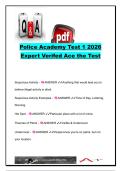
Police Academy Test 1 2026
Expert Verifed Ace the Test


Suspicious Activity - ANSWER ✔✔Anything that would lead you to

believe illegal activity is afoot.


Suspicious Activity Examples - ANSWER ✔✔Time of Day, Loitering,

Running


Hot Spot - ANSWER ✔✔Particular place with a lot of crime.


Theories of Patrol - ANSWER ✔✔Visible & Undercover


Undercover - ANSWER ✔✔People know you're on patrol, but not

your location.

, Preventive Enforcement - ANSWER ✔✔Protection, uses presence to

help prevent crime.


Selective Enforcement - ANSWER ✔✔Directed to specific violations

or circumstances. Normally the solution to where the trouble is likely to

occur.


Responding to crimes in progress. - ANSWER ✔✔1) Go directly to

scene.

2) Use emergency procedures.

3) Go to where fleeing suspect may be.

4) Know dangers exist for every call.


Responsibility of first respondent - ANSWER ✔✔1) Formulate flexible

plan

2) Coordinate with other units.


Modern Day Offender - ANSWER ✔✔1) Highly mobile


2) Ease of committing crimes away from home town.


Points of jeopardy at traffic stops. - ANSWER ✔✔1) Approaching

suspects vehicle

2) Violators hands out of view.

Escuela, estudio y materia

Institución
Grado

Información del documento

Subido en
17 de julio de 2026
Número de páginas
14
Escrito en
2025/2026
Tipo
Examen
Contiene
Preguntas y respuestas

Temas

$18.99
Accede al documento completo:

¿Documento equivocado? Cámbialo gratis Dentro de los 14 días posteriores a la compra y antes de descargarlo, puedes elegir otro documento. Puedes gastar el importe de nuevo.
Escrito por estudiantes que aprobaron
Inmediatamente disponible después del pago
Leer en línea o como PDF


Documento también disponible en un lote

Conoce al vendedor

Seller avatar
Los indicadores de reputación están sujetos a la cantidad de artículos vendidos por una tarifa y las reseñas que ha recibido por esos documentos. Hay tres niveles: Bronce, Plata y Oro. Cuanto mayor reputación, más podrás confiar en la calidad del trabajo del vendedor.
NinjaNerd Liberty University
Seguir Necesitas iniciar sesión para seguir a otros usuarios o asignaturas
Vendido
383
Miembro desde
2 año
Número de seguidores
6
Documentos
14972
Última venta
2 días hace
NinjaNerd

Here You will All Documents and Package Deals Offered by Seller NinjaNerd.

3.5

74 reseñas

5
26
4
14
3
16
2
4
1
14

Por qué los estudiantes eligen Stuvia

Creado por compañeros estudiantes, verificado por reseñas

Calidad en la que puedes confiar: escrito por estudiantes que aprobaron y evaluado por otros que han usado estos resúmenes.

¿No estás satisfecho? Elige otro documento

¡No te preocupes! Puedes elegir directamente otro documento que se ajuste mejor a lo que buscas.

Paga como quieras, empieza a estudiar al instante

Sin suscripción, sin compromisos. Paga como estés acostumbrado con tarjeta de crédito y descarga tu documento PDF inmediatamente.

Student with book image

“Comprado, descargado y aprobado. Así de fácil puede ser.”

Alisha Student

Preguntas frecuentes