

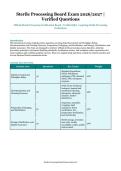
Sterile Processing Board Exam 2026/2027 |
Verified Questions
Official Sterile Processing Certification Board | Verified Q&A | Aspiring Sterile Processing
Technicians
Introduction
This document presents original practice questions covering Infection Control and Workplace Safety,
Decontamination and Cleaning Processes, Preparation, Packaging, and Sterilization, and Storage, Distribution, and
Quality Assurance. The items are designed to reinforce official sterile processing course objectives, infection
prevention principles, instrument handling standards, sterilization science, and workplace safety expectations for
exam readiness and certified academic success. These are original study questions created for mastery practice and
are not disclosed board examination items.
Content Area Overview
Content Area Questions Key Topics Weight
Standard precautions,
OSHA, bloodborne
Infection Control and
30 pathogens, PPE, chemical 20%
Workplace Safety
safety, SDS, emergency
response
Point-of-use treatment,
transport, manual and
Decontamination and mechanical cleaning,
38 25%
Cleaning Processes detergents, ultrasonic
cleaners, washer-
disinfectors
Inspection, assembly,
wrapping, rigid
Preparation, Packaging, containers, steam
52 35%
and Sterilization sterilization, low-
temperature sterilization,
load monitoring
Sterile storage, inventory,
Storage, Distribution, and case carts, recalls,
30 20%
Quality Assurance traceability, audits, quality
improvement
Sterile Processing Board Exam 2026/2027
,Actual Questions
Domain: Infection Control and Workplace Safety
1. Which statement best reflects standard precautions in sterile processing?
A. They apply only to trays from isolation rooms
B. They assume all blood and body fluids are potentially infectious and require consistent protective measures
C. They are used only after a confirmed exposure incident
D. They replace the need for routine hand hygiene
Answer: B
Rationale: Standard precautions are based on treating potentially infectious materials consistently, which
supports routine infection prevention in all work areas.
2. After removing contaminated gloves in the decontamination area, what should the technician do
next?
A. Handle clean packaging materials immediately
B. Perform hand hygiene before touching other surfaces or equipment
C. Document the load first and wash hands later
D. Put on a second pair of gloves without hand hygiene
Answer: B
Rationale: Glove removal does not eliminate contamination risk, so hand hygiene is still required to prevent
transfer to the environment or clean items.
3. A contaminated suture needle punctures a technician's finger. This is an example of what type of
occupational hazard?
A. Airborne exposure
B. Percutaneous bloodborne pathogen exposure
C. Thermal injury only
D. Ergonomic strain
Answer: B
Rationale: A sharps injury that breaks the skin is a percutaneous exposure and must be managed under
bloodborne pathogen protocols.
4. What is the main purpose of a facility exposure control plan?
A. To list vacation schedules for the department
B. To outline how occupational exposure to bloodborne pathogens will be prevented and managed
C. To replace all manufacturer instructions for use
D. To document only sterilizer maintenance activities
Answer: B
Rationale: OSHA requires an exposure control plan so staff know how hazards will be minimized and how
incidents will be handled.
5. Under bloodborne pathogen rules, when should the hepatitis B vaccine be offered to eligible
employees with occupational exposure risk?
A. Only after they have worked one full year
B. After a needlestick occurs and laboratory results return
C. At no cost after required training and within the required employment timeline
D. Only if the employee purchases it independently
Answer: C
Rationale: Eligible workers must be offered hepatitis B vaccination as part of the employer's bloodborne
pathogen program.
6. When should a sharps container generally be replaced?
Sterile Processing Board Exam 2026/2027
, A. Only when items begin falling out of the opening
B. When it reaches the designated fill line or recommended capacity
C. After every single needle is discarded
D. Only during annual department inspection
Answer: B
Rationale: Sharps containers should not be overfilled because overfilling increases the risk of injury during
disposal.
7. If a chemical splashes into a technician's eyes, what is the immediate first action?
A. Rub the eyes to remove the chemical faster
B. Go directly to lunch break and report later
C. Begin flushing the eyes at the eyewash station and follow facility protocol
D. Apply an ointment from a coworker's locker
Answer: C
Rationale: Immediate irrigation helps limit tissue injury after a chemical eye exposure and should occur without
delay.
8. What information is primarily found in a safety data sheet for a chemical used in sterile
processing?
A. Only the product's purchase price
B. Hazards, safe handling, required PPE, and first-aid measures
C. The name of the department manager on duty
D. The count sheet for orthopedic trays
Answer: B
Rationale: An SDS provides standardized hazard communication details so staff can use the chemical safely and
respond appropriately to exposures.
9. A detergent is transferred from its original bottle into a smaller working container. What is
required next?
A. Leave the new container unlabeled if it will be used today
B. Label the secondary container according to hazard communication policy
C. Store it under the sink without identification
D. Mix it with another detergent to reduce labeling steps
Answer: B
Rationale: Secondary containers require proper labeling so staff can identify hazards and safe handling
requirements.
10. Which sequence is most appropriate when donning PPE for the decontamination area?
A. Gloves, mask, gown, face shield
B. Gown, mask or face protection, then gloves
C. Face shield, gloves, shoe covers, then gown only if needed
D. Gloves first so the hands stay protected while dressing
Answer: B
Rationale: PPE is donned in an order that allows body and face protection to be secured before gloving for
contaminated work.
11. What is the safest principle when removing contaminated PPE?
A. Remove items in a way that avoids touching the contaminated outer surfaces
B. Shake the gown briskly to release moisture before removal
C. Take off the mask first with contaminated gloves and touch the front freely
D. Skip hand hygiene if the gloves remained intact
Answer: A
Rationale: PPE removal should minimize self-contamination by avoiding contact with soiled surfaces and by
incorporating hand hygiene.
12. Which PPE is most important when there is risk of fluid splash to the face during manual
cleaning?
A. Hair cover only
B. Eye and face protection such as a face shield or goggles with mask
C. Sterile gloves only
D. Lead apron
Sterile Processing Board Exam 2026/2027
Verified Questions
Official Sterile Processing Certification Board | Verified Q&A | Aspiring Sterile Processing
Technicians
Introduction
This document presents original practice questions covering Infection Control and Workplace Safety,
Decontamination and Cleaning Processes, Preparation, Packaging, and Sterilization, and Storage, Distribution, and
Quality Assurance. The items are designed to reinforce official sterile processing course objectives, infection
prevention principles, instrument handling standards, sterilization science, and workplace safety expectations for
exam readiness and certified academic success. These are original study questions created for mastery practice and
are not disclosed board examination items.
Content Area Overview
Content Area Questions Key Topics Weight
Standard precautions,
OSHA, bloodborne
Infection Control and
30 pathogens, PPE, chemical 20%
Workplace Safety
safety, SDS, emergency
response
Point-of-use treatment,
transport, manual and
Decontamination and mechanical cleaning,
38 25%
Cleaning Processes detergents, ultrasonic
cleaners, washer-
disinfectors
Inspection, assembly,
wrapping, rigid
Preparation, Packaging, containers, steam
52 35%
and Sterilization sterilization, low-
temperature sterilization,
load monitoring
Sterile storage, inventory,
Storage, Distribution, and case carts, recalls,
30 20%
Quality Assurance traceability, audits, quality
improvement
Sterile Processing Board Exam 2026/2027
,Actual Questions
Domain: Infection Control and Workplace Safety
1. Which statement best reflects standard precautions in sterile processing?
A. They apply only to trays from isolation rooms
B. They assume all blood and body fluids are potentially infectious and require consistent protective measures
C. They are used only after a confirmed exposure incident
D. They replace the need for routine hand hygiene
Answer: B
Rationale: Standard precautions are based on treating potentially infectious materials consistently, which
supports routine infection prevention in all work areas.
2. After removing contaminated gloves in the decontamination area, what should the technician do
next?
A. Handle clean packaging materials immediately
B. Perform hand hygiene before touching other surfaces or equipment
C. Document the load first and wash hands later
D. Put on a second pair of gloves without hand hygiene
Answer: B
Rationale: Glove removal does not eliminate contamination risk, so hand hygiene is still required to prevent
transfer to the environment or clean items.
3. A contaminated suture needle punctures a technician's finger. This is an example of what type of
occupational hazard?
A. Airborne exposure
B. Percutaneous bloodborne pathogen exposure
C. Thermal injury only
D. Ergonomic strain
Answer: B
Rationale: A sharps injury that breaks the skin is a percutaneous exposure and must be managed under
bloodborne pathogen protocols.
4. What is the main purpose of a facility exposure control plan?
A. To list vacation schedules for the department
B. To outline how occupational exposure to bloodborne pathogens will be prevented and managed
C. To replace all manufacturer instructions for use
D. To document only sterilizer maintenance activities
Answer: B
Rationale: OSHA requires an exposure control plan so staff know how hazards will be minimized and how
incidents will be handled.
5. Under bloodborne pathogen rules, when should the hepatitis B vaccine be offered to eligible
employees with occupational exposure risk?
A. Only after they have worked one full year
B. After a needlestick occurs and laboratory results return
C. At no cost after required training and within the required employment timeline
D. Only if the employee purchases it independently
Answer: C
Rationale: Eligible workers must be offered hepatitis B vaccination as part of the employer's bloodborne
pathogen program.
6. When should a sharps container generally be replaced?
Sterile Processing Board Exam 2026/2027
, A. Only when items begin falling out of the opening
B. When it reaches the designated fill line or recommended capacity
C. After every single needle is discarded
D. Only during annual department inspection
Answer: B
Rationale: Sharps containers should not be overfilled because overfilling increases the risk of injury during
disposal.
7. If a chemical splashes into a technician's eyes, what is the immediate first action?
A. Rub the eyes to remove the chemical faster
B. Go directly to lunch break and report later
C. Begin flushing the eyes at the eyewash station and follow facility protocol
D. Apply an ointment from a coworker's locker
Answer: C
Rationale: Immediate irrigation helps limit tissue injury after a chemical eye exposure and should occur without
delay.
8. What information is primarily found in a safety data sheet for a chemical used in sterile
processing?
A. Only the product's purchase price
B. Hazards, safe handling, required PPE, and first-aid measures
C. The name of the department manager on duty
D. The count sheet for orthopedic trays
Answer: B
Rationale: An SDS provides standardized hazard communication details so staff can use the chemical safely and
respond appropriately to exposures.
9. A detergent is transferred from its original bottle into a smaller working container. What is
required next?
A. Leave the new container unlabeled if it will be used today
B. Label the secondary container according to hazard communication policy
C. Store it under the sink without identification
D. Mix it with another detergent to reduce labeling steps
Answer: B
Rationale: Secondary containers require proper labeling so staff can identify hazards and safe handling
requirements.
10. Which sequence is most appropriate when donning PPE for the decontamination area?
A. Gloves, mask, gown, face shield
B. Gown, mask or face protection, then gloves
C. Face shield, gloves, shoe covers, then gown only if needed
D. Gloves first so the hands stay protected while dressing
Answer: B
Rationale: PPE is donned in an order that allows body and face protection to be secured before gloving for
contaminated work.
11. What is the safest principle when removing contaminated PPE?
A. Remove items in a way that avoids touching the contaminated outer surfaces
B. Shake the gown briskly to release moisture before removal
C. Take off the mask first with contaminated gloves and touch the front freely
D. Skip hand hygiene if the gloves remained intact
Answer: A
Rationale: PPE removal should minimize self-contamination by avoiding contact with soiled surfaces and by
incorporating hand hygiene.
12. Which PPE is most important when there is risk of fluid splash to the face during manual
cleaning?
A. Hair cover only
B. Eye and face protection such as a face shield or goggles with mask
C. Sterile gloves only
D. Lead apron
Sterile Processing Board Exam 2026/2027

