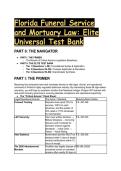
Florida Funeral Service
and Mortuary Law: Elite
Universal Test Bank
PART 0: THE NAVIGATOR
● PART I: THE PRIMER
○ The Mission & Critical Axioms (Legislative Baselines)
● PART II: THE ELITE TEST BANK
○ Tier 1 (Questions 1–28): Foundational Syntax & Application
○ Tier 2 (Questions 29–58): Complex Application & Simulation
○ Tier 3 (Questions 59–88): Grandmaster Synthesis
PART I: THE PRIMER
Mastering this exhaustive test bank translates directly to elite legal, clinical, and operational
command of Florida’s highly regulated deathcare industry. By internalizing these 88 high-stakes
scenarios, you will forge an academic intuition that flawlessly bridges Chapter 497 statutes with
real-world mortuary governance, ensuring absolute compliance and operational superiority.
● The "Critical Axioms" Cheat Sheet:
Legal/Operational Domain The Axiom / Standard Statutory/Rule Citation
Preneed Trusting Deposits must equal 70% for F.S. 497.458
services, 100% for cash
advances, and the greater of
30% retail or 110% wholesale
for merchandise.
LAP Hierarchy Inter vivos written direction → F.S. 497.005
Military Designee → Surviving
Spouse (void if arrested for
domestic violence against
decedent) → Adult Child →
Parent → Adult Sibling.
Vital Statistics Burial-transit permits MUST be F.S. 382.008
obtained within 5 days of death;
medical certifications within 72
hours of receipt.
The 2026 Abandonment Facilities may legally dispose of SB 598 (2026)
Mandate unclaimed human or cremated
remains after exactly 90 days in
,Legal/Operational Domain The Axiom / Standard Statutory/Rule Citation
lawful possession, shielded by
civil immunity.
M.E. Absolute Jurisdiction Cremations, anatomical F.S. 406.11
dissections, and sea burials
mandate prior Medical
Examiner approval, regardless
of cause of death.
PART II: THE ELITE TEST BANK
Tier 1 - Foundational Syntax & Application
Q1: A Florida preneed licensee executes a contract including a $2,000 casket. The wholesale
cost of the casket is $600. Based on the principles of F.S. 497.458, which trust deposit action is
the MOST ACCURATE for this merchandise? A) Deposit $1,400 into the trust, retaining the
wholesale cost as liquid capital. B) Deposit $2,000 into the trust, as all merchandise must be
100% trusted until fulfillment. C) Deposit $660 into the trust fund within 30 days after the end of
the calendar month. D) Deposit $600 into the Preneed Funeral Contract Consumer Protection
Trust Fund immediately.
● The Answer: C (Deposit $660 into the trust fund within 30 days after the end of the
calendar month.)
● Distractor Analysis:
○ A is incorrect: This calculation reverses the legal mandate, severely underfunding
the consumer's trust account.
○ B is incorrect: 100% trusting is exclusively required for cash advance items, not
merchandise.
○ D is incorrect: The CPTF requires a fractional remittance ($2.50 or $5) per contract,
not the entire merchandise principal.
The Mentor's Analysis: The state mathematically isolates consumer risk by requiring trusting of
the greater of 30% of the purchase price ($600) or 110% of the wholesale cost ($660). When
facing merchandise trusting, the immediate priority is calculating both variables to find the
statutory maximum. By utilizing this formula, you bypass the common trap of underfunding
liability. Professional/Academic Intuition: Always calculate both the 30% retail and 110%
wholesale metrics for preneed merchandise; trust the larger number.
Q2: A decedent passes away leaving no written inter vivos directions. The decedent is survived
by a spouse (recently arrested for domestic violence against the decedent), an emancipated
17-year-old son, and a 25-year-old brother. Under F.S. 497.005, who is the FIRST Legally
Authorized Person (LAP)? A) The surviving spouse, as an arrest is not a criminal conviction. B)
The 17-year-old son, due to his emancipated legal status. C) The 25-year-old brother. D) A
court-appointed public health officer.
● The Answer: C (The 25-year-old brother.)
● Distractor Analysis:
○ A is incorrect: The statute explicitly revokes LAP status upon the arrest for domestic
violence against the deceased; conviction is not required.
○ B is incorrect: Emancipation does not override the strict statutory requirement that a
son or daughter must be 18 years of age or older.
○ D is incorrect: Public health officers are only utilized when no family members or
, guardians exist.
The Mentor's Analysis: Statutory LAP hierarchy is rigid and does not bend to civil family
dynamics. When facing an arrest or age deficit, the immediate priority is to bypass the
disqualified individuals. By utilizing the strict statutory chain, you bypass the common trap of
executing an illegal contract. Professional/Academic Intuition: Age deficits and domestic
violence arrests instantly disqualify primary kin, escalating authorization to the next
competent adult in the statutory chain.
Q3: Following a fatal myocardial infarction in an assisted living facility, the attending physician
signs the death certificate. The family requests immediate cremation. Based on F.S. 406.11,
which action MUST occur before cremation proceeds? A) The attending physician must
physically inspect the remains a second time. B) The funeral director must wait 72 hours to
ensure no foul play is suspected. C) The District Medical Examiner must perform, or have
performed, an investigation and approve the cremation. D) The facility's risk management board
must issue a release of liability.
● The Answer: C (The District Medical Examiner must perform, or have performed, an
investigation and approve the cremation.)
● Distractor Analysis:
○ A is incorrect: The attending physician lacks the statutory forensic authority to
authorize cremations.
○ B is incorrect: The state mandates a 48-hour minimum wait for cremation under F.S.
872.03, not 72 hours.
○ D is incorrect: Facility liability releases have no bearing on state disposition law.
The Mentor's Analysis: Even in purely natural deaths, the permanent destruction of evidence via
cremation triggers mandatory forensic oversight. When facing a cremation request, the
immediate priority is obtaining District Medical Examiner clearance. By utilizing ME approval
protocols, you bypass the common trap of unlawful evidence destruction.
Professional/Academic Intuition: No body burns, sinks, or is dissected in Florida without
explicit Medical Examiner approval.
Q4: A newly formed cemetery company applies for licensure in Florida. They secure 25
contiguous acres and an additional 10 acres located two miles down the same state highway.
Based on F.S. 497.263, what is the MOST LOGICAL outcome of their application? A)
Approved, as the total aggregate acreage exceeds the 30-acre minimum. B) Approved,
provided the parcels are connected by a dedicated transportation corridor. C) Denied, because
the 30-acre minimum must be strictly contiguous and form a unified property. D) Denied,
because a new cemetery requires a minimum of 50 acres.
● The Answer: C (Denied, because the 30-acre minimum must be strictly contiguous and
form a unified property.)
● Distractor Analysis:
○ A is incorrect: Aggregate acreage is legally irrelevant; contiguity is the strict legal
standard.
○ B is incorrect: Parcels in distant geographic areas along a corridor explicitly do not
satisfy the contiguity requirement.
○ D is incorrect: The statutory minimum is 30 acres, not 50.
The Mentor's Analysis: The state strictly limits the proliferation of fragmented burial grounds to
ensure perpetual care viability. When facing cemetery land acquisition, the immediate priority is
securing a unified block. By utilizing a single tract, you bypass the common trap of aggregated
acreage disqualification. Professional/Academic Intuition: Cemetery land must be a unified,
contiguous block of at least 30 acres; public roads dividing a single tract are the only
, exception.
Q5: A purchaser wishes to cancel their $10,000 preneed contract 14 days after execution
because the beneficiary has not yet died and services are unused. According to F.S. 497.459,
what is the required refund parameter? A) A complete refund of the $10,000, processed within
30 days of receiving the written cancellation notice. B) A refund of $10,000 minus a $500
administrative cancellation fee. C) A full refund of the trusted amounts only (70% services / 30%
merchandise). D) A refund of the $10,000, minus any accumulated interest earned in the trust.
● The Answer: A (A complete refund of the $10,000, processed within 30 days of receiving
the written cancellation notice.)
● Distractor Analysis:
○ B is incorrect: Liquidated damages or cancellation fees cannot be applied if
canceled within the initial 30-day "free look" window.
○ C is incorrect: The purchaser is entitled to the full amount paid, not just the legally
required trusted fractional percentage.
○ D is incorrect: Accumulated interest retention by the licensee applies exclusively to
cancellations occurring after 30 days.
The Mentor's Analysis: Florida law grants consumers a strict 30-day "free look" period for
preneed contracts. When facing a rapid cancellation, the immediate priority is 100% liquidity. By
utilizing immediate full refunds, you bypass the common trap of illegal administrative penalties.
Professional/Academic Intuition: A preneed cancellation within the first 30 days requires an
absolute, unpenalized 100% refund of all monies paid.
Q6: In accordance with the 2026 legislative updates (SB 598), a funeral establishment has
possessed cremated remains that the legally authorized person has failed to claim. What is the
MINIMUM time the establishment must wait before legally disposing of the remains? A) 120
days from the date of cremation. B) 90 days in lawful possession. C) 365 days, followed by a
publication of notice in a local newspaper. D) 48 hours after written notice is sent via certified
mail.
● The Answer: B (90 days in lawful possession.)
● Distractor Analysis:
○ A is incorrect: 120 days is the legacy standard prior to the 2026 statutory update.
○ C is incorrect: A full year is an outdated best practice not mandated by current
Florida statute.
○ D is incorrect: 48 hours applies to the initial cremation waiting period, not the
abandonment of ashes.
The Mentor's Analysis: The 2026 legislature explicitly reduced the burden on funeral homes
storing abandoned remains. When facing an unresponsive LAP, the immediate priority is
clocking the possession. By utilizing the new 90-day metric, you bypass the common trap of
excessive, legally unnecessary storage. Professional/Academic Intuition: 90 days of lawful
possession is the new absolute trigger for the legal, immune disposal of abandoned
remains.
Q7: A hospital contacts a funeral director to remove a deceased patient. The death is
completely natural, but the family has not yet decided on a funeral home. Under FAC 69K-33,
how long can the body be held WITHOUT refrigeration or embalming? A) 24 hours. B) 48 hours.
C) 72 hours. D) Indefinitely, provided the room is air-conditioned to 65 degrees Fahrenheit.
● The Answer: A (24 hours.)
● Distractor Analysis:
○ B is incorrect: 48 hours is the waiting period for cremation, not the maximum
unpreserved holding time.
and Mortuary Law: Elite
Universal Test Bank
PART 0: THE NAVIGATOR
● PART I: THE PRIMER
○ The Mission & Critical Axioms (Legislative Baselines)
● PART II: THE ELITE TEST BANK
○ Tier 1 (Questions 1–28): Foundational Syntax & Application
○ Tier 2 (Questions 29–58): Complex Application & Simulation
○ Tier 3 (Questions 59–88): Grandmaster Synthesis
PART I: THE PRIMER
Mastering this exhaustive test bank translates directly to elite legal, clinical, and operational
command of Florida’s highly regulated deathcare industry. By internalizing these 88 high-stakes
scenarios, you will forge an academic intuition that flawlessly bridges Chapter 497 statutes with
real-world mortuary governance, ensuring absolute compliance and operational superiority.
● The "Critical Axioms" Cheat Sheet:
Legal/Operational Domain The Axiom / Standard Statutory/Rule Citation
Preneed Trusting Deposits must equal 70% for F.S. 497.458
services, 100% for cash
advances, and the greater of
30% retail or 110% wholesale
for merchandise.
LAP Hierarchy Inter vivos written direction → F.S. 497.005
Military Designee → Surviving
Spouse (void if arrested for
domestic violence against
decedent) → Adult Child →
Parent → Adult Sibling.
Vital Statistics Burial-transit permits MUST be F.S. 382.008
obtained within 5 days of death;
medical certifications within 72
hours of receipt.
The 2026 Abandonment Facilities may legally dispose of SB 598 (2026)
Mandate unclaimed human or cremated
remains after exactly 90 days in
,Legal/Operational Domain The Axiom / Standard Statutory/Rule Citation
lawful possession, shielded by
civil immunity.
M.E. Absolute Jurisdiction Cremations, anatomical F.S. 406.11
dissections, and sea burials
mandate prior Medical
Examiner approval, regardless
of cause of death.
PART II: THE ELITE TEST BANK
Tier 1 - Foundational Syntax & Application
Q1: A Florida preneed licensee executes a contract including a $2,000 casket. The wholesale
cost of the casket is $600. Based on the principles of F.S. 497.458, which trust deposit action is
the MOST ACCURATE for this merchandise? A) Deposit $1,400 into the trust, retaining the
wholesale cost as liquid capital. B) Deposit $2,000 into the trust, as all merchandise must be
100% trusted until fulfillment. C) Deposit $660 into the trust fund within 30 days after the end of
the calendar month. D) Deposit $600 into the Preneed Funeral Contract Consumer Protection
Trust Fund immediately.
● The Answer: C (Deposit $660 into the trust fund within 30 days after the end of the
calendar month.)
● Distractor Analysis:
○ A is incorrect: This calculation reverses the legal mandate, severely underfunding
the consumer's trust account.
○ B is incorrect: 100% trusting is exclusively required for cash advance items, not
merchandise.
○ D is incorrect: The CPTF requires a fractional remittance ($2.50 or $5) per contract,
not the entire merchandise principal.
The Mentor's Analysis: The state mathematically isolates consumer risk by requiring trusting of
the greater of 30% of the purchase price ($600) or 110% of the wholesale cost ($660). When
facing merchandise trusting, the immediate priority is calculating both variables to find the
statutory maximum. By utilizing this formula, you bypass the common trap of underfunding
liability. Professional/Academic Intuition: Always calculate both the 30% retail and 110%
wholesale metrics for preneed merchandise; trust the larger number.
Q2: A decedent passes away leaving no written inter vivos directions. The decedent is survived
by a spouse (recently arrested for domestic violence against the decedent), an emancipated
17-year-old son, and a 25-year-old brother. Under F.S. 497.005, who is the FIRST Legally
Authorized Person (LAP)? A) The surviving spouse, as an arrest is not a criminal conviction. B)
The 17-year-old son, due to his emancipated legal status. C) The 25-year-old brother. D) A
court-appointed public health officer.
● The Answer: C (The 25-year-old brother.)
● Distractor Analysis:
○ A is incorrect: The statute explicitly revokes LAP status upon the arrest for domestic
violence against the deceased; conviction is not required.
○ B is incorrect: Emancipation does not override the strict statutory requirement that a
son or daughter must be 18 years of age or older.
○ D is incorrect: Public health officers are only utilized when no family members or
, guardians exist.
The Mentor's Analysis: Statutory LAP hierarchy is rigid and does not bend to civil family
dynamics. When facing an arrest or age deficit, the immediate priority is to bypass the
disqualified individuals. By utilizing the strict statutory chain, you bypass the common trap of
executing an illegal contract. Professional/Academic Intuition: Age deficits and domestic
violence arrests instantly disqualify primary kin, escalating authorization to the next
competent adult in the statutory chain.
Q3: Following a fatal myocardial infarction in an assisted living facility, the attending physician
signs the death certificate. The family requests immediate cremation. Based on F.S. 406.11,
which action MUST occur before cremation proceeds? A) The attending physician must
physically inspect the remains a second time. B) The funeral director must wait 72 hours to
ensure no foul play is suspected. C) The District Medical Examiner must perform, or have
performed, an investigation and approve the cremation. D) The facility's risk management board
must issue a release of liability.
● The Answer: C (The District Medical Examiner must perform, or have performed, an
investigation and approve the cremation.)
● Distractor Analysis:
○ A is incorrect: The attending physician lacks the statutory forensic authority to
authorize cremations.
○ B is incorrect: The state mandates a 48-hour minimum wait for cremation under F.S.
872.03, not 72 hours.
○ D is incorrect: Facility liability releases have no bearing on state disposition law.
The Mentor's Analysis: Even in purely natural deaths, the permanent destruction of evidence via
cremation triggers mandatory forensic oversight. When facing a cremation request, the
immediate priority is obtaining District Medical Examiner clearance. By utilizing ME approval
protocols, you bypass the common trap of unlawful evidence destruction.
Professional/Academic Intuition: No body burns, sinks, or is dissected in Florida without
explicit Medical Examiner approval.
Q4: A newly formed cemetery company applies for licensure in Florida. They secure 25
contiguous acres and an additional 10 acres located two miles down the same state highway.
Based on F.S. 497.263, what is the MOST LOGICAL outcome of their application? A)
Approved, as the total aggregate acreage exceeds the 30-acre minimum. B) Approved,
provided the parcels are connected by a dedicated transportation corridor. C) Denied, because
the 30-acre minimum must be strictly contiguous and form a unified property. D) Denied,
because a new cemetery requires a minimum of 50 acres.
● The Answer: C (Denied, because the 30-acre minimum must be strictly contiguous and
form a unified property.)
● Distractor Analysis:
○ A is incorrect: Aggregate acreage is legally irrelevant; contiguity is the strict legal
standard.
○ B is incorrect: Parcels in distant geographic areas along a corridor explicitly do not
satisfy the contiguity requirement.
○ D is incorrect: The statutory minimum is 30 acres, not 50.
The Mentor's Analysis: The state strictly limits the proliferation of fragmented burial grounds to
ensure perpetual care viability. When facing cemetery land acquisition, the immediate priority is
securing a unified block. By utilizing a single tract, you bypass the common trap of aggregated
acreage disqualification. Professional/Academic Intuition: Cemetery land must be a unified,
contiguous block of at least 30 acres; public roads dividing a single tract are the only
, exception.
Q5: A purchaser wishes to cancel their $10,000 preneed contract 14 days after execution
because the beneficiary has not yet died and services are unused. According to F.S. 497.459,
what is the required refund parameter? A) A complete refund of the $10,000, processed within
30 days of receiving the written cancellation notice. B) A refund of $10,000 minus a $500
administrative cancellation fee. C) A full refund of the trusted amounts only (70% services / 30%
merchandise). D) A refund of the $10,000, minus any accumulated interest earned in the trust.
● The Answer: A (A complete refund of the $10,000, processed within 30 days of receiving
the written cancellation notice.)
● Distractor Analysis:
○ B is incorrect: Liquidated damages or cancellation fees cannot be applied if
canceled within the initial 30-day "free look" window.
○ C is incorrect: The purchaser is entitled to the full amount paid, not just the legally
required trusted fractional percentage.
○ D is incorrect: Accumulated interest retention by the licensee applies exclusively to
cancellations occurring after 30 days.
The Mentor's Analysis: Florida law grants consumers a strict 30-day "free look" period for
preneed contracts. When facing a rapid cancellation, the immediate priority is 100% liquidity. By
utilizing immediate full refunds, you bypass the common trap of illegal administrative penalties.
Professional/Academic Intuition: A preneed cancellation within the first 30 days requires an
absolute, unpenalized 100% refund of all monies paid.
Q6: In accordance with the 2026 legislative updates (SB 598), a funeral establishment has
possessed cremated remains that the legally authorized person has failed to claim. What is the
MINIMUM time the establishment must wait before legally disposing of the remains? A) 120
days from the date of cremation. B) 90 days in lawful possession. C) 365 days, followed by a
publication of notice in a local newspaper. D) 48 hours after written notice is sent via certified
mail.
● The Answer: B (90 days in lawful possession.)
● Distractor Analysis:
○ A is incorrect: 120 days is the legacy standard prior to the 2026 statutory update.
○ C is incorrect: A full year is an outdated best practice not mandated by current
Florida statute.
○ D is incorrect: 48 hours applies to the initial cremation waiting period, not the
abandonment of ashes.
The Mentor's Analysis: The 2026 legislature explicitly reduced the burden on funeral homes
storing abandoned remains. When facing an unresponsive LAP, the immediate priority is
clocking the possession. By utilizing the new 90-day metric, you bypass the common trap of
excessive, legally unnecessary storage. Professional/Academic Intuition: 90 days of lawful
possession is the new absolute trigger for the legal, immune disposal of abandoned
remains.
Q7: A hospital contacts a funeral director to remove a deceased patient. The death is
completely natural, but the family has not yet decided on a funeral home. Under FAC 69K-33,
how long can the body be held WITHOUT refrigeration or embalming? A) 24 hours. B) 48 hours.
C) 72 hours. D) Indefinitely, provided the room is air-conditioned to 65 degrees Fahrenheit.
● The Answer: A (24 hours.)
● Distractor Analysis:
○ B is incorrect: 48 hours is the waiting period for cremation, not the maximum
unpreserved holding time.