

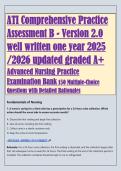
ATI Comprehensive Practice
Assessment B - Version 2.0
well written one year 2025
/2026 updated graded A+
Advanced Nursing Practice
Examination Bank 150 Multiple-Choice
Questions with Detailed Rationales
Fundamentals of Nursing
1. A nurse is caring for a client who has a prescription for a 24-hour urine collection. Which
action should the nurse take to ensure accurate results?
A. Discard the first voiding and begin the collection
B. Save all urine, including the first voiding
C. Collect urine in a sterile container only
D. Keep the urine at room temperature
- detailed answer 100 % correct :-A
Rationale: For a 24-hour urine collection, the first voiding is discarded, and the collection begins after
that. All subsequent urine is saved for 24 hours. The final voiding at the end of the collection period is
included. The collection container should be kept on ice or refrigerated.
,2. A nurse is preparing to insert a nasogastric (NG) tube for a client. Which action should the
nurse take to determine the correct length of the tube to insert?
A. Measure from the tip of the nose to the earlobe to the xiphoid process
B. Measure from the tip of the nose to the earlobe to the umbilicus
C. Measure from the tip of the nose to the earlobe
D. Measure from the xiphoid process to the umbilicus
- detailed answer 100 % correct :-A
Rationale: The correct length for NG tube insertion is measured from the tip of the nose to the
earlobe to the xiphoid process. This measurement approximates the distance from the nares to the
stomach.
The other measurements would result in incorrect placement.
3. A nurse is performing a sterile dressing change. Which action by the nurse indicates a break
in sterile technique?
A. The nurse opens the sterile package away from the body
B. The nurse holds sterile items above waist level
C. The nurse touches the outer edge of the sterile field
D. The nurse pours sterile solution into a sterile container
- detailed answer 100 % correct :-C
Rationale: Touching the outer edge of the sterile field contaminates the sterile area. Only the center of
the sterile field should be touched with sterile items. Sterile packages should be opened away from the
body, items held above waist level, and solution poured into sterile containers.
4. A nurse is assessing a client's pain using the PQRST method. Which question should the nurse
ask to assess the "R" in PQRST?
A. "What makes the pain worse or better?"
B. "Where is the pain located?"
C. "What does the pain feel like?"
,D. "How would you rate the pain on a scale of 0 to 10?"
- detailed answer 100 % correct :-A
Rationale: In the PQRST pain assessment, R stands for Relief or Radiation. Asking about what makes
the pain worse or better assesses relief factors. P is Provocation/Palliation, Q is Quality, R is
Region/Radiation/Relief, S is Severity, and T is Timing.
5. A nurse is providing oral care to an unconscious client. Which action should the nurse take to
prevent aspiration?
A. Position the client in a side-lying position
B. Use a toothbrush with a soft bristle
C. Apply suction during oral care
D. Use a small amount of water
- detailed answer 100 % correct :-A
Rationale: Positioning the client in a side-lying position allows gravity to drain secretions and prevents
aspiration during oral care. While applying suction is helpful, side-lying is the primary preventive
measure for aspiration.
6. A nurse is caring for a client who has a new prescription for a low-sodium diet. Which food
choice by the client indicates understanding of the diet?
A. Canned vegetable soup
B. Fresh grilled chicken breast
C. Pickled vegetables
D. Salted pretzels
- detailed answer 100 % correct :-B
Rationale: Fresh grilled chicken breast is naturally low in sodium. Canned soups, pickled vegetables,
and salted pretzels are high in sodium. A low-sodium diet typically restricts sodium to 2 g or less per
day.
, 7. A nurse is assessing a client's vital signs. Which finding should the nurse report to the
provider?
A. Respiratory rate 12/min
B. Blood pressure 118/76 mm Hg
C. Heart rate 110/min at rest
D. Temperature 98.2°F
- detailed answer 100 % correct :-C
Rationale: A heart rate of 110/min at rest indicates tachycardia and should be reported. Normal
resting heart rate is 60-100/min. Respiratory rate of 12/min, blood pressure 118/76 mm Hg, and
temperature 98.2°F are within normal ranges.
8. A nurse is preparing to administer a cleansing enema to a client. Which position should the
nurse place the client in?
A. Supine
B. Prone
C. Left side-lying
D. Right side-lying
- detailed answer 100 % correct :-C
Rationale: Left side-lying (Sims' position) is the preferred position for administering an enema
because it facilitates the flow of fluid into the sigmoid colon and rectum. The client's right knee should
be flexed.
9. A nurse is assessing a client for signs of dehydration. Which finding should the nurse expect?
A. Bounding pulse
B. Edema
C. Poor skin turgor
D. Jugular venous distention
Assessment B - Version 2.0
well written one year 2025
/2026 updated graded A+
Advanced Nursing Practice
Examination Bank 150 Multiple-Choice
Questions with Detailed Rationales
Fundamentals of Nursing
1. A nurse is caring for a client who has a prescription for a 24-hour urine collection. Which
action should the nurse take to ensure accurate results?
A. Discard the first voiding and begin the collection
B. Save all urine, including the first voiding
C. Collect urine in a sterile container only
D. Keep the urine at room temperature
- detailed answer 100 % correct :-A
Rationale: For a 24-hour urine collection, the first voiding is discarded, and the collection begins after
that. All subsequent urine is saved for 24 hours. The final voiding at the end of the collection period is
included. The collection container should be kept on ice or refrigerated.
,2. A nurse is preparing to insert a nasogastric (NG) tube for a client. Which action should the
nurse take to determine the correct length of the tube to insert?
A. Measure from the tip of the nose to the earlobe to the xiphoid process
B. Measure from the tip of the nose to the earlobe to the umbilicus
C. Measure from the tip of the nose to the earlobe
D. Measure from the xiphoid process to the umbilicus
- detailed answer 100 % correct :-A
Rationale: The correct length for NG tube insertion is measured from the tip of the nose to the
earlobe to the xiphoid process. This measurement approximates the distance from the nares to the
stomach.
The other measurements would result in incorrect placement.
3. A nurse is performing a sterile dressing change. Which action by the nurse indicates a break
in sterile technique?
A. The nurse opens the sterile package away from the body
B. The nurse holds sterile items above waist level
C. The nurse touches the outer edge of the sterile field
D. The nurse pours sterile solution into a sterile container
- detailed answer 100 % correct :-C
Rationale: Touching the outer edge of the sterile field contaminates the sterile area. Only the center of
the sterile field should be touched with sterile items. Sterile packages should be opened away from the
body, items held above waist level, and solution poured into sterile containers.
4. A nurse is assessing a client's pain using the PQRST method. Which question should the nurse
ask to assess the "R" in PQRST?
A. "What makes the pain worse or better?"
B. "Where is the pain located?"
C. "What does the pain feel like?"
,D. "How would you rate the pain on a scale of 0 to 10?"
- detailed answer 100 % correct :-A
Rationale: In the PQRST pain assessment, R stands for Relief or Radiation. Asking about what makes
the pain worse or better assesses relief factors. P is Provocation/Palliation, Q is Quality, R is
Region/Radiation/Relief, S is Severity, and T is Timing.
5. A nurse is providing oral care to an unconscious client. Which action should the nurse take to
prevent aspiration?
A. Position the client in a side-lying position
B. Use a toothbrush with a soft bristle
C. Apply suction during oral care
D. Use a small amount of water
- detailed answer 100 % correct :-A
Rationale: Positioning the client in a side-lying position allows gravity to drain secretions and prevents
aspiration during oral care. While applying suction is helpful, side-lying is the primary preventive
measure for aspiration.
6. A nurse is caring for a client who has a new prescription for a low-sodium diet. Which food
choice by the client indicates understanding of the diet?
A. Canned vegetable soup
B. Fresh grilled chicken breast
C. Pickled vegetables
D. Salted pretzels
- detailed answer 100 % correct :-B
Rationale: Fresh grilled chicken breast is naturally low in sodium. Canned soups, pickled vegetables,
and salted pretzels are high in sodium. A low-sodium diet typically restricts sodium to 2 g or less per
day.
, 7. A nurse is assessing a client's vital signs. Which finding should the nurse report to the
provider?
A. Respiratory rate 12/min
B. Blood pressure 118/76 mm Hg
C. Heart rate 110/min at rest
D. Temperature 98.2°F
- detailed answer 100 % correct :-C
Rationale: A heart rate of 110/min at rest indicates tachycardia and should be reported. Normal
resting heart rate is 60-100/min. Respiratory rate of 12/min, blood pressure 118/76 mm Hg, and
temperature 98.2°F are within normal ranges.
8. A nurse is preparing to administer a cleansing enema to a client. Which position should the
nurse place the client in?
A. Supine
B. Prone
C. Left side-lying
D. Right side-lying
- detailed answer 100 % correct :-C
Rationale: Left side-lying (Sims' position) is the preferred position for administering an enema
because it facilitates the flow of fluid into the sigmoid colon and rectum. The client's right knee should
be flexed.
9. A nurse is assessing a client for signs of dehydration. Which finding should the nurse expect?
A. Bounding pulse
B. Edema
C. Poor skin turgor
D. Jugular venous distention

