

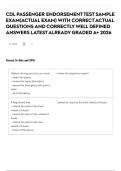
CDL PASSENGER ENDORSEMENT TEST SAMPLE
EXAM(ACTUAL EXAM) WITH CORRECT ACTUAL
QUESTIONS AND CORRECTLY WELL DEFINED
ANSWERS LATEST ALREADY GRADED A+ 2026
Save
Terms in this set (99)
1.Before driving your bus, you must: - review the inspection report.
- clean the interior.
- review the inspection report.
- ensure the emergency exit door is
open.
- All of the above.
2.Regrooved tires: - cannot be used on the front wheels of buses.
- cannot be used on the front
wheels of buses.
- cannot be used on the wheels of
buses.
- cannot be used on the rear
wheels of buses.
- None of the above.
,3.When going down a steep - the braking effect of the engine
downgrade, you should primarily
brake using:
- the emergency brake.
- the parking brake.
- the service brakes.
- the braking effect of the engine
4.If you recognize a distracted - give them plenty of room.
driver on the road, you should:
- follow them closely.
- give them plenty of room.
- flash your brake lights at them.
- try to pass them.
5.To correct a drive-wheel braking - stop braking.
skid, you should:
- apply the brakes and turn in the
direction of the skid.
- accelerate.
- stop braking.
- None of the above.
, 6.If a rider wants to board the bus - not allow the rider to carry on the battery.
with a car battery, the bus driver
should:
- inspect the battery before
allowing the rider to carry it on
board.
- not allow the rider to carry on the
battery.
- instruct the rider to sit next to the
exit doors.
- call the police.
7.As you approach off ramps and - that the posted speed limit may not be safe for
on ramps, remember: larger vehicles.
- to always brake and turn at the
same time.
- that the posted speed limit may
not be safe for larger vehicles.
- that downgrades make it easier to
reduce speed.
- to maintain your highway speed.
8.Air storage tanks: - hold compressed air for the brakes.
- are installed in the first tank the air
compressor pumps air to.
- pump air into the air storage tanks.
- use parts of the service brake
systems to stop the vehicle in a
brake system failure.
- hold compressed air for the
brakes.
EXAM(ACTUAL EXAM) WITH CORRECT ACTUAL
QUESTIONS AND CORRECTLY WELL DEFINED
ANSWERS LATEST ALREADY GRADED A+ 2026
Save
Terms in this set (99)
1.Before driving your bus, you must: - review the inspection report.
- clean the interior.
- review the inspection report.
- ensure the emergency exit door is
open.
- All of the above.
2.Regrooved tires: - cannot be used on the front wheels of buses.
- cannot be used on the front
wheels of buses.
- cannot be used on the wheels of
buses.
- cannot be used on the rear
wheels of buses.
- None of the above.
,3.When going down a steep - the braking effect of the engine
downgrade, you should primarily
brake using:
- the emergency brake.
- the parking brake.
- the service brakes.
- the braking effect of the engine
4.If you recognize a distracted - give them plenty of room.
driver on the road, you should:
- follow them closely.
- give them plenty of room.
- flash your brake lights at them.
- try to pass them.
5.To correct a drive-wheel braking - stop braking.
skid, you should:
- apply the brakes and turn in the
direction of the skid.
- accelerate.
- stop braking.
- None of the above.
, 6.If a rider wants to board the bus - not allow the rider to carry on the battery.
with a car battery, the bus driver
should:
- inspect the battery before
allowing the rider to carry it on
board.
- not allow the rider to carry on the
battery.
- instruct the rider to sit next to the
exit doors.
- call the police.
7.As you approach off ramps and - that the posted speed limit may not be safe for
on ramps, remember: larger vehicles.
- to always brake and turn at the
same time.
- that the posted speed limit may
not be safe for larger vehicles.
- that downgrades make it easier to
reduce speed.
- to maintain your highway speed.
8.Air storage tanks: - hold compressed air for the brakes.
- are installed in the first tank the air
compressor pumps air to.
- pump air into the air storage tanks.
- use parts of the service brake
systems to stop the vehicle in a
brake system failure.
- hold compressed air for the
brakes.

