

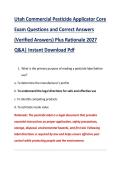
Utah Commercial Pesticide Applicator Core
Exam Questions and Correct Answers
(Verified Answers) Plus Rationale 2027
Q&A| Instant Download Pdf
1. What is the primary purpose of reading a pesticide label before
use?
a. To determine the manufacturer's profits
b. To understand the legal directions for safe and effective use
c. To identify competing products
d. To estimate resale value
Rationale: The pesticide label is a legal document that provides
essential instructions on proper application, safety precautions,
storage, disposal, environmental hazards, and first aid. Following
label directions is required by law and helps ensure effective pest
control while protecting people and the environment.
, 2. Which federal law regulates the registration and labeling of
pesticides in the United States?
a. Clean Air Act
b. Safe Drinking Water Act
c. Federal Insecticide, Fungicide, and Rodenticide Act (FIFRA)
d. Occupational Safety and Health Act
Rationale: FIFRA establishes the requirements for pesticide
registration, labeling, distribution, sale, and use. It authorizes the
Environmental Protection Agency (EPA) to regulate pesticides to
ensure they do not pose unreasonable risks when used according to
label directions.
3. What does the signal word "Danger" on a pesticide label indicate?
a. The product is environmentally friendly.
b. The product is intended only for agricultural use.
c. The pesticide has high acute toxicity or poses severe hazards.
d. The product has expired.
Rationale: "Danger" is the highest toxicity signal word used on
pesticide labels. It indicates that the product can cause severe injury
,or death through exposure and requires strict adherence to all safety
precautions.
4. Which signal word represents the lowest level of acute toxicity?
a. Danger
b. Warning
c. Caution-Restricted
d. Caution
Rationale: "Caution" indicates relatively low acute toxicity compared
with "Warning" and "Danger." However, even products labeled
"Caution" must be handled safely according to label instructions.
5. What is the primary route through which pesticide handlers are
exposed to pesticides?
a. Inhalation
b. Oral ingestion
c. Dermal absorption
d. Eye exposure
, Rationale: Skin exposure is the most common route of pesticide
exposure because handlers frequently mix, load, and apply pesticides.
Wearing appropriate personal protective equipment (PPE) greatly
reduces dermal exposure.
6. Which type of personal protective equipment protects the eyes
from pesticide splashes?
a. Hard hat
b. Cotton gloves
c. Chemical-resistant goggles or face shield
d. Leather boots
Rationale: Chemical-resistant goggles and face shields help prevent
pesticide splashes from contacting the eyes during mixing, loading,
and application, reducing the risk of serious eye injuries.
7. When should pesticide applicators wash their hands?
a. Only after finishing work
b. Before lunch only
c. At the end of the week
Exam Questions and Correct Answers
(Verified Answers) Plus Rationale 2027
Q&A| Instant Download Pdf
1. What is the primary purpose of reading a pesticide label before
use?
a. To determine the manufacturer's profits
b. To understand the legal directions for safe and effective use
c. To identify competing products
d. To estimate resale value
Rationale: The pesticide label is a legal document that provides
essential instructions on proper application, safety precautions,
storage, disposal, environmental hazards, and first aid. Following
label directions is required by law and helps ensure effective pest
control while protecting people and the environment.
, 2. Which federal law regulates the registration and labeling of
pesticides in the United States?
a. Clean Air Act
b. Safe Drinking Water Act
c. Federal Insecticide, Fungicide, and Rodenticide Act (FIFRA)
d. Occupational Safety and Health Act
Rationale: FIFRA establishes the requirements for pesticide
registration, labeling, distribution, sale, and use. It authorizes the
Environmental Protection Agency (EPA) to regulate pesticides to
ensure they do not pose unreasonable risks when used according to
label directions.
3. What does the signal word "Danger" on a pesticide label indicate?
a. The product is environmentally friendly.
b. The product is intended only for agricultural use.
c. The pesticide has high acute toxicity or poses severe hazards.
d. The product has expired.
Rationale: "Danger" is the highest toxicity signal word used on
pesticide labels. It indicates that the product can cause severe injury
,or death through exposure and requires strict adherence to all safety
precautions.
4. Which signal word represents the lowest level of acute toxicity?
a. Danger
b. Warning
c. Caution-Restricted
d. Caution
Rationale: "Caution" indicates relatively low acute toxicity compared
with "Warning" and "Danger." However, even products labeled
"Caution" must be handled safely according to label instructions.
5. What is the primary route through which pesticide handlers are
exposed to pesticides?
a. Inhalation
b. Oral ingestion
c. Dermal absorption
d. Eye exposure
, Rationale: Skin exposure is the most common route of pesticide
exposure because handlers frequently mix, load, and apply pesticides.
Wearing appropriate personal protective equipment (PPE) greatly
reduces dermal exposure.
6. Which type of personal protective equipment protects the eyes
from pesticide splashes?
a. Hard hat
b. Cotton gloves
c. Chemical-resistant goggles or face shield
d. Leather boots
Rationale: Chemical-resistant goggles and face shields help prevent
pesticide splashes from contacting the eyes during mixing, loading,
and application, reducing the risk of serious eye injuries.
7. When should pesticide applicators wash their hands?
a. Only after finishing work
b. Before lunch only
c. At the end of the week

