

NR565 Advanced Pharmacology Final Exam
2026/2027 | Actual Questions
Chamberlain University College of Nursing | Actual Q&A | MSN and NP Candidates
Introduction
This original question set is designed to reinforce NR565 Advanced Pharmacology Fundamentals course
objectives for exam readiness. The questions cover Pharmacokinetics, Pharmacodynamics, and
Pharmacogenomics; Central Nervous System, Psychiatric, and Pain Management Pharmacology; Cardiovascular,
Pulmonary, and Renal Pharmacology; Endocrine, Gastrointestinal, and Reproductive Pharmacology; and Anti-
infectives, Immunology, and Oncology Pharmacology. Across the assessment, MSN and NP candidates apply
mechanism-of-action knowledge, adverse-effect recognition, contraindication screening, interaction assessment,
monitoring priorities, and evidence-based prescribing principles. A uniqueness cross-check was applied so each of
the 100 questions targets a distinct pharmacologic mechanism, clinical scenario, safety issue, therapeutic class, or
prescribing decision.
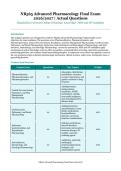
Content Area Overview
Content Area Questions Key Topics Weight
Absorption, distribution,
Pharmacokinetics, metabolism, excretion,
Pharmacodynamics, and 20 receptor interactions, and 20%
Pharmacogenomics genetic variation in drug
response
Antidepressants,
antipsychotics,
Central Nervous System,
anxiolytics, ADHD
Psychiatric, and Pain
20 medications, opioids, 20%
Management
non-opioid analgesics,
Pharmacology
and neurodegenerative
disease drugs
Antihypertensives,
antiarrhythmics, heart
Cardiovascular,
failure medications,
Pulmonary, and Renal 20 20%
bronchodilators,
Pharmacology
diuretics, and renal-
function considerations
Diabetes medications,
Endocrine, thyroid disorders,
Gastrointestinal, and hormonal contraceptives,
20 20%
Reproductive hormone therapy, GI
Pharmacology motility, and acid-
reducing agents
Antibiotics, antivirals,
Anti-infectives, antifungals,
Immunology, and 20 immunosuppressants, 20%
Oncology Pharmacology biologics, and
antineoplastic agents
NR565 Advanced Pharmacology Final Exam 2026/2027
,Actual Questions
Domain: Pharmacokinetics, Pharmacodynamics, and Pharmacogenomics
1. Which pharmacokinetic term describes the fraction of an administered dose that reaches
systemic circulation unchanged?
A. Volume of distribution
B. Bioavailability
C. Intrinsic efficacy
D. Therapeutic index
Answer: B
Rationale: Bioavailability is the fraction of drug reaching systemic circulation in active form. Lehne's
Pharmacotherapeutics emphasizes that oral drugs may have reduced bioavailability because of incomplete
absorption and first-pass metabolism.
2. A drug with extensive first-pass metabolism is most likely to show which clinical feature after
oral administration?
A. Reduced systemic availability compared with an equivalent intravenous dose
B. Complete avoidance of hepatic metabolism
C. No need for dose adjustment in liver disease
D. A guaranteed absence of drug interactions
Answer: A
Rationale: First-pass metabolism occurs mainly in the gut wall and liver before drug reaches systemic
circulation. Extensive first-pass extraction can lower oral bioavailability.
3. Which route of administration most reliably avoids first-pass hepatic metabolism?
A. Oral tablet
B. Enteric-coated capsule
C. Intravenous injection
D. Swallowed liquid suspension
Answer: C
Rationale: Intravenous administration places drug directly into systemic circulation and has 100%
bioavailability. Oral products usually pass through portal circulation before systemic distribution.
4. A highly lipophilic drug with extensive tissue binding is most likely to have which
pharmacokinetic property?
A. Low receptor affinity
B. Large volume of distribution
C. Zero elimination half-life
D. No crossing of membranes
Answer: B
Rationale: Volume of distribution rises when a drug distributes widely into tissues rather than remaining in
plasma. Lipophilicity and tissue binding commonly increase apparent volume of distribution.
5. Two highly protein-bound drugs are prescribed together. Which issue is most clinically
relevant?
A. They cannot be absorbed from the intestine.
B. They may compete for binding sites and increase free active drug concentration.
C. They must both become inactive immediately.
D. They will be excreted only in bile.
Answer: B
Rationale: Only unbound drug is pharmacologically active and available for elimination. Competition for
albumin or other protein binding may increase free drug levels, especially for narrow-therapeutic-index
drugs.
NR565 Advanced Pharmacology Final Exam 2026/2027
, 6. Approximately how many half-lives are usually required for a drug given repeatedly to
approach steady state?
A. One half-life
B. Two half-lives
C. Four to five half-lives
D. Twenty half-lives
Answer: C
Rationale: Most drugs approach steady state after about four to five half-lives when dosing is consistent.
This principle guides titration and timing of serum drug monitoring.
7. Which patient factor most directly increases risk of accumulation for a medication cleared
primarily by the kidneys?
A. Reduced glomerular filtration rate
B. Blue eye color
C. High dietary fiber intake only
D. Use of a topical moisturizer
Answer: A
Rationale: Renal impairment decreases clearance of renally eliminated drugs and can increase drug
exposure. Advanced practice prescribing requires dose adjustment or alternative therapy when renal
function is reduced.
8. A potent CYP3A4 inhibitor is added to a regimen that includes a CYP3A4 substrate. What is the
expected effect on many substrate drugs?
A. Lower serum concentration and therapeutic failure
B. Higher serum concentration and increased toxicity risk
C. Immediate renal excretion of the substrate
D. Permanent loss of receptor binding
Answer: B
Rationale: CYP inhibition slows metabolism of susceptible substrates, often increasing drug concentration
and adverse effect risk. This is a common mechanism of clinically important drug-drug interactions.
9. Rifampin induces several hepatic drug-metabolizing enzymes. Which outcome is most likely for
susceptible substrate medications?
A. Reduced drug levels and possible loss of efficacy
B. Increased levels from blocked metabolism
C. No possible interaction
D. Conversion of all drugs to biologics
Answer: A
Rationale: Enzyme induction increases metabolic capacity and can lower concentrations of affected drugs.
Loss of contraceptive, anticoagulant, or antiviral efficacy may occur depending on the substrate.
10. A medication with a narrow therapeutic index requires special attention because what is true?
A. The toxic dose is close to the effective dose.
B. The drug has no adverse effects.
C. The drug cannot interact with any other drug.
D. The drug is always available over the counter.
Answer: A
Rationale: A narrow therapeutic index means the margin between beneficial and toxic concentrations is
small. Monitoring, dose precision, and interaction avoidance are especially important.
11. Which term describes the maximum effect a drug can produce, regardless of dose increases
beyond that point?
A. Potency
B. Efficacy
NR565 Advanced Pharmacology Final Exam 2026/2027
2026/2027 | Actual Questions
Chamberlain University College of Nursing | Actual Q&A | MSN and NP Candidates
Introduction
This original question set is designed to reinforce NR565 Advanced Pharmacology Fundamentals course
objectives for exam readiness. The questions cover Pharmacokinetics, Pharmacodynamics, and
Pharmacogenomics; Central Nervous System, Psychiatric, and Pain Management Pharmacology; Cardiovascular,
Pulmonary, and Renal Pharmacology; Endocrine, Gastrointestinal, and Reproductive Pharmacology; and Anti-
infectives, Immunology, and Oncology Pharmacology. Across the assessment, MSN and NP candidates apply
mechanism-of-action knowledge, adverse-effect recognition, contraindication screening, interaction assessment,
monitoring priorities, and evidence-based prescribing principles. A uniqueness cross-check was applied so each of
the 100 questions targets a distinct pharmacologic mechanism, clinical scenario, safety issue, therapeutic class, or
prescribing decision.
Content Area Overview
Content Area Questions Key Topics Weight
Absorption, distribution,
Pharmacokinetics, metabolism, excretion,
Pharmacodynamics, and 20 receptor interactions, and 20%
Pharmacogenomics genetic variation in drug
response
Antidepressants,
antipsychotics,
Central Nervous System,
anxiolytics, ADHD
Psychiatric, and Pain
20 medications, opioids, 20%
Management
non-opioid analgesics,
Pharmacology
and neurodegenerative
disease drugs
Antihypertensives,
antiarrhythmics, heart
Cardiovascular,
failure medications,
Pulmonary, and Renal 20 20%
bronchodilators,
Pharmacology
diuretics, and renal-
function considerations
Diabetes medications,
Endocrine, thyroid disorders,
Gastrointestinal, and hormonal contraceptives,
20 20%
Reproductive hormone therapy, GI
Pharmacology motility, and acid-
reducing agents
Antibiotics, antivirals,
Anti-infectives, antifungals,
Immunology, and 20 immunosuppressants, 20%
Oncology Pharmacology biologics, and
antineoplastic agents
NR565 Advanced Pharmacology Final Exam 2026/2027
,Actual Questions
Domain: Pharmacokinetics, Pharmacodynamics, and Pharmacogenomics
1. Which pharmacokinetic term describes the fraction of an administered dose that reaches
systemic circulation unchanged?
A. Volume of distribution
B. Bioavailability
C. Intrinsic efficacy
D. Therapeutic index
Answer: B
Rationale: Bioavailability is the fraction of drug reaching systemic circulation in active form. Lehne's
Pharmacotherapeutics emphasizes that oral drugs may have reduced bioavailability because of incomplete
absorption and first-pass metabolism.
2. A drug with extensive first-pass metabolism is most likely to show which clinical feature after
oral administration?
A. Reduced systemic availability compared with an equivalent intravenous dose
B. Complete avoidance of hepatic metabolism
C. No need for dose adjustment in liver disease
D. A guaranteed absence of drug interactions
Answer: A
Rationale: First-pass metabolism occurs mainly in the gut wall and liver before drug reaches systemic
circulation. Extensive first-pass extraction can lower oral bioavailability.
3. Which route of administration most reliably avoids first-pass hepatic metabolism?
A. Oral tablet
B. Enteric-coated capsule
C. Intravenous injection
D. Swallowed liquid suspension
Answer: C
Rationale: Intravenous administration places drug directly into systemic circulation and has 100%
bioavailability. Oral products usually pass through portal circulation before systemic distribution.
4. A highly lipophilic drug with extensive tissue binding is most likely to have which
pharmacokinetic property?
A. Low receptor affinity
B. Large volume of distribution
C. Zero elimination half-life
D. No crossing of membranes
Answer: B
Rationale: Volume of distribution rises when a drug distributes widely into tissues rather than remaining in
plasma. Lipophilicity and tissue binding commonly increase apparent volume of distribution.
5. Two highly protein-bound drugs are prescribed together. Which issue is most clinically
relevant?
A. They cannot be absorbed from the intestine.
B. They may compete for binding sites and increase free active drug concentration.
C. They must both become inactive immediately.
D. They will be excreted only in bile.
Answer: B
Rationale: Only unbound drug is pharmacologically active and available for elimination. Competition for
albumin or other protein binding may increase free drug levels, especially for narrow-therapeutic-index
drugs.
NR565 Advanced Pharmacology Final Exam 2026/2027
, 6. Approximately how many half-lives are usually required for a drug given repeatedly to
approach steady state?
A. One half-life
B. Two half-lives
C. Four to five half-lives
D. Twenty half-lives
Answer: C
Rationale: Most drugs approach steady state after about four to five half-lives when dosing is consistent.
This principle guides titration and timing of serum drug monitoring.
7. Which patient factor most directly increases risk of accumulation for a medication cleared
primarily by the kidneys?
A. Reduced glomerular filtration rate
B. Blue eye color
C. High dietary fiber intake only
D. Use of a topical moisturizer
Answer: A
Rationale: Renal impairment decreases clearance of renally eliminated drugs and can increase drug
exposure. Advanced practice prescribing requires dose adjustment or alternative therapy when renal
function is reduced.
8. A potent CYP3A4 inhibitor is added to a regimen that includes a CYP3A4 substrate. What is the
expected effect on many substrate drugs?
A. Lower serum concentration and therapeutic failure
B. Higher serum concentration and increased toxicity risk
C. Immediate renal excretion of the substrate
D. Permanent loss of receptor binding
Answer: B
Rationale: CYP inhibition slows metabolism of susceptible substrates, often increasing drug concentration
and adverse effect risk. This is a common mechanism of clinically important drug-drug interactions.
9. Rifampin induces several hepatic drug-metabolizing enzymes. Which outcome is most likely for
susceptible substrate medications?
A. Reduced drug levels and possible loss of efficacy
B. Increased levels from blocked metabolism
C. No possible interaction
D. Conversion of all drugs to biologics
Answer: A
Rationale: Enzyme induction increases metabolic capacity and can lower concentrations of affected drugs.
Loss of contraceptive, anticoagulant, or antiviral efficacy may occur depending on the substrate.
10. A medication with a narrow therapeutic index requires special attention because what is true?
A. The toxic dose is close to the effective dose.
B. The drug has no adverse effects.
C. The drug cannot interact with any other drug.
D. The drug is always available over the counter.
Answer: A
Rationale: A narrow therapeutic index means the margin between beneficial and toxic concentrations is
small. Monitoring, dose precision, and interaction avoidance are especially important.
11. Which term describes the maximum effect a drug can produce, regardless of dose increases
beyond that point?
A. Potency
B. Efficacy
NR565 Advanced Pharmacology Final Exam 2026/2027

