

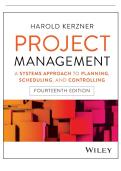
, TESTBANK FOR Project Management A Systems Approach to Planning,
Scheduling, and Controlling, 14th Edition Kerzner
Important Notes
The file organized chapter by chapter.
A sample of selected pages has been provided for preview.
All available appendices and Excel files (if included in the original resources) are
provided.
We continuously update our files to ensure you receive the latest and most accurate
editions.
New editions are added regularly – stay connected for updates!
⚠️Note on Answer Keys: If the answer key is not included within the chapter
questions, you will find the complete answers and solutions at the end of each
chapter.
✅ Why Buy From Us?
📚 Complete & organized chapter-by-chapter – no missing content, no guessing.
⚡ Instant digital delivery – get your file the moment you pay, no waiting.
📅 Always up to date – we track new editions so you always get the latest version.
💬 Friendly support – real humans ready to help, anytime you need us.
🔒 Safe & secure – thousands of satisfied students trust us every semester.
🛡️Our Guarantees
💰 Money-Back Guarantee: Not satisfied? We offer a full refund – no questions asked.
🔄 Wrong File? No Problem: Contact us and we will replace it immediately with the
correct version, free of charge.
⏰ 24/7 Support: We are always here – reach out anytime and expect a fast response.
,TEST BANK - CHAPTER 1
Multiple Choice Questions (20)
1. What is the primary difference between a project and ongoing operations?
A. Projects are more important than operations
B. Projects are temporary with defined start and end dates ✅
C. Projects require more resources than operations
D. Projects always involve external customers
Answer: B Explanation: Projects are temporary endeavors with specific objectives and defined
timeframes, while operations are ongoing and repetitive.
Learning Objective: 2 Bloom's Level: Comprehension Difficulty: Easy
2. According to Kerzner, the traditional triple constraints of project management are:
A. Quality, scope, and stakeholders
B. Time, cost, and performance/scope ✅
C. Resources, risk, and requirements
D. Planning, execution, and control
Answer: B Explanation: The traditional triple constraints are time, cost, and performance/scope,
though modern PM recognizes additional competing constraints.
Learning Objective: 4 Bloom's Level: Knowledge Difficulty: Easy
3. Which component of PMI's Talent Triangle has gained increased importance in the 14th
edition?
A. Technical Project Management
B. Leadership Skills
C. Business Acumen ✅
D. Risk Management
Answer: C Explanation: Business Acumen has gained prominence as project managers now
manage part of a business rather than just technical projects.
Learning Objective: 7 Bloom's Level: Comprehension Difficulty: Medium
4. Data-driven project management primarily involves:
A. Using more software tools
B. Making decisions based on factual information rather than intuition ✅
C. Collecting more project data
D. Automating project processes
,Answer: B Explanation: Data-driven PM emphasizes making decisions based on facts and
analytical insights rather than gut feelings or intuition.
Learning Objective: 9 Bloom's Level: Comprehension Difficulty: Medium
5. In a project-driven organization, projects typically:
A. Support the functional departments
B. Have their own profit and loss statements ✅
C. Are managed by functional managers
D. Have lower priority than operations
Answer: B Explanation: In project-driven organizations, each project operates as a separate
profit center with its own P&L statement.
Learning Objective: 8 Bloom's Level: Comprehension Difficulty: Medium
6. The project manager's primary responsibility for resources is to:
A. Directly control all project resources
B. Negotiate with functional managers for resources ✅
C. Hire all project team members
D. Set salary levels for team members
Answer: B Explanation: Project managers typically negotiate with functional managers who
control the actual resources.
Learning Objective: 5 Bloom's Level: Comprehension Difficulty: Medium
7. Which of the following best describes "added value" in project management?
A. Increasing project costs
B. Extending project duration
C. Incremental improvements that enhance deliverable performance ✅
D. Adding more project team members
Answer: C Explanation: Added value refers to incremental improvements that enhance
performance or provide business advantage.
Learning Objective: 10 Bloom's Level: Comprehension Difficulty: Medium
8. The concept of "competing constraints" recognizes that projects may have:
A. Only three constraints to manage
B. Five or more constraints requiring trade-off analysis ✅
C. No real constraints in modern PM
D. Constraints that never conflict
,Answer: B Explanation: Modern PM recognizes multiple competing constraints beyond the
traditional triple constraints.
Learning Objective: 4 Bloom's Level: Analysis Difficulty: Hard
9. In matrix organizations, project team members typically report to:
A. Only the project manager
B. Only the functional manager
C. Both project and functional managers ✅
D. Senior executives only
Answer: C Explanation: Matrix structures involve dual reporting relationships to both project
and functional management.
Learning Objective: 6 Bloom's Level: Comprehension Difficulty: Medium
10. Project success in the 14th edition is defined as:
A. Meeting time, cost, and scope only
B. Satisfying the customer requirements
C. Delivering business benefits and value within competing constraints ✅
D. Using the latest project management tools
Answer: C Explanation: Modern project success includes business value creation within multiple
competing constraints.
Learning Objective: 1 Bloom's Level: Comprehension Difficulty: Medium
11. The primary reason project management has grown since the 1990s is:
A. Better software tools became available
B. Companies realized it was mandatory for survival ✅
C. Government regulations required it
D. It became easier to implement
Answer: B Explanation: Companies realized PM was necessary for survival, not just a nice-to-
have capability.
Learning Objective: 3 Bloom's Level: Comprehension Difficulty: Medium
12. Functional managers are primarily responsible for:
A. Project integration and coordination
B. Providing technical expertise and resources ✅
C. Customer relationship management
D. Project scheduling and budgeting
,Answer: B Explanation: Functional managers provide technical expertise and assign resources to
projects.
Learning Objective: 5 Bloom's Level: Comprehension Difficulty: Easy
13. Which factor contributed most to early project management development?
A. Commercial software development
B. Defense and aerospace industry requirements ✅
C. Manufacturing automation
D. Financial services growth
Answer: B Explanation: Early PM development was driven by defense and aerospace industry
complexity.
Learning Objective: 3 Bloom's Level: Knowledge Difficulty: Easy
14. The role of artificial intelligence in modern project management is primarily to:
A. Replace project managers
B. Support data-driven decision making ✅
C. Eliminate project risks
D. Automate all project processes
Answer: B Explanation: AI supports better decision-making through data analysis and insights.
Learning Objective: 9 Bloom's Level: Comprehension Difficulty: Medium
15. Project deliverables are best defined as:
A. Project management documents
B. Measurable, tangible outputs from project work ✅
C. Customer requirements
D. Project management software
Answer: B Explanation: Deliverables are measurable, tangible outputs that create business
value.
Learning Objective: 2 Bloom's Level: Knowledge Difficulty: Easy
16. In non-project-driven organizations, projects typically:
A. Have higher priority than operations
B. Support functional departments and product lines ✅
C. Operate as independent profit centers
D. Are managed by external consultants
,Answer: B Explanation: In non-project-driven orgs, projects support the main functional
operations.
Learning Objective: 8 Bloom's Level: Comprehension Difficulty: Medium
17. The project sponsor's primary role is to:
A. Manage day-to-day project activities
B. Provide resources and remove obstacles ✅
C. Perform technical work on the project
D. Control project team performance
Answer: B Explanation: Sponsors provide high-level support, resources, and obstacle removal.
Learning Objective: 5 Bloom's Level: Comprehension Difficulty: Easy
18. Business value in project management refers to:
A. The cost of the project
B. Quantifiable and non-quantifiable benefits from deliverables ✅
C. The number of deliverables produced
D. The project management methodology used
Answer: B Explanation: Business value includes both quantifiable and non-quantifiable benefits.
Learning Objective: 10 Bloom's Level: Comprehension Difficulty: Medium
19. The systems approach to project management emphasizes:
A. Using computer systems for planning
B. Integration of all organizational activities toward project objectives ✅
C. Creating separate systems for each project
D. Avoiding organizational complexity
Answer: B Explanation: Systems approach focuses on integrating all activities toward common
objectives.
Learning Objective: 1 Bloom's Level: Analysis Difficulty: Hard
20. Modern project managers are expected to make decisions about:
A. Technical issues only
B. Project management processes only
C. Both project and business issues ✅
D. Functional department operations
Answer: C Explanation: Modern PMs manage part of the business and make both project and
business decisions.
,Learning Objective: 7 Bloom's Level: Comprehension Difficulty: Medium
True/False Questions (10)
1. Projects are typically repetitive activities that continue indefinitely.
Answer: False Explanation: Projects are temporary endeavors with defined start and end dates.
Learning Objective: 2 Bloom's Level: Knowledge Difficulty: Easy
2. Data-driven project management relies primarily on intuition and experience.
Answer: False Explanation: Data-driven PM emphasizes factual information over intuition.
Learning Objective: 9 Bloom's Level: Comprehension Difficulty: Easy
3. In project-driven organizations, each project typically operates as a separate profit center.
Answer: True Explanation: Project-driven organizations treat projects as individual profit
centers.
Learning Objective: 8 Bloom's Level: Knowledge Difficulty: Easy
4. The traditional triple constraints are the only constraints that affect project success.
Answer: False Explanation: Modern PM recognizes multiple competing constraints beyond the
traditional three.
Learning Objective: 4 Bloom's Level: Comprehension Difficulty: Medium
5. Functional managers typically have authority to assign and remove resources from projects.
Answer: True Explanation: Functional managers control resources and make assignment
decisions.
Learning Objective: 5 Bloom's Level: Comprehension Difficulty: Easy
6. Business Acumen has become less important for project managers in recent years.
Answer: False Explanation: Business Acumen has gained importance as PMs manage business
aspects.
Learning Objective: 7 Bloom's Level: Comprehension Difficulty: Medium
7. Added value always increases project costs and duration.
Answer: False Explanation: Added value can provide benefits that justify additional investment.
Learning Objective: 10 Bloom's Level: Analysis Difficulty: Medium
8. Matrix organizations eliminate the need for functional departments.
Answer: False Explanation: Matrix structures combine functional and project organizations.
Learning Objective: 6 Bloom's Level: Comprehension Difficulty: Easy
9. Project success can only be measured by meeting time, cost, and scope constraints.
Answer: False Explanation: Modern success includes business value and stakeholder
satisfaction.
,Learning Objective: 1 Bloom's Level: Comprehension Difficulty: Medium
10. Artificial intelligence is expected to replace project managers in most organizations.
Answer: False Explanation: AI supports decision-making but doesn't replace PM leadership
roles.
Learning Objective: 9 Bloom's Level: Comprehension Difficulty: Medium
Short Answer Questions (7)
1. Explain the difference between project-driven and non-project-driven organizations.
Answer: Project-driven organizations characterize all work through projects, with each project
as a separate profit center. Non-project-driven organizations use projects to support functional
operations and product lines, with profit measured on vertical/functional lines.
Learning Objective: 8 Bloom's Level: Comprehension Difficulty: Medium
2. Describe the three components of PMI's updated Talent Triangle.
Answer: Ways of Working (technical PM skills), Power Skills (leadership and interpersonal
abilities), and Business Acumen (strategic and business management knowledge). Business
Acumen has gained prominence as PMs now manage business aspects.
Learning Objective: 7 Bloom's Level: Comprehension Difficulty: Medium
3. What are competing constraints and why are they important in modern project
management?
Answer: Competing constraints are multiple project limitations beyond time/cost/scope,
including quality, risk, stakeholder satisfaction, and resources. They require sophisticated trade-
off analysis as not all constraints can be optimized simultaneously.
Learning Objective: 4 Bloom's Level: Analysis Difficulty: Hard
4. How does data-driven project management differ from traditional decision-making
approaches?
Answer: Data-driven PM bases decisions on factual information, analytical insights, and
structured data rather than intuition or gut feelings. It provides more precise information and
better risk management.
Learning Objective: 9 Bloom's Level: Analysis Difficulty: Medium
5. Explain the roles and responsibilities of project managers versus functional managers.
Answer: Project managers coordinate and integrate activities across functions, focusing on
"when" and "what." Functional managers provide technical expertise and resources,
determining "how" work is accomplished while maintaining technical excellence.
Learning Objective: 5 Bloom's Level: Comprehension Difficulty: Medium
6. Why has project management evolved from a "nice-to-have" to a "mandatory" capability?
, Answer: Economic pressures, increased competition, technological complexity, and need for
better resource control made PM essential for survival. Companies now manage their business
as a series of projects.
Learning Objective: 3 Bloom's Level: Analysis Difficulty: Medium
7. What is business value in project management and how is it measured?
Answer: Business value includes quantifiable benefits (ROI, cost savings) and non-quantifiable
benefits (customer satisfaction, competitive advantage) resulting from project deliverables. It's
measured through various metrics aligned with strategic objectives.
Learning Objective: 10 Bloom's Level: Analysis Difficulty: Hard
Essay/Case-Based Questions (3)
1. Case Analysis: Matrix Organization Authority Conflict
A project manager in a matrix organization is experiencing conflicts with functional managers
over resource assignments. The functional managers claim they need their best people for
department work, while the project manager needs these same resources for a critical client
project. Analyze this situation using Kerzner's framework and recommend solutions.
Sample Answer: This represents a classic matrix authority conflict. Solutions include: (1)
Executive intervention to clarify priorities, (2) Negotiation based on business value and client
importance, (3) Resource sharing agreements, (4) Clear role definition through responsibility
matrices. Success requires shared accountability and recognition that both vertical and
horizontal needs are legitimate.
Learning Objective: 6 Bloom's Level: Analysis Difficulty: Hard
2. Strategic Analysis: Implementing Data-Driven Project Management
Your organization wants to transition from intuition-based to data-driven project management.
Develop a comprehensive plan addressing the cultural, technological, and process changes
required. Consider resistance factors and implementation strategies.
Sample Answer: Implementation requires: (1) Cultural change management to overcome
resistance to data-based decisions, (2) Technology infrastructure for data collection and
analysis, (3) Training on analytical tools and interpretation, (4) Gradual implementation starting
with pilot projects, (5) Metrics and KPIs aligned with business objectives, (6) Leadership
commitment and modeling of data-driven behavior.
Learning Objective: 9 Bloom's Level: Synthesis Difficulty: Hard
3. Business Value Creation: Beyond Triple Constraints
Explain how modern project management creates business value beyond simply meeting time,
cost, and scope constraints. Provide specific examples of how projects can contribute to
organizational competitive advantage and long-term success.
Sample Answer: Modern PM creates value through: (1) Strategic alignment with business
objectives, (2) Capability building and knowledge transfer, (3) Market positioning and
Scheduling, and Controlling, 14th Edition Kerzner
Important Notes
The file organized chapter by chapter.
A sample of selected pages has been provided for preview.
All available appendices and Excel files (if included in the original resources) are
provided.
We continuously update our files to ensure you receive the latest and most accurate
editions.
New editions are added regularly – stay connected for updates!
⚠️Note on Answer Keys: If the answer key is not included within the chapter
questions, you will find the complete answers and solutions at the end of each
chapter.
✅ Why Buy From Us?
📚 Complete & organized chapter-by-chapter – no missing content, no guessing.
⚡ Instant digital delivery – get your file the moment you pay, no waiting.
📅 Always up to date – we track new editions so you always get the latest version.
💬 Friendly support – real humans ready to help, anytime you need us.
🔒 Safe & secure – thousands of satisfied students trust us every semester.
🛡️Our Guarantees
💰 Money-Back Guarantee: Not satisfied? We offer a full refund – no questions asked.
🔄 Wrong File? No Problem: Contact us and we will replace it immediately with the
correct version, free of charge.
⏰ 24/7 Support: We are always here – reach out anytime and expect a fast response.
,TEST BANK - CHAPTER 1
Multiple Choice Questions (20)
1. What is the primary difference between a project and ongoing operations?
A. Projects are more important than operations
B. Projects are temporary with defined start and end dates ✅
C. Projects require more resources than operations
D. Projects always involve external customers
Answer: B Explanation: Projects are temporary endeavors with specific objectives and defined
timeframes, while operations are ongoing and repetitive.
Learning Objective: 2 Bloom's Level: Comprehension Difficulty: Easy
2. According to Kerzner, the traditional triple constraints of project management are:
A. Quality, scope, and stakeholders
B. Time, cost, and performance/scope ✅
C. Resources, risk, and requirements
D. Planning, execution, and control
Answer: B Explanation: The traditional triple constraints are time, cost, and performance/scope,
though modern PM recognizes additional competing constraints.
Learning Objective: 4 Bloom's Level: Knowledge Difficulty: Easy
3. Which component of PMI's Talent Triangle has gained increased importance in the 14th
edition?
A. Technical Project Management
B. Leadership Skills
C. Business Acumen ✅
D. Risk Management
Answer: C Explanation: Business Acumen has gained prominence as project managers now
manage part of a business rather than just technical projects.
Learning Objective: 7 Bloom's Level: Comprehension Difficulty: Medium
4. Data-driven project management primarily involves:
A. Using more software tools
B. Making decisions based on factual information rather than intuition ✅
C. Collecting more project data
D. Automating project processes
,Answer: B Explanation: Data-driven PM emphasizes making decisions based on facts and
analytical insights rather than gut feelings or intuition.
Learning Objective: 9 Bloom's Level: Comprehension Difficulty: Medium
5. In a project-driven organization, projects typically:
A. Support the functional departments
B. Have their own profit and loss statements ✅
C. Are managed by functional managers
D. Have lower priority than operations
Answer: B Explanation: In project-driven organizations, each project operates as a separate
profit center with its own P&L statement.
Learning Objective: 8 Bloom's Level: Comprehension Difficulty: Medium
6. The project manager's primary responsibility for resources is to:
A. Directly control all project resources
B. Negotiate with functional managers for resources ✅
C. Hire all project team members
D. Set salary levels for team members
Answer: B Explanation: Project managers typically negotiate with functional managers who
control the actual resources.
Learning Objective: 5 Bloom's Level: Comprehension Difficulty: Medium
7. Which of the following best describes "added value" in project management?
A. Increasing project costs
B. Extending project duration
C. Incremental improvements that enhance deliverable performance ✅
D. Adding more project team members
Answer: C Explanation: Added value refers to incremental improvements that enhance
performance or provide business advantage.
Learning Objective: 10 Bloom's Level: Comprehension Difficulty: Medium
8. The concept of "competing constraints" recognizes that projects may have:
A. Only three constraints to manage
B. Five or more constraints requiring trade-off analysis ✅
C. No real constraints in modern PM
D. Constraints that never conflict
,Answer: B Explanation: Modern PM recognizes multiple competing constraints beyond the
traditional triple constraints.
Learning Objective: 4 Bloom's Level: Analysis Difficulty: Hard
9. In matrix organizations, project team members typically report to:
A. Only the project manager
B. Only the functional manager
C. Both project and functional managers ✅
D. Senior executives only
Answer: C Explanation: Matrix structures involve dual reporting relationships to both project
and functional management.
Learning Objective: 6 Bloom's Level: Comprehension Difficulty: Medium
10. Project success in the 14th edition is defined as:
A. Meeting time, cost, and scope only
B. Satisfying the customer requirements
C. Delivering business benefits and value within competing constraints ✅
D. Using the latest project management tools
Answer: C Explanation: Modern project success includes business value creation within multiple
competing constraints.
Learning Objective: 1 Bloom's Level: Comprehension Difficulty: Medium
11. The primary reason project management has grown since the 1990s is:
A. Better software tools became available
B. Companies realized it was mandatory for survival ✅
C. Government regulations required it
D. It became easier to implement
Answer: B Explanation: Companies realized PM was necessary for survival, not just a nice-to-
have capability.
Learning Objective: 3 Bloom's Level: Comprehension Difficulty: Medium
12. Functional managers are primarily responsible for:
A. Project integration and coordination
B. Providing technical expertise and resources ✅
C. Customer relationship management
D. Project scheduling and budgeting
,Answer: B Explanation: Functional managers provide technical expertise and assign resources to
projects.
Learning Objective: 5 Bloom's Level: Comprehension Difficulty: Easy
13. Which factor contributed most to early project management development?
A. Commercial software development
B. Defense and aerospace industry requirements ✅
C. Manufacturing automation
D. Financial services growth
Answer: B Explanation: Early PM development was driven by defense and aerospace industry
complexity.
Learning Objective: 3 Bloom's Level: Knowledge Difficulty: Easy
14. The role of artificial intelligence in modern project management is primarily to:
A. Replace project managers
B. Support data-driven decision making ✅
C. Eliminate project risks
D. Automate all project processes
Answer: B Explanation: AI supports better decision-making through data analysis and insights.
Learning Objective: 9 Bloom's Level: Comprehension Difficulty: Medium
15. Project deliverables are best defined as:
A. Project management documents
B. Measurable, tangible outputs from project work ✅
C. Customer requirements
D. Project management software
Answer: B Explanation: Deliverables are measurable, tangible outputs that create business
value.
Learning Objective: 2 Bloom's Level: Knowledge Difficulty: Easy
16. In non-project-driven organizations, projects typically:
A. Have higher priority than operations
B. Support functional departments and product lines ✅
C. Operate as independent profit centers
D. Are managed by external consultants
,Answer: B Explanation: In non-project-driven orgs, projects support the main functional
operations.
Learning Objective: 8 Bloom's Level: Comprehension Difficulty: Medium
17. The project sponsor's primary role is to:
A. Manage day-to-day project activities
B. Provide resources and remove obstacles ✅
C. Perform technical work on the project
D. Control project team performance
Answer: B Explanation: Sponsors provide high-level support, resources, and obstacle removal.
Learning Objective: 5 Bloom's Level: Comprehension Difficulty: Easy
18. Business value in project management refers to:
A. The cost of the project
B. Quantifiable and non-quantifiable benefits from deliverables ✅
C. The number of deliverables produced
D. The project management methodology used
Answer: B Explanation: Business value includes both quantifiable and non-quantifiable benefits.
Learning Objective: 10 Bloom's Level: Comprehension Difficulty: Medium
19. The systems approach to project management emphasizes:
A. Using computer systems for planning
B. Integration of all organizational activities toward project objectives ✅
C. Creating separate systems for each project
D. Avoiding organizational complexity
Answer: B Explanation: Systems approach focuses on integrating all activities toward common
objectives.
Learning Objective: 1 Bloom's Level: Analysis Difficulty: Hard
20. Modern project managers are expected to make decisions about:
A. Technical issues only
B. Project management processes only
C. Both project and business issues ✅
D. Functional department operations
Answer: C Explanation: Modern PMs manage part of the business and make both project and
business decisions.
,Learning Objective: 7 Bloom's Level: Comprehension Difficulty: Medium
True/False Questions (10)
1. Projects are typically repetitive activities that continue indefinitely.
Answer: False Explanation: Projects are temporary endeavors with defined start and end dates.
Learning Objective: 2 Bloom's Level: Knowledge Difficulty: Easy
2. Data-driven project management relies primarily on intuition and experience.
Answer: False Explanation: Data-driven PM emphasizes factual information over intuition.
Learning Objective: 9 Bloom's Level: Comprehension Difficulty: Easy
3. In project-driven organizations, each project typically operates as a separate profit center.
Answer: True Explanation: Project-driven organizations treat projects as individual profit
centers.
Learning Objective: 8 Bloom's Level: Knowledge Difficulty: Easy
4. The traditional triple constraints are the only constraints that affect project success.
Answer: False Explanation: Modern PM recognizes multiple competing constraints beyond the
traditional three.
Learning Objective: 4 Bloom's Level: Comprehension Difficulty: Medium
5. Functional managers typically have authority to assign and remove resources from projects.
Answer: True Explanation: Functional managers control resources and make assignment
decisions.
Learning Objective: 5 Bloom's Level: Comprehension Difficulty: Easy
6. Business Acumen has become less important for project managers in recent years.
Answer: False Explanation: Business Acumen has gained importance as PMs manage business
aspects.
Learning Objective: 7 Bloom's Level: Comprehension Difficulty: Medium
7. Added value always increases project costs and duration.
Answer: False Explanation: Added value can provide benefits that justify additional investment.
Learning Objective: 10 Bloom's Level: Analysis Difficulty: Medium
8. Matrix organizations eliminate the need for functional departments.
Answer: False Explanation: Matrix structures combine functional and project organizations.
Learning Objective: 6 Bloom's Level: Comprehension Difficulty: Easy
9. Project success can only be measured by meeting time, cost, and scope constraints.
Answer: False Explanation: Modern success includes business value and stakeholder
satisfaction.
,Learning Objective: 1 Bloom's Level: Comprehension Difficulty: Medium
10. Artificial intelligence is expected to replace project managers in most organizations.
Answer: False Explanation: AI supports decision-making but doesn't replace PM leadership
roles.
Learning Objective: 9 Bloom's Level: Comprehension Difficulty: Medium
Short Answer Questions (7)
1. Explain the difference between project-driven and non-project-driven organizations.
Answer: Project-driven organizations characterize all work through projects, with each project
as a separate profit center. Non-project-driven organizations use projects to support functional
operations and product lines, with profit measured on vertical/functional lines.
Learning Objective: 8 Bloom's Level: Comprehension Difficulty: Medium
2. Describe the three components of PMI's updated Talent Triangle.
Answer: Ways of Working (technical PM skills), Power Skills (leadership and interpersonal
abilities), and Business Acumen (strategic and business management knowledge). Business
Acumen has gained prominence as PMs now manage business aspects.
Learning Objective: 7 Bloom's Level: Comprehension Difficulty: Medium
3. What are competing constraints and why are they important in modern project
management?
Answer: Competing constraints are multiple project limitations beyond time/cost/scope,
including quality, risk, stakeholder satisfaction, and resources. They require sophisticated trade-
off analysis as not all constraints can be optimized simultaneously.
Learning Objective: 4 Bloom's Level: Analysis Difficulty: Hard
4. How does data-driven project management differ from traditional decision-making
approaches?
Answer: Data-driven PM bases decisions on factual information, analytical insights, and
structured data rather than intuition or gut feelings. It provides more precise information and
better risk management.
Learning Objective: 9 Bloom's Level: Analysis Difficulty: Medium
5. Explain the roles and responsibilities of project managers versus functional managers.
Answer: Project managers coordinate and integrate activities across functions, focusing on
"when" and "what." Functional managers provide technical expertise and resources,
determining "how" work is accomplished while maintaining technical excellence.
Learning Objective: 5 Bloom's Level: Comprehension Difficulty: Medium
6. Why has project management evolved from a "nice-to-have" to a "mandatory" capability?
, Answer: Economic pressures, increased competition, technological complexity, and need for
better resource control made PM essential for survival. Companies now manage their business
as a series of projects.
Learning Objective: 3 Bloom's Level: Analysis Difficulty: Medium
7. What is business value in project management and how is it measured?
Answer: Business value includes quantifiable benefits (ROI, cost savings) and non-quantifiable
benefits (customer satisfaction, competitive advantage) resulting from project deliverables. It's
measured through various metrics aligned with strategic objectives.
Learning Objective: 10 Bloom's Level: Analysis Difficulty: Hard
Essay/Case-Based Questions (3)
1. Case Analysis: Matrix Organization Authority Conflict
A project manager in a matrix organization is experiencing conflicts with functional managers
over resource assignments. The functional managers claim they need their best people for
department work, while the project manager needs these same resources for a critical client
project. Analyze this situation using Kerzner's framework and recommend solutions.
Sample Answer: This represents a classic matrix authority conflict. Solutions include: (1)
Executive intervention to clarify priorities, (2) Negotiation based on business value and client
importance, (3) Resource sharing agreements, (4) Clear role definition through responsibility
matrices. Success requires shared accountability and recognition that both vertical and
horizontal needs are legitimate.
Learning Objective: 6 Bloom's Level: Analysis Difficulty: Hard
2. Strategic Analysis: Implementing Data-Driven Project Management
Your organization wants to transition from intuition-based to data-driven project management.
Develop a comprehensive plan addressing the cultural, technological, and process changes
required. Consider resistance factors and implementation strategies.
Sample Answer: Implementation requires: (1) Cultural change management to overcome
resistance to data-based decisions, (2) Technology infrastructure for data collection and
analysis, (3) Training on analytical tools and interpretation, (4) Gradual implementation starting
with pilot projects, (5) Metrics and KPIs aligned with business objectives, (6) Leadership
commitment and modeling of data-driven behavior.
Learning Objective: 9 Bloom's Level: Synthesis Difficulty: Hard
3. Business Value Creation: Beyond Triple Constraints
Explain how modern project management creates business value beyond simply meeting time,
cost, and scope constraints. Provide specific examples of how projects can contribute to
organizational competitive advantage and long-term success.
Sample Answer: Modern PM creates value through: (1) Strategic alignment with business
objectives, (2) Capability building and knowledge transfer, (3) Market positioning and

