

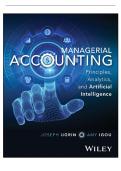
,SOLUTION MANUAL FOR Managerial Accounting Principles, Analytics, and
Artificial Intelligence Ugrin
Important Notes
The file organized chapter by chapter.
A sample of selected pages has been provided for preview.
All available appendices and Excel files (if included in the original resources) are
provided.
We continuously update our files to ensure you receive the latest and most accurate
editions.
New editions are added regularly – stay connected for updates!
⚠️Note on Answer Keys: If the answer key is not included within the chapter
questions, you will find the complete answers and solutions at the end of each
chapter.
✅ Why Buy From Us?
📚 Complete & organized chapter-by-chapter – no missing content, no guessing.
⚡ Instant digital delivery – get your file the moment you pay, no waiting.
📅 Always up to date – we track new editions so you always get the latest version.
💬 Friendly support – real humans ready to help, anytime you need us.
🔒 Safe & secure – thousands of satisfied students trust us every semester.
🛡️Our Guarantees
💰 Money-Back Guarantee: Not satisfied? We offer a full refund – no questions asked.
🔄 Wrong File? No Problem: Contact us and we will replace it immediately with the
correct version, free of charge.
⏰ 24/7 Support: We are always here – reach out anytime and expect a fast response.
,Chapter 1
Introduction to Managerial Accounting
Review Questions
1. Managerial accounting is primarily concerned with preparing data for external stakeholders.
(Learning Objective 1)
a. True
b. False
2. Developing a forecast is an example of a planning function. (Learning Objective 1)
a. True
b. False
3. Implementing a program to incentivize employees is an example of a facilitating function.
(Learning Objective 1)
a. True
b. False
4. Which is the best example of a controlling function? (Learning Objective 1)
a. Preparing a budget
b. Comparing results with budgets
5. Which of the following describes a managerial accountant’s job? (Learning Objective 1)
a. An internal business partner
b. A trusted advisor to clients
6. Managerial accounting reports are usually audited. (Learning Objective 2)
a. True
b. False
7. Which type of accounting typically focuses on aggregating accounting events into financial
statements? (Learning Objective 2)
a. Financial
b. Managerial
1
,8. Which type of accounting is more likely to report on operational data? (Learning Objective
2)
a. Financial
b. Managerial
9. What mechanism is used to link business strategy and financial results? (Learning Objective
3)
a. The operating budget
b. The balance scorecard
10. Which balanced scorecard perspective focuses on improvement in business processes?
(Learning Objective 3)
a. The learning and growth perspective
b. The internal business perspective
c. The customer value perspective
d. The financial performance perspective
11. A __________ is a tool that integrates all four balanced scorecard perspectives. (Learning
Objective 3)
a. strategy map
b. key performance indicator
12. Data analytics can best be defined as (Learning Objective 4)
a. the use of statistical techniques to turn data into useful information.
b. the use of tools to make managerial accounting more efficient.
13. ________ involves recognizing patterns in data and using the patterns to improve the
accuracy of future decisions. (Learning Objective 4)
a. Artificial intelligence
b. Machine learning
14. Which tasks are most likely to be automated? (Learning Objective 4)
a. Recording and compiling data for reports
b. Interpreting data from reports
15. New technologies will give managerial accountants more time and tools for analyzing and
interpreting data and information. (Learning Objective 4)
a. True
b. False
2
,Short Exercises
S:1-1 (Learning Objective 1)
Which of the following is not a traditional managerial accounting function?
a. Planning for operations
b. Instigating operations through negotiating prices
c. Facilitating operations through developing structures and strategies
d. Controlling operations through preparing performance reports
e. All of these are traditional managerial accounting functions.
S:1-2 (Learning Objective 1)
Emerson James is the corporate controller for True-Built Trailor Company in Miles City,
Montana. Which of the following parts of Emerson’s job would not be considered a planning
activity?
a. Performing a cost-benefit analysis before purchasing a new tube bending machine
b. Analyzing labor costs from a production job in the factory
c. Budgeting for material purchases
d. Developing profit targets to meet stockholder objectives
e. All of these are planning activities.
S:1-3 (Learning Objective 1)
Which of the following communications skills are necessary to be an effective managerial
accountant?
3
, a. An ability to articulate results
b. An ability to explain why results happened
c. An ability to outline the decisions that led to the results
d. An ability to link the strategies that influenced the decisions
e. All of these are important communication skills.
S:1-4 (Learning Objective 2)
Which is a primary difference between financial and managerial accounting?
a. Financial accounting reports are primarily prepared for external users.
b. Management accounting reports are not usually evaluated by auditors.
c. Financial accounting reports are generally prepared at specific intervals.
d. All of these are true.
S:1-5 (Learning Objective 2)
Aram Stevens owns a boutique clothing store. Which of the following metrics would help Aram
operate the store effectively?
a. Monthly gross profit percentage
b. Annual net profit
c. Average amount of sale per customer
d. All of these are important metrics.
S:1-6 (Learning Objective 2)
Consider Aram Stevens’ clothing store. Which of the following metrics would be considered
managerial accounting metric over a financial accounting metric?
4
, a. Monthly gross profit percentage
b. Annual net profit
c. Average inventory turnover rate
d. All of these are important financial accounting metrics.
S:1-7 (Learning Objective 3)
The balanced scorecard perspective that emphasizes the use of intellectual capital is the
a. learning and growth perspective.
b. internal business perspective.
c. customer value perspective.
d. financial perspective.
S:1-8 (Learning Objective 3)
The balanced scorecard perspective that emphasizes how well businesses meet customer requests
is
a. earning and growth perspective.
b. internal business perspective.
c. customer value perspective.
d. financial perspective.
5
,S:1-9 (Learning Objective 3)
The balanced scorecard perspective that emphasizes the process businesses put in place to meet
customer requests is the
a. learning and growth perspective.
b. internal business perspective.
c. customer value perspective.
d. financial perspective.
S:1-10 (Learning Objective 3)
The balanced scorecard culminates in which perspective?
a. The learning and growth perspective
b. The internal business perspective
c. The customer value perspective
d. The financial perspective
S:1-11 (Learning Objective 4)
Which types of technologies are likely to disrupt the managerial accounting profession in the
future?
a. Machine learning
b. Artificial intelligence
c. Automation
d. All of these technologies will disrupt the managerial accounting profession.
6
,S:1-12 (Learning Objective 4)
A computer program that incorporates new data to become progressively more
accurate would be an example of
a. data analytics.
b. machine learning.
c. artificial intelligence.
d. automation.
S:1-13 (Learning Objective 4)
Today’s managerial accounting job includes which function(s)?
a. Accounting
b. Data Analysis
c. Communication
d. All of these are part of a managerial accountant’s job.
Exercises
E:1-14 (Learning Objective 1)
Consider the following managerial accounting activities:
a. Preparing a financial statement
b. Comparing budget and actual results
c. Implementing a reward system for production employees
d. Preparing a budget
e. Implementing a new accounting system
f. Evaluating bids from suppliers
7
, Requirement
Drop the activities under the correct functional category.
Planning Facilitating Controlling
d. Preparing a budget c. Implementing a a. Preparing a financial
Reward system for statement.
production employees b. Comparing budget
e. Implementing a new and actual results.
accounting system
f. Evaluating bids from
suppliers
E:1-15 (Learning Objective 2)
Consider the following accounting characteristics:
a. Provides information for external decision-makers
b. Aggregates and communicates detailed financial, nonfinancial, operational, and other
information
c. Provides information for internal decision-makers
d. Does not verify reports with outside parties
e. Relies on auditors to verify reports for faithful representation
f. Prepares unstructured reports related to operational, investing, and other ad hoc decisions
g. Aggregates and communicates financial information related to accounting events
h. Prepares regular financial reports, including the income statement, balance sheet, and
statement of cash flows
Requirement
Drop the characteristics under the correct column to indicate if they are financial or
managerial accounting characteristics.
Financial Managerial
a. Provides information for external b. Aggregates and communicates
decision-makers detailed financial, nonfinancial,
e. Relies on auditors to verify reports operational, and other information
8
Artificial Intelligence Ugrin
Important Notes
The file organized chapter by chapter.
A sample of selected pages has been provided for preview.
All available appendices and Excel files (if included in the original resources) are
provided.
We continuously update our files to ensure you receive the latest and most accurate
editions.
New editions are added regularly – stay connected for updates!
⚠️Note on Answer Keys: If the answer key is not included within the chapter
questions, you will find the complete answers and solutions at the end of each
chapter.
✅ Why Buy From Us?
📚 Complete & organized chapter-by-chapter – no missing content, no guessing.
⚡ Instant digital delivery – get your file the moment you pay, no waiting.
📅 Always up to date – we track new editions so you always get the latest version.
💬 Friendly support – real humans ready to help, anytime you need us.
🔒 Safe & secure – thousands of satisfied students trust us every semester.
🛡️Our Guarantees
💰 Money-Back Guarantee: Not satisfied? We offer a full refund – no questions asked.
🔄 Wrong File? No Problem: Contact us and we will replace it immediately with the
correct version, free of charge.
⏰ 24/7 Support: We are always here – reach out anytime and expect a fast response.
,Chapter 1
Introduction to Managerial Accounting
Review Questions
1. Managerial accounting is primarily concerned with preparing data for external stakeholders.
(Learning Objective 1)
a. True
b. False
2. Developing a forecast is an example of a planning function. (Learning Objective 1)
a. True
b. False
3. Implementing a program to incentivize employees is an example of a facilitating function.
(Learning Objective 1)
a. True
b. False
4. Which is the best example of a controlling function? (Learning Objective 1)
a. Preparing a budget
b. Comparing results with budgets
5. Which of the following describes a managerial accountant’s job? (Learning Objective 1)
a. An internal business partner
b. A trusted advisor to clients
6. Managerial accounting reports are usually audited. (Learning Objective 2)
a. True
b. False
7. Which type of accounting typically focuses on aggregating accounting events into financial
statements? (Learning Objective 2)
a. Financial
b. Managerial
1
,8. Which type of accounting is more likely to report on operational data? (Learning Objective
2)
a. Financial
b. Managerial
9. What mechanism is used to link business strategy and financial results? (Learning Objective
3)
a. The operating budget
b. The balance scorecard
10. Which balanced scorecard perspective focuses on improvement in business processes?
(Learning Objective 3)
a. The learning and growth perspective
b. The internal business perspective
c. The customer value perspective
d. The financial performance perspective
11. A __________ is a tool that integrates all four balanced scorecard perspectives. (Learning
Objective 3)
a. strategy map
b. key performance indicator
12. Data analytics can best be defined as (Learning Objective 4)
a. the use of statistical techniques to turn data into useful information.
b. the use of tools to make managerial accounting more efficient.
13. ________ involves recognizing patterns in data and using the patterns to improve the
accuracy of future decisions. (Learning Objective 4)
a. Artificial intelligence
b. Machine learning
14. Which tasks are most likely to be automated? (Learning Objective 4)
a. Recording and compiling data for reports
b. Interpreting data from reports
15. New technologies will give managerial accountants more time and tools for analyzing and
interpreting data and information. (Learning Objective 4)
a. True
b. False
2
,Short Exercises
S:1-1 (Learning Objective 1)
Which of the following is not a traditional managerial accounting function?
a. Planning for operations
b. Instigating operations through negotiating prices
c. Facilitating operations through developing structures and strategies
d. Controlling operations through preparing performance reports
e. All of these are traditional managerial accounting functions.
S:1-2 (Learning Objective 1)
Emerson James is the corporate controller for True-Built Trailor Company in Miles City,
Montana. Which of the following parts of Emerson’s job would not be considered a planning
activity?
a. Performing a cost-benefit analysis before purchasing a new tube bending machine
b. Analyzing labor costs from a production job in the factory
c. Budgeting for material purchases
d. Developing profit targets to meet stockholder objectives
e. All of these are planning activities.
S:1-3 (Learning Objective 1)
Which of the following communications skills are necessary to be an effective managerial
accountant?
3
, a. An ability to articulate results
b. An ability to explain why results happened
c. An ability to outline the decisions that led to the results
d. An ability to link the strategies that influenced the decisions
e. All of these are important communication skills.
S:1-4 (Learning Objective 2)
Which is a primary difference between financial and managerial accounting?
a. Financial accounting reports are primarily prepared for external users.
b. Management accounting reports are not usually evaluated by auditors.
c. Financial accounting reports are generally prepared at specific intervals.
d. All of these are true.
S:1-5 (Learning Objective 2)
Aram Stevens owns a boutique clothing store. Which of the following metrics would help Aram
operate the store effectively?
a. Monthly gross profit percentage
b. Annual net profit
c. Average amount of sale per customer
d. All of these are important metrics.
S:1-6 (Learning Objective 2)
Consider Aram Stevens’ clothing store. Which of the following metrics would be considered
managerial accounting metric over a financial accounting metric?
4
, a. Monthly gross profit percentage
b. Annual net profit
c. Average inventory turnover rate
d. All of these are important financial accounting metrics.
S:1-7 (Learning Objective 3)
The balanced scorecard perspective that emphasizes the use of intellectual capital is the
a. learning and growth perspective.
b. internal business perspective.
c. customer value perspective.
d. financial perspective.
S:1-8 (Learning Objective 3)
The balanced scorecard perspective that emphasizes how well businesses meet customer requests
is
a. earning and growth perspective.
b. internal business perspective.
c. customer value perspective.
d. financial perspective.
5
,S:1-9 (Learning Objective 3)
The balanced scorecard perspective that emphasizes the process businesses put in place to meet
customer requests is the
a. learning and growth perspective.
b. internal business perspective.
c. customer value perspective.
d. financial perspective.
S:1-10 (Learning Objective 3)
The balanced scorecard culminates in which perspective?
a. The learning and growth perspective
b. The internal business perspective
c. The customer value perspective
d. The financial perspective
S:1-11 (Learning Objective 4)
Which types of technologies are likely to disrupt the managerial accounting profession in the
future?
a. Machine learning
b. Artificial intelligence
c. Automation
d. All of these technologies will disrupt the managerial accounting profession.
6
,S:1-12 (Learning Objective 4)
A computer program that incorporates new data to become progressively more
accurate would be an example of
a. data analytics.
b. machine learning.
c. artificial intelligence.
d. automation.
S:1-13 (Learning Objective 4)
Today’s managerial accounting job includes which function(s)?
a. Accounting
b. Data Analysis
c. Communication
d. All of these are part of a managerial accountant’s job.
Exercises
E:1-14 (Learning Objective 1)
Consider the following managerial accounting activities:
a. Preparing a financial statement
b. Comparing budget and actual results
c. Implementing a reward system for production employees
d. Preparing a budget
e. Implementing a new accounting system
f. Evaluating bids from suppliers
7
, Requirement
Drop the activities under the correct functional category.
Planning Facilitating Controlling
d. Preparing a budget c. Implementing a a. Preparing a financial
Reward system for statement.
production employees b. Comparing budget
e. Implementing a new and actual results.
accounting system
f. Evaluating bids from
suppliers
E:1-15 (Learning Objective 2)
Consider the following accounting characteristics:
a. Provides information for external decision-makers
b. Aggregates and communicates detailed financial, nonfinancial, operational, and other
information
c. Provides information for internal decision-makers
d. Does not verify reports with outside parties
e. Relies on auditors to verify reports for faithful representation
f. Prepares unstructured reports related to operational, investing, and other ad hoc decisions
g. Aggregates and communicates financial information related to accounting events
h. Prepares regular financial reports, including the income statement, balance sheet, and
statement of cash flows
Requirement
Drop the characteristics under the correct column to indicate if they are financial or
managerial accounting characteristics.
Financial Managerial
a. Provides information for external b. Aggregates and communicates
decision-makers detailed financial, nonfinancial,
e. Relies on auditors to verify reports operational, and other information
8

