

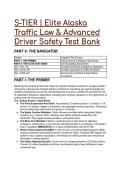
S-TIER | Elite Alaska
Traffic Law & Advanced
Driver Safety Test Bank
PART 0: THE NAVIGATOR
Section Cognitive Tier & Focus
PART I: THE PRIMER Critical Axioms & Statutory Hard Decks
PART II: THE ELITE TEST BANK Core Escalating Assessment
Tier 1 (Q1–15) Foundational Syntax & Statutory Application
Tier 2 (Q16–35) Complex Application & Traffic Simulation
Tier 3 (Q36–60) Grandmaster Synthesis & High-Stakes
Compliance
PART I: THE PRIMER
Mastering this exhaustive test bank forges the cognitive discipline required to navigate Alaska’s
unforgiving roadways and stringent statutory architecture, translating raw legal knowledge into
bulletproof operational survival. By internalizing these scenarios, practitioners eliminate the risk
of catastrophic physical or legal failure, elevating their vehicular operations to the highest tiers of
professional and clinical mastery.
The "Critical Axioms" Cheat Sheet:
● The Point Suspension Hard Deck: Accumulating 12 demerit points in 12 months, or 18
points in 24 months, triggers a mandatory, non-negotiable license suspension. Provisional
license holders face intervention at 6 points in 12 months.
● The Safety Corridor Multiplier: Traffic offenses committed within designated Safety
Corridors (e.g., Seward, Parks, Sterling) carry strictly enforced double fines (AS
28.90.030). This targets financial penalties, not demerit points.
● The Move Over Mandate: Failing to vacate the lane or slow down for stationary
emergency, maintenance, or tow vehicles with flashing lights is an infraction. If it results in
injury, it escalates IMMEDIATELY to a Class A Misdemeanor (AS 28.35.185).
● Winter Kinetic Superiority (ABS): In skid recovery, an Anti-lock Braking System (ABS)
requires sustained, heavy pedal pressure ("stomp and steer"). Pumping ABS negates the
system's micro-cadence calculations. All-Wheel Drive (AWD) provides zero mechanical
advantage in braking distance.
● The Dalton Highway Directive: Travel north of Livengood requires a CB Radio tuned to
Channel 19, active headlights at all times, and absolute right-of-way forfeiture to heavy
commercial rigs.
,PART II: THE ELITE TEST BANK
Tier 1: Foundational Syntax & Application
Q1: Under AS 28.15.221, at what exact threshold does the Alaska Division of Motor Vehicles
FIRST mandate a rigid, non-negotiable suspension of standard driving privileges? A) 6 points
within 12 months. B) 10 points within 12 months. C) 12 points within 12 months or 18 points
within 24 months. D) 15 points within 24 months.
● The Answer: C (12 points within 12 months or 18 points within 24 months.)
● Distractor Analysis:
○ A is incorrect: 6 points in 12 months triggers mandatory driver improvement for
provisional licenses and a warning letter for standard licenses, not immediate
suspension.
○ B is incorrect: 10 points is the penalty for a single severe violation (e.g., DUI), but
does not independently trigger the aggregate point suspension.
○ D is incorrect: This is a legacy metric used in other jurisdictions; Alaska strictly
utilizes the 12/18 threshold.
The Mentor's Analysis: Statutory boundaries are absolute. The DMV operates on a rigid
mathematical timeline. By tracking the 12-month and 24-month rolling accumulations, you
bypass the trap of assuming point decay outpaces recent infractions. Professional/Academic
Intuition: 12 in 12, or 18 in 24 equals a suspended license.
Q2: A driver is traveling southbound on the Seward Highway Safety Corridor and commits a
minor speeding infraction. Under AS 28.90.030, how is the penalty structurally modified? A) The
demerit points assessed to the license are doubled. B) The driver is subject to a mandatory
30-day license revocation. C) The monetary fine for the infraction is doubled. D) The infraction is
automatically escalated to Reckless Driving.
● The Answer: C (The monetary fine for the infraction is doubled.)
● Distractor Analysis:
○ A is incorrect: Safety Corridor multipliers apply to financial penalties, not the
administrative demerit point matrix.
○ B is incorrect: Revocations require point thresholds or major criminal violations
(e.g., DUI).
○ D is incorrect: Speeding only escalates to Reckless Driving if it represents a
"substantial and unjustifiable risk" per AS 28.35.400, not merely by location.
The Mentor's Analysis: Safety Corridors (Seward, Parks, Knik/Goose Bay, Sterling) are
high-fatality zones. The state utilizes financial multipliers to force compliance. By recognizing
the financial nature of the statute, you bypass the novice error of conflating fines with DMV
points. Professional/Academic Intuition: Safety Corridors double your fines, not your
points.
Q3: A driver in Anchorage intends to make a right turn at a signalized intersection. Under 13
AAC 02.215, what is the MINIMUM distance the driver must continuously display a turn signal
before executing the maneuver? A) 50 feet B) 100 feet C) 200 feet D) 500 feet
● The Answer: B (100 feet)
● Distractor Analysis:
○ A is incorrect: 50 feet is insufficient notice and legally non-compliant, leaving trailing
vehicles no reaction time.
, ○ C is incorrect: While safer at high speeds, the absolute statutory minimum is 100
feet.
○ D is incorrect: 500 feet is the distance a turn signal light must be physically visible in
sunlight, not the required activation distance.
The Mentor's Analysis: Signal activation distance dictates traffic flow predictability. The
100-foot rule is an unyielding baseline for intersection safety. Professional/Academic
Intuition: Signal 100 feet before the pivot.
Q4: Based on Alaska’s 2026 enactment of HB 192, which action regarding a cellular device is
MOST ACCURATE while operating a vehicle in motion? A) Hands-free operation is permitted,
but physically holding the device is prohibited and subject to primary enforcement. B) Holding
the device is permitted only if the driver is strictly making a voice call, not texting. C) Holding the
device is permitted as long as the driver is over the age of 21. D) All cellular device use,
including hands-free and voice-to-text, is entirely banned.
● The Answer: A (Hands-free operation is permitted, but physically holding the device is
prohibited and subject to primary enforcement.)
● Distractor Analysis:
○ B is incorrect: Under the 2026 "hands-free" mandate, the physical act of holding the
phone is illegal, regardless of the app in use.
○ C is incorrect: Alaska’s hands-free legislation applies universally to all age
demographics.
○ D is incorrect: Hands-free systems integrated into the vehicle remain permissible.
The Mentor's Analysis: HB 192 transitions Alaska into a strict hands-free jurisdiction. The law
targets the physical occupation of the driver's hands and eyes, not the communication itself.
Professional/Academic Intuition: If the vehicle is in gear, the phone cannot be in your
hand.
Q5: A driver approaches a stationary tow truck on a two-lane highway (one lane in each
direction). The truck's amber emergency lights are flashing. According to the Alaska Move Over
Law (AS 28.35.185), what is the driver's IMMEDIATE statutory obligation? A) Stop completely
until the tow truck operator signals it is safe to pass. B) Maintain speed but move to the far right
edge of the current lane. C) Slow to a reasonable and prudent speed considering traffic,
roadway, and weather conditions. D) Accelerate to pass the hazard quickly.
● The Answer: C (Slow to a reasonable and prudent speed considering traffic, roadway,
and weather conditions.)
● Distractor Analysis:
○ A is incorrect: A complete stop is only required for school buses or active peace
officer directives, not stationary maintenance/tow vehicles.
○ B is incorrect: Maintaining speed in adjacent proximity to an emergency vehicle
violates the core safety premise of the statute.
○ D is incorrect: Acceleration drastically increases the kinetic risk to the exposed
worker.
The Mentor's Analysis: On a single-direction lane where vacating is physically impossible, the
law requires kinetic reduction. By slowing to a prudent speed, you mitigate the fatal risk to
vulnerable roadside workers. Professional/Academic Intuition: If you cannot move over,
you must slow down.
Q6: Under Alaska child passenger safety regulations (AS 28.05.095), a healthy 2-year-old child
weighing 25 pounds must be secured in which of the following configurations? A) A rear-facing
infant seat. B) A federally approved forward-facing child restraint device. C) A booster seat
utilizing the vehicle's lap and shoulder belt. D) A standard vehicle seat belt.
Traffic Law & Advanced
Driver Safety Test Bank
PART 0: THE NAVIGATOR
Section Cognitive Tier & Focus
PART I: THE PRIMER Critical Axioms & Statutory Hard Decks
PART II: THE ELITE TEST BANK Core Escalating Assessment
Tier 1 (Q1–15) Foundational Syntax & Statutory Application
Tier 2 (Q16–35) Complex Application & Traffic Simulation
Tier 3 (Q36–60) Grandmaster Synthesis & High-Stakes
Compliance
PART I: THE PRIMER
Mastering this exhaustive test bank forges the cognitive discipline required to navigate Alaska’s
unforgiving roadways and stringent statutory architecture, translating raw legal knowledge into
bulletproof operational survival. By internalizing these scenarios, practitioners eliminate the risk
of catastrophic physical or legal failure, elevating their vehicular operations to the highest tiers of
professional and clinical mastery.
The "Critical Axioms" Cheat Sheet:
● The Point Suspension Hard Deck: Accumulating 12 demerit points in 12 months, or 18
points in 24 months, triggers a mandatory, non-negotiable license suspension. Provisional
license holders face intervention at 6 points in 12 months.
● The Safety Corridor Multiplier: Traffic offenses committed within designated Safety
Corridors (e.g., Seward, Parks, Sterling) carry strictly enforced double fines (AS
28.90.030). This targets financial penalties, not demerit points.
● The Move Over Mandate: Failing to vacate the lane or slow down for stationary
emergency, maintenance, or tow vehicles with flashing lights is an infraction. If it results in
injury, it escalates IMMEDIATELY to a Class A Misdemeanor (AS 28.35.185).
● Winter Kinetic Superiority (ABS): In skid recovery, an Anti-lock Braking System (ABS)
requires sustained, heavy pedal pressure ("stomp and steer"). Pumping ABS negates the
system's micro-cadence calculations. All-Wheel Drive (AWD) provides zero mechanical
advantage in braking distance.
● The Dalton Highway Directive: Travel north of Livengood requires a CB Radio tuned to
Channel 19, active headlights at all times, and absolute right-of-way forfeiture to heavy
commercial rigs.
,PART II: THE ELITE TEST BANK
Tier 1: Foundational Syntax & Application
Q1: Under AS 28.15.221, at what exact threshold does the Alaska Division of Motor Vehicles
FIRST mandate a rigid, non-negotiable suspension of standard driving privileges? A) 6 points
within 12 months. B) 10 points within 12 months. C) 12 points within 12 months or 18 points
within 24 months. D) 15 points within 24 months.
● The Answer: C (12 points within 12 months or 18 points within 24 months.)
● Distractor Analysis:
○ A is incorrect: 6 points in 12 months triggers mandatory driver improvement for
provisional licenses and a warning letter for standard licenses, not immediate
suspension.
○ B is incorrect: 10 points is the penalty for a single severe violation (e.g., DUI), but
does not independently trigger the aggregate point suspension.
○ D is incorrect: This is a legacy metric used in other jurisdictions; Alaska strictly
utilizes the 12/18 threshold.
The Mentor's Analysis: Statutory boundaries are absolute. The DMV operates on a rigid
mathematical timeline. By tracking the 12-month and 24-month rolling accumulations, you
bypass the trap of assuming point decay outpaces recent infractions. Professional/Academic
Intuition: 12 in 12, or 18 in 24 equals a suspended license.
Q2: A driver is traveling southbound on the Seward Highway Safety Corridor and commits a
minor speeding infraction. Under AS 28.90.030, how is the penalty structurally modified? A) The
demerit points assessed to the license are doubled. B) The driver is subject to a mandatory
30-day license revocation. C) The monetary fine for the infraction is doubled. D) The infraction is
automatically escalated to Reckless Driving.
● The Answer: C (The monetary fine for the infraction is doubled.)
● Distractor Analysis:
○ A is incorrect: Safety Corridor multipliers apply to financial penalties, not the
administrative demerit point matrix.
○ B is incorrect: Revocations require point thresholds or major criminal violations
(e.g., DUI).
○ D is incorrect: Speeding only escalates to Reckless Driving if it represents a
"substantial and unjustifiable risk" per AS 28.35.400, not merely by location.
The Mentor's Analysis: Safety Corridors (Seward, Parks, Knik/Goose Bay, Sterling) are
high-fatality zones. The state utilizes financial multipliers to force compliance. By recognizing
the financial nature of the statute, you bypass the novice error of conflating fines with DMV
points. Professional/Academic Intuition: Safety Corridors double your fines, not your
points.
Q3: A driver in Anchorage intends to make a right turn at a signalized intersection. Under 13
AAC 02.215, what is the MINIMUM distance the driver must continuously display a turn signal
before executing the maneuver? A) 50 feet B) 100 feet C) 200 feet D) 500 feet
● The Answer: B (100 feet)
● Distractor Analysis:
○ A is incorrect: 50 feet is insufficient notice and legally non-compliant, leaving trailing
vehicles no reaction time.
, ○ C is incorrect: While safer at high speeds, the absolute statutory minimum is 100
feet.
○ D is incorrect: 500 feet is the distance a turn signal light must be physically visible in
sunlight, not the required activation distance.
The Mentor's Analysis: Signal activation distance dictates traffic flow predictability. The
100-foot rule is an unyielding baseline for intersection safety. Professional/Academic
Intuition: Signal 100 feet before the pivot.
Q4: Based on Alaska’s 2026 enactment of HB 192, which action regarding a cellular device is
MOST ACCURATE while operating a vehicle in motion? A) Hands-free operation is permitted,
but physically holding the device is prohibited and subject to primary enforcement. B) Holding
the device is permitted only if the driver is strictly making a voice call, not texting. C) Holding the
device is permitted as long as the driver is over the age of 21. D) All cellular device use,
including hands-free and voice-to-text, is entirely banned.
● The Answer: A (Hands-free operation is permitted, but physically holding the device is
prohibited and subject to primary enforcement.)
● Distractor Analysis:
○ B is incorrect: Under the 2026 "hands-free" mandate, the physical act of holding the
phone is illegal, regardless of the app in use.
○ C is incorrect: Alaska’s hands-free legislation applies universally to all age
demographics.
○ D is incorrect: Hands-free systems integrated into the vehicle remain permissible.
The Mentor's Analysis: HB 192 transitions Alaska into a strict hands-free jurisdiction. The law
targets the physical occupation of the driver's hands and eyes, not the communication itself.
Professional/Academic Intuition: If the vehicle is in gear, the phone cannot be in your
hand.
Q5: A driver approaches a stationary tow truck on a two-lane highway (one lane in each
direction). The truck's amber emergency lights are flashing. According to the Alaska Move Over
Law (AS 28.35.185), what is the driver's IMMEDIATE statutory obligation? A) Stop completely
until the tow truck operator signals it is safe to pass. B) Maintain speed but move to the far right
edge of the current lane. C) Slow to a reasonable and prudent speed considering traffic,
roadway, and weather conditions. D) Accelerate to pass the hazard quickly.
● The Answer: C (Slow to a reasonable and prudent speed considering traffic, roadway,
and weather conditions.)
● Distractor Analysis:
○ A is incorrect: A complete stop is only required for school buses or active peace
officer directives, not stationary maintenance/tow vehicles.
○ B is incorrect: Maintaining speed in adjacent proximity to an emergency vehicle
violates the core safety premise of the statute.
○ D is incorrect: Acceleration drastically increases the kinetic risk to the exposed
worker.
The Mentor's Analysis: On a single-direction lane where vacating is physically impossible, the
law requires kinetic reduction. By slowing to a prudent speed, you mitigate the fatal risk to
vulnerable roadside workers. Professional/Academic Intuition: If you cannot move over,
you must slow down.
Q6: Under Alaska child passenger safety regulations (AS 28.05.095), a healthy 2-year-old child
weighing 25 pounds must be secured in which of the following configurations? A) A rear-facing
infant seat. B) A federally approved forward-facing child restraint device. C) A booster seat
utilizing the vehicle's lap and shoulder belt. D) A standard vehicle seat belt.

