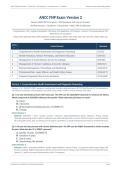
ANCC FNP Exam Version 2 - 2026/2027 | 200 Questions | Verified Answers | Graded A+ American Nurses Credentialing Center
ANCC FNP Exam Version 2
Newest 2026/2027 Complete - 200 Questions and Correct Answers
Verified Answers | Graded A+ | Brand New | ANCC FNP Certification
Total Questions: 200 | Cognitive Distribution: 25% Recall, 50% Application, 25% Analysis | Format: 75% Scenario-Based, 20%
Direct Recall, 5% Calculation
Aligned with 2026-2027 ANCC FNP certification content outline, USPSTF, CDC, ACOG, AAP, ADA, AHA/ACC, GOLD, GINA, and
current evidence-based practice standards.
Sectio
Content Domain Questions
n
1 Comprehensive Health Assessment and Diagnostic Reasoning Q1-Q35
2 Health Promotion, Disease Prevention, and Patient Education Q36-Q55
3 Management of Acute Illnesses Across the Lifespan Q56-Q85
4 Management of Chronic Conditions Across the Lifespan Q86-Q125
5 Pharmacotherapeutics, Prescribing, and Monitoring Q126-Q155
6 Professional Role, Legal, Ethical, and Health Policy Issues Q156-Q175
7 Complex Integrated Clinical Case Scenarios Q176-Q200
Section 1: Comprehensive Health Assessment and Diagnostic Reasoning
Questions 1-35 | OLDCARTS, PQRST, genograms, cardiovascular/respiratory/abdominal exam, CBC/CMP/lipid/thyroid/A1C/UA interpretation,
CXR/DEXA/ECG/spirometry, clinical prediction rules (Wells, Centor, HEART, CURB-65, Ottawa, Alvarado), E/M coding.
Q1: A 52-year-old female presents with chest pain. The FNP uses the OLDCARTS framework to structure the history.
Which component of OLDCARTS addresses the question 'What makes the pain better or worse?'
A. Onset.
B. Character.
C. Relieving/Exacerbating factors. [CORRECT]
D. Timing.
Correct Answer: C
Rationale: OLDCARTS = Onset, Location, Duration, Character, Aggravating/Relieving factors, Radiation, Timing, Severity.
'Relieving/Exacerbating factors' (option C) addresses what makes the pain better or worse. Onset (A) is when it started, Character
(B) is the quality (sharp, dull), and Timing (D) is the pattern. OLDCARTS is a standard HPI framework tested on the ANCC FNP exam.
Q2: A 45-year-old male presents with chronic abdominal pain. The FNP uses the PQRST framework to further evaluate
the pain. What does the 'Q' in PQRST represent?
A. Quality of pain. [CORRECT]
B. Quantity of pain.
C. Quick onset.
D. Questioning the patient.
Correct Answer: A
Rationale: PQRST = Provocation/Palliation, Quality, Region/Radiation, Severity, Timing. 'Q' represents Quality of pain (sharp, dull,
burning, cramping). PQRST is particularly useful for pain assessment and is tested as a key HPI framework on the ANCC FNP exam.
Options B, C, and D are incorrect interpretations of the 'Q' component.
Family Nurse Practitioner Certification Examination Page 1
,ANCC FNP Exam Version 2 - 2026/2027 | 200 Questions | Verified Answers | Graded A+ American Nurses Credentialing Center
Q3: An FNP is constructing a genogram for a patient with a family history of breast cancer. The patient's mother was
diagnosed at age 42 and the maternal aunt at age 38. Which hereditary syndrome should the FNP suspect?
A. Lynch syndrome.
B. BRCA1/BRCA2 mutation syndrome with hereditary breast and ovarian cancer (HBOC)
risk. [CORRECT]
C. Familial adenomatous polyposis.
D. Von Hippel-Lindau syndrome.
Correct Answer: B
Rationale: Early-onset breast cancer (before 50) in multiple first-degree or second-degree relatives strongly suggests hereditary
breast and ovarian cancer (HBOC) syndrome due to BRCA1/BRCA2 mutations. Lynch syndrome (A) is associated with colorectal and
endometrial cancer. FAP (C) is associated with colon polyps. VHL (D) is associated with renal cell carcinoma and CNS
hemangioblastomas. ANCC tests genogram interpretation and hereditary risk assessment.
Q4: An FNP is performing a comprehensive cardiovascular exam. When auscultating heart sounds, the FNP notes an S3
gallop. Which condition is most commonly associated with an S3 in adults over 40?
A. Aortic stenosis.
B. Left ventricular volume overload as seen in heart failure. [CORRECT]
C. Pericarditis.
D. Mitral valve prolapse.
Correct Answer: B
Rationale: An S3 heart sound (ventricular gallop) in adults over 40 is most commonly associated with left ventricular volume
overload, typically from heart failure. It occurs from rapid ventricular filling into a noncompliant ventricle. S4 (not S3) is associated
with decreased ventricular compliance (hypertension, aortic stenosis). Pericarditis (C) produces a friction rub. ANCC expects FNPs to
differentiate S1-S4 and abnormal sounds.
Q5: A 60-year-old male presents with acute onset dyspnea. On auscultation, the FNP notes absent breath sounds on
the right side with hyperresonance to percussion. Which condition is most likely?
A. Right-sided pneumonia.
B. Right-sided pleural effusion.
C. Right-sided pneumothorax. [CORRECT]
D. Right-sided atelectasis.
Correct Answer: C
Rationale: Absent breath sounds with hyperresonance to percussion is classic for pneumothorax (air in the pleural space).
Pneumonia (A) produces crackles/rales with dullness to percussion. Pleural effusion (B) produces decreased breath sounds with
dullness (not hyperresonance). Atelectasis (D) produces decreased breath sounds with dullness. ANCC tests the integration of
percussion and auscultation findings.
Q6: An FNP is assessing a patient with suspected consolidation from pneumonia. Which physical exam finding would
support this diagnosis?
A. Decreased tactile fremitus.
B. Increased tactile fremitus, egophony (E to A change), and whispered pectoriloquy.
[CORRECT]
C. Hyperresonance to percussion.
D. Decreased breath sounds only.
Correct Answer: B
Rationale: Pulmonary consolidation (pneumonia) transmits sound better, producing increased tactile fremitus, bronchial breath
sounds, egophony (E becomes A), and whispered pectoriloquy. Decreased fremitus (A) occurs with pleural effusion or
pneumothorax. Hyperresonance (C) suggests pneumothorax or COPD. ANCC expects FNPs to interpret chest exam findings for
differential diagnosis.
Family Nurse Practitioner Certification Examination Page 2
,ANCC FNP Exam Version 2 - 2026/2027 | 200 Questions | Verified Answers | Graded A+ American Nurses Credentialing Center
Q7: A 35-year-old female presents with fatigue. CBC shows: Hgb 9.2 g/dL, MCV 72 fL, ferritin 8 ng/mL. Which diagnosis
is most likely?
A. Vitamin B12 deficiency anemia.
B. Iron deficiency anemia (microcytic, hypochromic). [CORRECT]
C. Folic acid deficiency anemia.
D. Anemia of chronic disease.
Correct Answer: B
Rationale: Low Hgb, low MCV (<80 = microcytic), and low ferritin (<15 ng/mL) are classic for iron deficiency anemia. B12 (A) and
folate (C) deficiency cause macrocytic (high MCV >100) anemia. Anemia of chronic disease (D) typically has normal or high ferritin.
ANCC expects FNPs to interpret CBC indices and iron studies for anemia classification.
Q8: A 58-year-old male with type 2 diabetes has an eGFR of 38 mL/min/1.73m2 and albuminuria of 300 mg/24 hr.
Which stage of CKD does this represent?
A. Stage 2 (mild).
B. Stage 3b (moderate to severe). [CORRECT]
C. Stage 4 (severe).
D. Stage 5 (kidney failure).
Correct Answer: B
Rationale: CKD staging by eGFR: Stage 1 ≥90, Stage 2 60-89, Stage 3a 45-59, Stage 3b 30-44, Stage 4 15-29, Stage 5 <15 or
dialysis. eGFR 38 = Stage 3b. Albuminuria of 300 mg/24 hr (A3) indicates significantly increased albuminuria. ANCC expects FNPs to
stage CKD using both eGFR and albuminuria categories per KDIGO guidelines.
Q9: An FNP interprets a lipid panel: Total cholesterol 220, HDL 38, LDL 145, Triglycerides 180. Which ASCVD risk factor
does the low HDL represent?
A. HDL <40 in men is a risk factor for ASCVD. [CORRECT]
B. HDL <50 in women is protective.
C. HDL >60 is a risk factor.
D. HDL has no role in ASCVD risk.
Correct Answer: A
Rationale: HDL <40 in men (or <50 in women) is a major ASCVD risk factor. HDL >60 mg/dL is considered protective (negative risk
factor). This patient's HDL of 38 is a risk factor. ANCC expects FNPs to interpret lipid panels and apply ASCVD risk assessment per
ACC/AHA guidelines for statin therapy decisions.
Q10: A 70-year-old male presents with confusion and lethargy. CMP shows Na+ 118 mEq/L. Which finding would
suggest this is acute (vs. chronic) hyponatremia requiring urgent treatment?
A. Seizures or coma indicating cerebral edema from rapid sodium shift. [CORRECT]
B. Mild nausea only.
C. Asymptomatic with Na+ discovered incidentally.
D. Chronic SIADH with stable sodium for months.
Correct Answer: A
Rationale: Acute hyponatremia (developing over <48 hours) with severe symptoms (seizures, coma) requires urgent hypertonic
saline to prevent cerebral edema and herniation. Chronic hyponatremia must be corrected slowly (≤8-10 mEq/L in 24 hours) to
avoid osmotic demyelination. ANCC tests recognition of emergent electrolyte abnormalities requiring immediate intervention.
Q11: An FNP is evaluating a 25-year-old female with suspected hyperthyroidism. Which laboratory pattern confirms
primary hyperthyroidism?
A. Elevated TSH, low free T4.
B. Low TSH, elevated free T4 and/or free T3. [CORRECT]
C. Normal TSH, normal free T4.
Family Nurse Practitioner Certification Examination Page 3
, ANCC FNP Exam Version 2 - 2026/2027 | 200 Questions | Verified Answers | Graded A+ American Nurses Credentialing Center
D. Low TSH, low free T4 (central hypothyroidism).
Correct Answer: B
Rationale: Primary hyperthyroidism (e.g., Graves' disease) shows suppressed TSH (negative feedback from high thyroid hormones)
with elevated free T4 and/or free T3. Elevated TSH with low T4 (A) is primary hypothyroidism. Low TSH with low T4 (D) suggests
central (secondary) hypothyroidism. ANCC tests thyroid panel interpretation for differential diagnosis.
Q12: A 55-year-old male with type 2 diabetes has A1C 9.2%. What does this correlate to as an estimated average blood
glucose?
A. Approximately 150 mg/dL.
B. Approximately 213 mg/dL (eAG = 28.7 x A1C - 46.7). [CORRECT]
C. Approximately 300 mg/dL.
D. Approximately 100 mg/dL.
Correct Answer: B
Rationale: The estimated average glucose (eAG) formula is eAG = 28.7 x A1C - 46.7. For A1C 9.2: eAG = 28.7(9.2) - 46.7 = 264 - 46.7
= 217 mg/dL (closest to 213). A1C 9.2% is well above the general target of <7%. ANCC expects FNPs to interpret A1C and
understand its relationship to average glucose for diabetes management.
Q13: A 30-year-old female presents with dysuria, frequency, and urgency. Urinalysis shows positive leukocyte
esterase, positive nitrites, and WBCs. What is the most likely diagnosis?
A. Uncomplicated cystitis (UTI). [CORRECT]
B. Pyelonephritis.
C. Vaginitis.
D. Urethritis from STI.
Correct Answer: A
Rationale: Dysuria, frequency, urgency with positive leukocyte esterase, nitrites, and WBCs on UA is classic for uncomplicated
cystitis (lower UTI). Pyelonephritis (B) includes fever and flank pain. Vaginitis (C) typically has vaginal discharge. STI urethritis (D)
may have discharge and risk factors. ANCC tests UA interpretation in the context of clinical presentation.
Q14: A 45-year-old male presents with pleuritic chest pain and dyspnea. Wells score is 4 (intermediate risk). Which
D-dimer result would safely rule out PE without imaging?
A. D-dimer <500 ng/mL (or 50). [CORRECT]
B. D-dimer of 800 ng/mL.
C. D-dimer of 1500 ng/mL.
D. Any D-dimer value rules out PE.
Correct Answer: A
Rationale: In intermediate-risk patients (Wells 2-6), a negative D-dimer (<500 ng/mL, or 50) safely rules out PE without imaging. A
positive D-dimer requires CT pulmonary angiography or V/Q scan. ANCC tests the use of clinical prediction rules (Wells, PERC) and
D-dimer for PE risk stratification per current guidelines.
Q15: A 35-year-old male presents with acute chest pain that improves with leaning forward and worsens with lying
flat. ECG shows diffuse ST elevations and PR depressions. Which diagnosis is most likely?
A. Acute ST-elevation myocardial infarction (STEMI).
B. Acute pericarditis. [CORRECT]
C. Pulmonary embolism.
D. Costochondritis.
Correct Answer: B
Rationale: Pleuritic chest pain relieved by sitting forward and worsened by lying flat, with diffuse ST elevations and PR depressions
on ECG, is classic for acute pericarditis. STEMI (A) shows focal (not diffuse) ST elevations with reciprocal changes. PE (C) typically
shows sinus tachycardia, S1Q3T3. ANCC tests ECG pattern recognition for differential chest pain diagnosis.
Family Nurse Practitioner Certification Examination Page 4
ANCC FNP Exam Version 2
Newest 2026/2027 Complete - 200 Questions and Correct Answers
Verified Answers | Graded A+ | Brand New | ANCC FNP Certification
Total Questions: 200 | Cognitive Distribution: 25% Recall, 50% Application, 25% Analysis | Format: 75% Scenario-Based, 20%
Direct Recall, 5% Calculation
Aligned with 2026-2027 ANCC FNP certification content outline, USPSTF, CDC, ACOG, AAP, ADA, AHA/ACC, GOLD, GINA, and
current evidence-based practice standards.
Sectio
Content Domain Questions
n
1 Comprehensive Health Assessment and Diagnostic Reasoning Q1-Q35
2 Health Promotion, Disease Prevention, and Patient Education Q36-Q55
3 Management of Acute Illnesses Across the Lifespan Q56-Q85
4 Management of Chronic Conditions Across the Lifespan Q86-Q125
5 Pharmacotherapeutics, Prescribing, and Monitoring Q126-Q155
6 Professional Role, Legal, Ethical, and Health Policy Issues Q156-Q175
7 Complex Integrated Clinical Case Scenarios Q176-Q200
Section 1: Comprehensive Health Assessment and Diagnostic Reasoning
Questions 1-35 | OLDCARTS, PQRST, genograms, cardiovascular/respiratory/abdominal exam, CBC/CMP/lipid/thyroid/A1C/UA interpretation,
CXR/DEXA/ECG/spirometry, clinical prediction rules (Wells, Centor, HEART, CURB-65, Ottawa, Alvarado), E/M coding.
Q1: A 52-year-old female presents with chest pain. The FNP uses the OLDCARTS framework to structure the history.
Which component of OLDCARTS addresses the question 'What makes the pain better or worse?'
A. Onset.
B. Character.
C. Relieving/Exacerbating factors. [CORRECT]
D. Timing.
Correct Answer: C
Rationale: OLDCARTS = Onset, Location, Duration, Character, Aggravating/Relieving factors, Radiation, Timing, Severity.
'Relieving/Exacerbating factors' (option C) addresses what makes the pain better or worse. Onset (A) is when it started, Character
(B) is the quality (sharp, dull), and Timing (D) is the pattern. OLDCARTS is a standard HPI framework tested on the ANCC FNP exam.
Q2: A 45-year-old male presents with chronic abdominal pain. The FNP uses the PQRST framework to further evaluate
the pain. What does the 'Q' in PQRST represent?
A. Quality of pain. [CORRECT]
B. Quantity of pain.
C. Quick onset.
D. Questioning the patient.
Correct Answer: A
Rationale: PQRST = Provocation/Palliation, Quality, Region/Radiation, Severity, Timing. 'Q' represents Quality of pain (sharp, dull,
burning, cramping). PQRST is particularly useful for pain assessment and is tested as a key HPI framework on the ANCC FNP exam.
Options B, C, and D are incorrect interpretations of the 'Q' component.
Family Nurse Practitioner Certification Examination Page 1
,ANCC FNP Exam Version 2 - 2026/2027 | 200 Questions | Verified Answers | Graded A+ American Nurses Credentialing Center
Q3: An FNP is constructing a genogram for a patient with a family history of breast cancer. The patient's mother was
diagnosed at age 42 and the maternal aunt at age 38. Which hereditary syndrome should the FNP suspect?
A. Lynch syndrome.
B. BRCA1/BRCA2 mutation syndrome with hereditary breast and ovarian cancer (HBOC)
risk. [CORRECT]
C. Familial adenomatous polyposis.
D. Von Hippel-Lindau syndrome.
Correct Answer: B
Rationale: Early-onset breast cancer (before 50) in multiple first-degree or second-degree relatives strongly suggests hereditary
breast and ovarian cancer (HBOC) syndrome due to BRCA1/BRCA2 mutations. Lynch syndrome (A) is associated with colorectal and
endometrial cancer. FAP (C) is associated with colon polyps. VHL (D) is associated with renal cell carcinoma and CNS
hemangioblastomas. ANCC tests genogram interpretation and hereditary risk assessment.
Q4: An FNP is performing a comprehensive cardiovascular exam. When auscultating heart sounds, the FNP notes an S3
gallop. Which condition is most commonly associated with an S3 in adults over 40?
A. Aortic stenosis.
B. Left ventricular volume overload as seen in heart failure. [CORRECT]
C. Pericarditis.
D. Mitral valve prolapse.
Correct Answer: B
Rationale: An S3 heart sound (ventricular gallop) in adults over 40 is most commonly associated with left ventricular volume
overload, typically from heart failure. It occurs from rapid ventricular filling into a noncompliant ventricle. S4 (not S3) is associated
with decreased ventricular compliance (hypertension, aortic stenosis). Pericarditis (C) produces a friction rub. ANCC expects FNPs to
differentiate S1-S4 and abnormal sounds.
Q5: A 60-year-old male presents with acute onset dyspnea. On auscultation, the FNP notes absent breath sounds on
the right side with hyperresonance to percussion. Which condition is most likely?
A. Right-sided pneumonia.
B. Right-sided pleural effusion.
C. Right-sided pneumothorax. [CORRECT]
D. Right-sided atelectasis.
Correct Answer: C
Rationale: Absent breath sounds with hyperresonance to percussion is classic for pneumothorax (air in the pleural space).
Pneumonia (A) produces crackles/rales with dullness to percussion. Pleural effusion (B) produces decreased breath sounds with
dullness (not hyperresonance). Atelectasis (D) produces decreased breath sounds with dullness. ANCC tests the integration of
percussion and auscultation findings.
Q6: An FNP is assessing a patient with suspected consolidation from pneumonia. Which physical exam finding would
support this diagnosis?
A. Decreased tactile fremitus.
B. Increased tactile fremitus, egophony (E to A change), and whispered pectoriloquy.
[CORRECT]
C. Hyperresonance to percussion.
D. Decreased breath sounds only.
Correct Answer: B
Rationale: Pulmonary consolidation (pneumonia) transmits sound better, producing increased tactile fremitus, bronchial breath
sounds, egophony (E becomes A), and whispered pectoriloquy. Decreased fremitus (A) occurs with pleural effusion or
pneumothorax. Hyperresonance (C) suggests pneumothorax or COPD. ANCC expects FNPs to interpret chest exam findings for
differential diagnosis.
Family Nurse Practitioner Certification Examination Page 2
,ANCC FNP Exam Version 2 - 2026/2027 | 200 Questions | Verified Answers | Graded A+ American Nurses Credentialing Center
Q7: A 35-year-old female presents with fatigue. CBC shows: Hgb 9.2 g/dL, MCV 72 fL, ferritin 8 ng/mL. Which diagnosis
is most likely?
A. Vitamin B12 deficiency anemia.
B. Iron deficiency anemia (microcytic, hypochromic). [CORRECT]
C. Folic acid deficiency anemia.
D. Anemia of chronic disease.
Correct Answer: B
Rationale: Low Hgb, low MCV (<80 = microcytic), and low ferritin (<15 ng/mL) are classic for iron deficiency anemia. B12 (A) and
folate (C) deficiency cause macrocytic (high MCV >100) anemia. Anemia of chronic disease (D) typically has normal or high ferritin.
ANCC expects FNPs to interpret CBC indices and iron studies for anemia classification.
Q8: A 58-year-old male with type 2 diabetes has an eGFR of 38 mL/min/1.73m2 and albuminuria of 300 mg/24 hr.
Which stage of CKD does this represent?
A. Stage 2 (mild).
B. Stage 3b (moderate to severe). [CORRECT]
C. Stage 4 (severe).
D. Stage 5 (kidney failure).
Correct Answer: B
Rationale: CKD staging by eGFR: Stage 1 ≥90, Stage 2 60-89, Stage 3a 45-59, Stage 3b 30-44, Stage 4 15-29, Stage 5 <15 or
dialysis. eGFR 38 = Stage 3b. Albuminuria of 300 mg/24 hr (A3) indicates significantly increased albuminuria. ANCC expects FNPs to
stage CKD using both eGFR and albuminuria categories per KDIGO guidelines.
Q9: An FNP interprets a lipid panel: Total cholesterol 220, HDL 38, LDL 145, Triglycerides 180. Which ASCVD risk factor
does the low HDL represent?
A. HDL <40 in men is a risk factor for ASCVD. [CORRECT]
B. HDL <50 in women is protective.
C. HDL >60 is a risk factor.
D. HDL has no role in ASCVD risk.
Correct Answer: A
Rationale: HDL <40 in men (or <50 in women) is a major ASCVD risk factor. HDL >60 mg/dL is considered protective (negative risk
factor). This patient's HDL of 38 is a risk factor. ANCC expects FNPs to interpret lipid panels and apply ASCVD risk assessment per
ACC/AHA guidelines for statin therapy decisions.
Q10: A 70-year-old male presents with confusion and lethargy. CMP shows Na+ 118 mEq/L. Which finding would
suggest this is acute (vs. chronic) hyponatremia requiring urgent treatment?
A. Seizures or coma indicating cerebral edema from rapid sodium shift. [CORRECT]
B. Mild nausea only.
C. Asymptomatic with Na+ discovered incidentally.
D. Chronic SIADH with stable sodium for months.
Correct Answer: A
Rationale: Acute hyponatremia (developing over <48 hours) with severe symptoms (seizures, coma) requires urgent hypertonic
saline to prevent cerebral edema and herniation. Chronic hyponatremia must be corrected slowly (≤8-10 mEq/L in 24 hours) to
avoid osmotic demyelination. ANCC tests recognition of emergent electrolyte abnormalities requiring immediate intervention.
Q11: An FNP is evaluating a 25-year-old female with suspected hyperthyroidism. Which laboratory pattern confirms
primary hyperthyroidism?
A. Elevated TSH, low free T4.
B. Low TSH, elevated free T4 and/or free T3. [CORRECT]
C. Normal TSH, normal free T4.
Family Nurse Practitioner Certification Examination Page 3
, ANCC FNP Exam Version 2 - 2026/2027 | 200 Questions | Verified Answers | Graded A+ American Nurses Credentialing Center
D. Low TSH, low free T4 (central hypothyroidism).
Correct Answer: B
Rationale: Primary hyperthyroidism (e.g., Graves' disease) shows suppressed TSH (negative feedback from high thyroid hormones)
with elevated free T4 and/or free T3. Elevated TSH with low T4 (A) is primary hypothyroidism. Low TSH with low T4 (D) suggests
central (secondary) hypothyroidism. ANCC tests thyroid panel interpretation for differential diagnosis.
Q12: A 55-year-old male with type 2 diabetes has A1C 9.2%. What does this correlate to as an estimated average blood
glucose?
A. Approximately 150 mg/dL.
B. Approximately 213 mg/dL (eAG = 28.7 x A1C - 46.7). [CORRECT]
C. Approximately 300 mg/dL.
D. Approximately 100 mg/dL.
Correct Answer: B
Rationale: The estimated average glucose (eAG) formula is eAG = 28.7 x A1C - 46.7. For A1C 9.2: eAG = 28.7(9.2) - 46.7 = 264 - 46.7
= 217 mg/dL (closest to 213). A1C 9.2% is well above the general target of <7%. ANCC expects FNPs to interpret A1C and
understand its relationship to average glucose for diabetes management.
Q13: A 30-year-old female presents with dysuria, frequency, and urgency. Urinalysis shows positive leukocyte
esterase, positive nitrites, and WBCs. What is the most likely diagnosis?
A. Uncomplicated cystitis (UTI). [CORRECT]
B. Pyelonephritis.
C. Vaginitis.
D. Urethritis from STI.
Correct Answer: A
Rationale: Dysuria, frequency, urgency with positive leukocyte esterase, nitrites, and WBCs on UA is classic for uncomplicated
cystitis (lower UTI). Pyelonephritis (B) includes fever and flank pain. Vaginitis (C) typically has vaginal discharge. STI urethritis (D)
may have discharge and risk factors. ANCC tests UA interpretation in the context of clinical presentation.
Q14: A 45-year-old male presents with pleuritic chest pain and dyspnea. Wells score is 4 (intermediate risk). Which
D-dimer result would safely rule out PE without imaging?
A. D-dimer <500 ng/mL (or 50). [CORRECT]
B. D-dimer of 800 ng/mL.
C. D-dimer of 1500 ng/mL.
D. Any D-dimer value rules out PE.
Correct Answer: A
Rationale: In intermediate-risk patients (Wells 2-6), a negative D-dimer (<500 ng/mL, or 50) safely rules out PE without imaging. A
positive D-dimer requires CT pulmonary angiography or V/Q scan. ANCC tests the use of clinical prediction rules (Wells, PERC) and
D-dimer for PE risk stratification per current guidelines.
Q15: A 35-year-old male presents with acute chest pain that improves with leaning forward and worsens with lying
flat. ECG shows diffuse ST elevations and PR depressions. Which diagnosis is most likely?
A. Acute ST-elevation myocardial infarction (STEMI).
B. Acute pericarditis. [CORRECT]
C. Pulmonary embolism.
D. Costochondritis.
Correct Answer: B
Rationale: Pleuritic chest pain relieved by sitting forward and worsened by lying flat, with diffuse ST elevations and PR depressions
on ECG, is classic for acute pericarditis. STEMI (A) shows focal (not diffuse) ST elevations with reciprocal changes. PE (C) typically
shows sinus tachycardia, S1Q3T3. ANCC tests ECG pattern recognition for differential chest pain diagnosis.
Family Nurse Practitioner Certification Examination Page 4