EDPNA Exam 2026/2027 Nephrology Nursing | 120 Questions
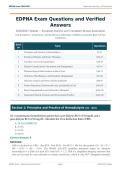
EDPNA Exam Questions and Verified
Answers
2026/2027 Update — European Dialysis and Transplant Nurses Association
120 Questions | 10 Sections | Comprehensive Rationales | KDOQI & European Best Practice
Guidelines
Secti
Topic Questions
on
1 Principles and Practice of Hemodialysis Q1-25
2 Peritoneal Dialysis and Home Therapies Q26-35
3 Vascular Access and Cannulation Q36-50
4 Dialysis Complications: Prevention and Management Q51-65
5 Pharmacological Interventions in Renal Care Q66-75
6 Nutrition, Fluid Balance, and Metabolic Management Q76-85
7 Infection Control and Water Quality Standards Q86-95
8 Patient Education, Psychosocial Care, and Quality of Life Q96-105
9 Renal Transplantation and Alternative Therapies Q106-115
10 Integrated Clinical Scenarios and Professional Practice Q116-120
Section 1: Principles and Practice of Hemodialysis (Q1 - Q25)
Q1: A maintenance hemodialysis patient has a pre-dialysis BUN of 95 mg/dL and a
post-dialysis BUN of 28 mg/dL. Calculate the Urea Reduction Ratio (URR).
A. 70.5% [CORRECT]
B. 29.5%
C. 67.0%
D. 60.0%
Correct Answer: A
Rationale:
URR is calculated as: URR = (Pre-BUN - Post-BUN) / Pre-BUN × 100. For this patient: (95 - 28) / 95 ×
100 = 67/95 × 100 = 70.5%. The KDOQI 2026/2027 guideline minimum target for adequate
hemodialysis is a URR of at least 65% (with Kt/V ≥ 1.2). URR is a simplified adequacy measure that
does not account for urea rebound or volume contraction, which is why Kt/V (Daugirdas formula)
EDPNA Exam - Dialysis Nursing Practice Page 1 2026/2027 Update
,EDPNA Exam 2026/2027 Nephrology Nursing | 120 Questions
provides a more accurate assessment. Choice B (29.5%) incorrectly subtracts in reverse; choice C
(67%) is close but is a miscalculation; choice D (60%) falls below the adequacy threshold.
Q2: Which principle of hemodialysis involves the movement of solutes across a
semipermeable membrane from an area of higher concentration to an area of lower
concentration?
A. Convection
B. Diffusion [CORRECT]
C. Ultrafiltration
D. Adsorption
Correct Answer: B
Rationale:
Diffusion is the movement of solutes across a semipermeable membrane from higher to lower
concentration gradient, driven by concentration differences. This is the primary mechanism for
removal of small uremic toxins like urea and creatinine. Convection involves solute drag with water
movement (solute drag mechanism, used in hemofiltration). Ultrafiltration is the movement of water
across the membrane due to hydrostatic pressure differences (fluid removal). Adsorption is the
binding of substances to the membrane surface. Understanding these distinctions is essential for
prescribing appropriate dialysis modalities.
Q3: A patient on hemodialysis requires removal of 3.0 kg of fluid during a 4-hour
treatment. What is the ultrafiltration rate (UFR) in mL/kg/hr if the patient weighs 70 kg?
A. 10.7 mL/kg/hr [CORRECT]
B. 7.5 mL/kg/hr
C. 13 mL/kg/hr
D. 5.4 mL/kg/hr
Correct Answer: A
Rationale:
Ultrafiltration rate (UFR) is calculated as: (Total UF volume in mL) / (Treatment time in hours ×
Patient weight in kg). For this patient: 3000 mL / (4 hr × 70 kg) = = 10.7 mL/kg/hr. KDOQI
guidelines recommend keeping UFR ≤ 13 mL/kg/hr to minimize intradialytic hypotension and
cardiovascular stress. This patient's UFR of 10.7 mL/kg/hr is within safe limits but approaching the
upper boundary. Higher UFRs are associated with increased mortality, myocardial stunning, and
intradialytic hypotension. Choice C (13 mL/kg/hr) is at the upper limit; choice B and D represent
miscalculations.
EDPNA Exam - Dialysis Nursing Practice Page 2 2026/2027 Update
,EDPNA Exam 2026/2027 Nephrology Nursing | 120 Questions
Q4: Which dialyzer membrane characteristic is most associated with improved
biocompatibility and reduced complement activation in hemodialysis patients?
A. Cuprophane (unmodified cellulose)
B. Synthetic membranes (polysulfone, polyamide, polymethylmethacrylate) [CORRECT]
C. Low-flux cellulose acetate
D. Reused cellulose-based membranes
Correct Answer: B
Rationale:
Synthetic membranes (polysulfone, polyamide, polymethylmethacrylate, polyethersulfone) are
considered highly biocompatible because they minimally activate complement and leukocytes,
reducing inflammatory response during dialysis. Cuprophane and unmodified cellulose membranes
are bioincompatible, causing significant complement activation, leukopenia, and chronic
inflammation that contributes to long-term complications. Cellulose acetate is moderately
biocompatible. The 2026/2027 EDPNA standards recommend synthetic high-flux membranes for
maintenance hemodialysis to reduce inflammation, improve middle molecule clearance
(β2-microglobulin), and lower the risk of dialysis-related amyloidosis.
Q5: A patient on hemodialysis develops muscle cramps during the last hour of treatment.
The current ultrafiltration goal is 4.0 L over 4 hours; weight is 65 kg. What is the most
appropriate initial intervention to relieve cramps while continuing dialysis?
A. Stop dialysis immediately and remove the patient
B. Reduce the ultrafiltration rate, place the patient in Trendelenburg, and administer a 200
mL normal saline bolus if needed [CORRECT]
C. Increase the dialysate temperature to 38°C
D. Administer IV quinine sulfate
Correct Answer: B
Rationale:
Muscle cramps during hemodialysis are most commonly caused by rapid ultrafiltration leading to
intravascular volume depletion and hypo-osmolarity. The UFR is 4000/4/65 = 15.4 mL/kg/hr, which
exceeds the KDOQI-recommended maximum of 13 mL/kg/hr. The initial management is to reduce the
UF rate, place the patient in Trendelenburg to improve venous return, and administer a small
(100-200 mL) normal saline bolus if symptoms persist. Stopping dialysis prematurely leaves the
patient underdialyzed and fluid overloaded. Increasing dialysate temperature worsens vasodilation
and hypotension. Quinine sulfate is no longer recommended due to FDA safety warnings
(thrombocytopenia, cardiac arrhythmias). Prevention focuses on accurate dry weight assessment and
limiting interdialytic weight gain.
EDPNA Exam - Dialysis Nursing Practice Page 3 2026/2027 Update
, EDPNA Exam 2026/2027 Nephrology Nursing | 120 Questions
Q6: According to the Daugirdas II (second-generation) formula, which of the following is
the correct formula for single-pool Kt/V?
A. Kt/V = -ln(R - 0.008t) + (4 - 3.5R) × UF/W [CORRECT]
B. Kt/V = ln(Pre-BUN/Post-BUN)
C. Kt/V = (Pre-BUN - Post-BUN) / Pre-BUN
D. Kt/V = -ln(R) × t
Correct Answer: A
Rationale:
The Daugirdas II formula for single-pool Kt/V is: Kt/V = -ln(R - 0.008t) + (4 - 3.5R) × (UF/W), where R =
post/pre-dialysis BUN ratio, t = treatment time in hours, UF = ultrafiltration volume in liters, and W =
post-dialysis weight in kg. The first term accounts for urea generation during dialysis and the
logarithmic reduction; the second term corrects for urea rebound and volume contraction. The
KDOQI target is spKt/V ≥ 1.2 per session (target 1.4) for thrice-weekly hemodialysis. Choice B is a
simplified ratio; choice C is the URR formula; choice D omits the volume contraction correction term.
Q7: Which dialysate composition adjustment is MOST appropriate for a patient with a
pre-dialysis serum potassium of 6.2 mEq/L and known cardiac arrhythmia history?
A. Use a 3.0 mEq/L potassium dialysate to allow gradual correction [CORRECT]
B. Use a 1.0 mEq/L potassium dialysate for rapid potassium removal
C. Use a 4.0 mEq/L potassium dialysate to prevent hypokalemia
D. Use a zero potassium dialysate for maximum removal
Correct Answer: A
Rationale:
For a patient with hyperkalemia (K+ 6.2 mEq/L) and cardiac arrhythmia history, a 2.0 or 3.0 mEq/L
potassium dialysate is appropriate for gradual, safe correction. Rapid potassium removal with very
low bath concentrations (0 or 1.0 mEq/L) increases the risk of arrhythmias by causing steep
transmembrane potassium gradients and prolonging the QT interval. The European Best Practice
Guidelines recommend avoiding dialysate potassium below 2.0 mEq/L in patients with arrhythmia
history. A 4.0 mEq/L bath would not adequately correct hyperkalemia. Continuous ECG monitoring is
recommended during treatment. Post-dialysis potassium rebound should also be considered when
interpreting post-treatment values.
Q8: A chronic hemodialysis patient receives maintenance unfractionated heparin (UFH)
with a bolus of 2000 units followed by 1000 units/hour. The patient is scheduled for surgery
tomorrow. At what point before surgery should heparin be discontinued?
A. 1 hour before surgery
B. 2-4 hours before surgery
C. 12-24 hours before surgery [CORRECT]
D. Heparin can be continued through surgery
Correct Answer: C
EDPNA Exam - Dialysis Nursing Practice Page 4 2026/2027 Update
EDPNA Exam Questions and Verified
Answers
2026/2027 Update — European Dialysis and Transplant Nurses Association
120 Questions | 10 Sections | Comprehensive Rationales | KDOQI & European Best Practice
Guidelines
Secti
Topic Questions
on
1 Principles and Practice of Hemodialysis Q1-25
2 Peritoneal Dialysis and Home Therapies Q26-35
3 Vascular Access and Cannulation Q36-50
4 Dialysis Complications: Prevention and Management Q51-65
5 Pharmacological Interventions in Renal Care Q66-75
6 Nutrition, Fluid Balance, and Metabolic Management Q76-85
7 Infection Control and Water Quality Standards Q86-95
8 Patient Education, Psychosocial Care, and Quality of Life Q96-105
9 Renal Transplantation and Alternative Therapies Q106-115
10 Integrated Clinical Scenarios and Professional Practice Q116-120
Section 1: Principles and Practice of Hemodialysis (Q1 - Q25)
Q1: A maintenance hemodialysis patient has a pre-dialysis BUN of 95 mg/dL and a
post-dialysis BUN of 28 mg/dL. Calculate the Urea Reduction Ratio (URR).
A. 70.5% [CORRECT]
B. 29.5%
C. 67.0%
D. 60.0%
Correct Answer: A
Rationale:
URR is calculated as: URR = (Pre-BUN - Post-BUN) / Pre-BUN × 100. For this patient: (95 - 28) / 95 ×
100 = 67/95 × 100 = 70.5%. The KDOQI 2026/2027 guideline minimum target for adequate
hemodialysis is a URR of at least 65% (with Kt/V ≥ 1.2). URR is a simplified adequacy measure that
does not account for urea rebound or volume contraction, which is why Kt/V (Daugirdas formula)
EDPNA Exam - Dialysis Nursing Practice Page 1 2026/2027 Update
,EDPNA Exam 2026/2027 Nephrology Nursing | 120 Questions
provides a more accurate assessment. Choice B (29.5%) incorrectly subtracts in reverse; choice C
(67%) is close but is a miscalculation; choice D (60%) falls below the adequacy threshold.
Q2: Which principle of hemodialysis involves the movement of solutes across a
semipermeable membrane from an area of higher concentration to an area of lower
concentration?
A. Convection
B. Diffusion [CORRECT]
C. Ultrafiltration
D. Adsorption
Correct Answer: B
Rationale:
Diffusion is the movement of solutes across a semipermeable membrane from higher to lower
concentration gradient, driven by concentration differences. This is the primary mechanism for
removal of small uremic toxins like urea and creatinine. Convection involves solute drag with water
movement (solute drag mechanism, used in hemofiltration). Ultrafiltration is the movement of water
across the membrane due to hydrostatic pressure differences (fluid removal). Adsorption is the
binding of substances to the membrane surface. Understanding these distinctions is essential for
prescribing appropriate dialysis modalities.
Q3: A patient on hemodialysis requires removal of 3.0 kg of fluid during a 4-hour
treatment. What is the ultrafiltration rate (UFR) in mL/kg/hr if the patient weighs 70 kg?
A. 10.7 mL/kg/hr [CORRECT]
B. 7.5 mL/kg/hr
C. 13 mL/kg/hr
D. 5.4 mL/kg/hr
Correct Answer: A
Rationale:
Ultrafiltration rate (UFR) is calculated as: (Total UF volume in mL) / (Treatment time in hours ×
Patient weight in kg). For this patient: 3000 mL / (4 hr × 70 kg) = = 10.7 mL/kg/hr. KDOQI
guidelines recommend keeping UFR ≤ 13 mL/kg/hr to minimize intradialytic hypotension and
cardiovascular stress. This patient's UFR of 10.7 mL/kg/hr is within safe limits but approaching the
upper boundary. Higher UFRs are associated with increased mortality, myocardial stunning, and
intradialytic hypotension. Choice C (13 mL/kg/hr) is at the upper limit; choice B and D represent
miscalculations.
EDPNA Exam - Dialysis Nursing Practice Page 2 2026/2027 Update
,EDPNA Exam 2026/2027 Nephrology Nursing | 120 Questions
Q4: Which dialyzer membrane characteristic is most associated with improved
biocompatibility and reduced complement activation in hemodialysis patients?
A. Cuprophane (unmodified cellulose)
B. Synthetic membranes (polysulfone, polyamide, polymethylmethacrylate) [CORRECT]
C. Low-flux cellulose acetate
D. Reused cellulose-based membranes
Correct Answer: B
Rationale:
Synthetic membranes (polysulfone, polyamide, polymethylmethacrylate, polyethersulfone) are
considered highly biocompatible because they minimally activate complement and leukocytes,
reducing inflammatory response during dialysis. Cuprophane and unmodified cellulose membranes
are bioincompatible, causing significant complement activation, leukopenia, and chronic
inflammation that contributes to long-term complications. Cellulose acetate is moderately
biocompatible. The 2026/2027 EDPNA standards recommend synthetic high-flux membranes for
maintenance hemodialysis to reduce inflammation, improve middle molecule clearance
(β2-microglobulin), and lower the risk of dialysis-related amyloidosis.
Q5: A patient on hemodialysis develops muscle cramps during the last hour of treatment.
The current ultrafiltration goal is 4.0 L over 4 hours; weight is 65 kg. What is the most
appropriate initial intervention to relieve cramps while continuing dialysis?
A. Stop dialysis immediately and remove the patient
B. Reduce the ultrafiltration rate, place the patient in Trendelenburg, and administer a 200
mL normal saline bolus if needed [CORRECT]
C. Increase the dialysate temperature to 38°C
D. Administer IV quinine sulfate
Correct Answer: B
Rationale:
Muscle cramps during hemodialysis are most commonly caused by rapid ultrafiltration leading to
intravascular volume depletion and hypo-osmolarity. The UFR is 4000/4/65 = 15.4 mL/kg/hr, which
exceeds the KDOQI-recommended maximum of 13 mL/kg/hr. The initial management is to reduce the
UF rate, place the patient in Trendelenburg to improve venous return, and administer a small
(100-200 mL) normal saline bolus if symptoms persist. Stopping dialysis prematurely leaves the
patient underdialyzed and fluid overloaded. Increasing dialysate temperature worsens vasodilation
and hypotension. Quinine sulfate is no longer recommended due to FDA safety warnings
(thrombocytopenia, cardiac arrhythmias). Prevention focuses on accurate dry weight assessment and
limiting interdialytic weight gain.
EDPNA Exam - Dialysis Nursing Practice Page 3 2026/2027 Update
, EDPNA Exam 2026/2027 Nephrology Nursing | 120 Questions
Q6: According to the Daugirdas II (second-generation) formula, which of the following is
the correct formula for single-pool Kt/V?
A. Kt/V = -ln(R - 0.008t) + (4 - 3.5R) × UF/W [CORRECT]
B. Kt/V = ln(Pre-BUN/Post-BUN)
C. Kt/V = (Pre-BUN - Post-BUN) / Pre-BUN
D. Kt/V = -ln(R) × t
Correct Answer: A
Rationale:
The Daugirdas II formula for single-pool Kt/V is: Kt/V = -ln(R - 0.008t) + (4 - 3.5R) × (UF/W), where R =
post/pre-dialysis BUN ratio, t = treatment time in hours, UF = ultrafiltration volume in liters, and W =
post-dialysis weight in kg. The first term accounts for urea generation during dialysis and the
logarithmic reduction; the second term corrects for urea rebound and volume contraction. The
KDOQI target is spKt/V ≥ 1.2 per session (target 1.4) for thrice-weekly hemodialysis. Choice B is a
simplified ratio; choice C is the URR formula; choice D omits the volume contraction correction term.
Q7: Which dialysate composition adjustment is MOST appropriate for a patient with a
pre-dialysis serum potassium of 6.2 mEq/L and known cardiac arrhythmia history?
A. Use a 3.0 mEq/L potassium dialysate to allow gradual correction [CORRECT]
B. Use a 1.0 mEq/L potassium dialysate for rapid potassium removal
C. Use a 4.0 mEq/L potassium dialysate to prevent hypokalemia
D. Use a zero potassium dialysate for maximum removal
Correct Answer: A
Rationale:
For a patient with hyperkalemia (K+ 6.2 mEq/L) and cardiac arrhythmia history, a 2.0 or 3.0 mEq/L
potassium dialysate is appropriate for gradual, safe correction. Rapid potassium removal with very
low bath concentrations (0 or 1.0 mEq/L) increases the risk of arrhythmias by causing steep
transmembrane potassium gradients and prolonging the QT interval. The European Best Practice
Guidelines recommend avoiding dialysate potassium below 2.0 mEq/L in patients with arrhythmia
history. A 4.0 mEq/L bath would not adequately correct hyperkalemia. Continuous ECG monitoring is
recommended during treatment. Post-dialysis potassium rebound should also be considered when
interpreting post-treatment values.
Q8: A chronic hemodialysis patient receives maintenance unfractionated heparin (UFH)
with a bolus of 2000 units followed by 1000 units/hour. The patient is scheduled for surgery
tomorrow. At what point before surgery should heparin be discontinued?
A. 1 hour before surgery
B. 2-4 hours before surgery
C. 12-24 hours before surgery [CORRECT]
D. Heparin can be continued through surgery
Correct Answer: C
EDPNA Exam - Dialysis Nursing Practice Page 4 2026/2027 Update