EDPNA Exam — Test Questions & Verified Answers (2026/2027 Update) Page 1
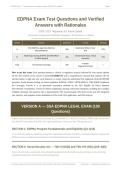
EDPNA Exam Test Questions and Verified
Answers with Rationales
Regulatory & Clinical Update
Two-Domain Comprehensive Certification Preparation | 200 Questions | A+ Verified
Version Domain Questions Format Passing
SSA EDPNA Legal (Non-Attorney Open-book MCQ, 3-hour
A 100 70%
Representative) limit
Nephrology Nursing EDPNA (EDTNA/ERCA Closed-book MCQ, clinical
B 100 70%
& ANNA aligned) scenarios
4-option
Total Two-Domain Coverage 200 —
single-best-answer
How to use this exam: Each question presents a clinical or regulatory scenario followed by four answer options
(A–D). The verified correct answer is marked [CORRECT] with a comprehensive rationale that explains why the
selected option is right and why each distractor is wrong, citing the underlying SSA regulation, HALLEX/POMS
provision, Social Security Ruling, or clinical guideline (KDOQI, ANNA, EDTNA/ERCA, CMS ESRD Conditions
for Coverage). Version A is an open-book assessment modeled on the SSA Eligible for Direct Payment
Non-Attorney examination; Version B reflects nephrology nursing certification blueprints including the Canadian
CNeph(C) domains. The question mix is approximately 70% scenario-based, 20% direct recall, and 10% integrated
case analysis, with cognitive levels distributed as 25% recall, 55% application, and 20% analysis.
VERSION A — SSA EDPNA LEGAL EXAM (100
Questions)
Aligned with Section 206(e) of the Social Security Act, 20 CFR 404..1517, HALLEX, POMS, SSRs, and 20 CFR
Part 404 (Title II) and Part 416 (Title XVI). Open-book format, 3-hour time limit, 70% passing score.
SECTION 1: EDPNA Program Fundamentals and Eligibility (Q1–Q15)
Covers statutory authority, eligibility prerequisites, application and registration forms, examination logistics, professional
liability insurance, background investigation, and continuing education requirements.
SECTION 2: Social Security Act — Title II (SSDI) and Title XVI (SSI) (Q16–Q35)
Covers insured-status requirements, SGA, substantial gainful activity thresholds, income and resource rules, deeming,
expedited reinstatement, and the five-month waiting period.
A+ Verified | Aligned with SSA HALLEX/POMS, ANNA, KDOQI, CMS ESRD, and BCEN standards Confidential — Professional Certification Use
,EDPNA Exam — Test Questions & Verified Answers (2026/2027 Update) Page 2
SECTION 3: Sequential Evaluation Process (Step 1–5) (Q36–Q55)
Covers the five-step disability determination sequence including SGA screen, severe medically determinable impairment,
Listing of Impairments, past relevant work, and residual functional capacity with the medical-vocational grid rules.
SECTION 4: Evidence Evaluation and Medical/Vocational Considerations
(Q56–Q75)
Covers treating-physician rule, opinion weight, medical source evidence, exertional and nonexertional limitations,
transferable skills, and vocational adjustment.
SECTION 5: Appeals Process, HALLEX, and ALJ Procedures (Q76–Q90)
Covers reconsideration, ALJ hearing jurisdiction, Appeals Council review, federal court review, HALLEX procedural
guidance, and representative conduct.
SECTION 6: Ethics, Professional Conduct, and Fee Agreements (Q91–Q100)
Covers duty to claimant, fee agreements and fee petitions, direct payment requirements, confidentiality, HIPAA
compliance, and CE compliance.
SECTION 1: EDPNA Program Fundamentals and Eligibility (Q1–Q15)
Covers statutory authority, eligibility prerequisites, application and registration forms, examination logistics, professional
liability insurance, background investigation, and continuing education requirements.
Q1. A non-attorney representative wishes to receive direct payment of authorized fees from SSA. Which
statutory provision specifically authorizes the Eligible for Direct Payment Non-Attorney (EDPNA) program?
A. Section 206(a) of the Social Security Act
B. Section 206(e) of the Social Security Act
C. Section 1631(d)(2) of the Social Security Act
D. Section 221(i) of the Social Security Act
Answer: B. Section 206(e) of the Social Security Act [CORRECT]
Rationale: Section 206(e) of the Social Security Act, implemented by 20 CFR 404.1717 and 416.1517, specifically authorizes
SSA to pay qualified non-attorney representatives directly. Section 206(a) governs general representative fees, 1631(d)(2)
addresses SSI administrative provisions, and 221(i) defines disability. The EDPNA classification is exclusively a 206(e)
creation.
Q2. Which combination of prerequisites must a non-attorney satisfy before SSA will recognize them as an
EDPNA eligible for direct fee payment?
A+ Verified | Aligned with SSA HALLEX/POMS, ANNA, KDOQI, CMS ESRD, and BCEN standards Confidential — Professional Certification Use
,EDPNA Exam — Test Questions & Verified Answers (2026/2027 Update) Page 3
A. Law degree, three years of practice, and bar admission
B. Bachelor's degree (or HS diploma/GED plus 4 years relevant experience), background check, examination
passage, and $100,000 professional liability insurance
C. Paralegal certificate, two years of SSA experience, and $50,000 liability insurance
D. Master's degree in social work, five years of casework, and $250,000 liability insurance
Answer: B. Bachelor's degree (or HS diploma/GED plus 4 years relevant experience), background check,
examination passage, and $100,000 professional liability insurance [CORRECT]
Rationale: 20 CFR 404.1717 and 416.1517 require a bachelor's degree (or HS diploma/GED with 4 years of relevant
experience), successful passage of the SSA examination, a criminal background check, and professional liability insurance of
at least $100,000 per incident. A law degree or bar admission would qualify the person as an attorney under separate rules;
the other options understate either the experience or the insurance threshold.
Q3. A representative passes the EDPNA examination in May 2026 but has not yet secured professional
liability insurance. What is the correct status?
A. Eligible immediately; insurance can be obtained after first direct-payment case
B. Eligible only after the insurance binder is filed and SSA posts the coverage to the representative's record
C. Eligible only for SSI cases, which do not require insurance
D. Eligible only for one year pending insurance acquisition
Answer: B. Eligible only after the insurance binder is filed and SSA posts the coverage to the representative's
record [CORRECT]
Rationale: SSA will not activate direct-payment status until proof of professional liability insurance meeting the $100,000
per-incident minimum is on file. Per POMS GN 03913.020, the insurance must be in force before direct payment can be
authorized, and coverage must be maintained continuously. The other options incorrectly suggest probationary or partial
eligibility that the regulations do not permit.
Q4. Which SSA form must a non-attorney representative file to register for direct payment of fees, and which
form is used to apply for EDPNA status itself?
A. Form SSA-1699 to apply for EDPNA status; Form SSA-1691 to register for direct payment
B. Form SSA-1691 to apply for EDPNA status; Form SSA-1699 to register for direct payment
C. Form SSA-1696 to apply for EDPNA status; Form SSA-1699 to register for direct payment
D. Form SSA-1695 to apply for EDPNA status; Form SSA-3288 to register for direct payment
Answer: B. Form SSA-1691 to apply for EDPNA status; Form SSA-1699 to register for direct payment
[CORRECT]
Rationale: Form SSA-1691 is the application to participate in the direct-payment program for non-attorneys (EDPNA
application). Form SSA-1699 is the registration form that establishes or updates the representative's direct-payment
registration, including banking information for fee deposits. Form SSA-1696 is the Appointment of Representative form, and
SSA-1695 is used by attorneys/non-attorneys to register fee arrangements; neither is the EDPNA application.
Q5. An EDPNA's professional liability insurance policy lapses on July 15, 2026, and is reinstated August 1,
2026. What is the appropriate action under SSA direct-payment rules?
A. No action is required because coverage was reinstated within 30 days
B. The EDPNA must notify SSA within 20 days of the lapse and may not receive direct payment during the gap
C. The EDPNA automatically forfeits EDPNA status permanently
D. The EDPNA must file a new Form SSA-1691 application
A+ Verified | Aligned with SSA HALLEX/POMS, ANNA, KDOQI, CMS ESRD, and BCEN standards Confidential — Professional Certification Use
, EDPNA Exam — Test Questions & Verified Answers (2026/2027 Update) Page 4
Answer: B. The EDPNA must notify SSA within 20 days of the lapse and may not receive direct payment during
the gap [CORRECT]
Rationale: POMS GN 03913.030 requires an EDPNA to maintain continuous professional liability coverage and to notify
SSA within 20 days of any lapse. During the gap, direct-payment status is suspended; fees authorized during the lapse are
withheld from the claimant or paid indirectly. Permanent forfeiture or new application is not triggered automatically, but
repeated lapses may result in revocation.
Q6. Which statement most accurately describes the timing and frequency of the SSA EDPNA examination?
A. Offered monthly at any Social Security field office
B. Offered annually, with an application period of approximately four weeks
C. Offered every two years to coincide with regulation updates
D. Offered continuously online through the SSA Learning Management System
Answer: B. Offered annually, with an application period of approximately four weeks [CORRECT]
Rationale: Per POMS GN 03913.010, the EDPNA examination is administered approximately once per year, preceded by an
application window of about four weeks during which Form SSA-1691 and supporting documentation must be submitted. The
exam is administered at designated proctored sites; it is not offered monthly, biennially, or as an open online assessment.
Q7. A representative who passed the EDPNA examination in 2024 asks whether continuing education is
required. Which statement is correct?
A. No CE is required after passing the examination
B. CE must be completed annually by the end of the federal fiscal year (September 30)
C. CE is required only every three years
D. CE is required only if the representative handles more than 25 cases per year
Answer: B. CE must be completed annually by the end of the federal fiscal year (September 30) [CORRECT]
Rationale: POMS GN 03913.050 requires EDPNAs to complete annual continuing education by the end of the federal fiscal
year (September 30). Failure to certify CE completion may result in suspension of direct-payment eligibility. The other
options understate the frequency or incorrectly condition CE on caseload.
Q8. An EDPNA candidate lists on Form SSA-1691 a four-year history of representing claimants before SSA,
supported by a high school diploma. Under SSA eligibility rules this candidate:
A. Fails the educational requirement and is ineligible
B. Meets the educational/experience alternative (HS diploma or GED plus 4 years of relevant experience)
C. Must obtain a bachelor's degree before applying
D. Is eligible only for SSI cases
Answer: B. Meets the educational/experience alternative (HS diploma or GED plus 4 years of relevant
experience) [CORRECT]
Rationale: 20 CFR 404.1717(b)(2) and 416.1517(b)(2) allow a candidate without a bachelor's degree to qualify through a
high school diploma or GED plus four years of relevant experience in representing SSA claimants. The candidate meets the
alternative and is eligible for both Title II and Title XVI direct-payment work, not just SSI.
Q9. Which of the following is NOT a basis for SSA to revoke or deny EDPNA status?
A. Conviction of a felony related to the representative's SSA practice
B. Failure to maintain professional liability insurance
A+ Verified | Aligned with SSA HALLEX/POMS, ANNA, KDOQI, CMS ESRD, and BCEN standards Confidential — Professional Certification Use
EDPNA Exam Test Questions and Verified
Answers with Rationales
Regulatory & Clinical Update
Two-Domain Comprehensive Certification Preparation | 200 Questions | A+ Verified
Version Domain Questions Format Passing
SSA EDPNA Legal (Non-Attorney Open-book MCQ, 3-hour
A 100 70%
Representative) limit
Nephrology Nursing EDPNA (EDTNA/ERCA Closed-book MCQ, clinical
B 100 70%
& ANNA aligned) scenarios
4-option
Total Two-Domain Coverage 200 —
single-best-answer
How to use this exam: Each question presents a clinical or regulatory scenario followed by four answer options
(A–D). The verified correct answer is marked [CORRECT] with a comprehensive rationale that explains why the
selected option is right and why each distractor is wrong, citing the underlying SSA regulation, HALLEX/POMS
provision, Social Security Ruling, or clinical guideline (KDOQI, ANNA, EDTNA/ERCA, CMS ESRD Conditions
for Coverage). Version A is an open-book assessment modeled on the SSA Eligible for Direct Payment
Non-Attorney examination; Version B reflects nephrology nursing certification blueprints including the Canadian
CNeph(C) domains. The question mix is approximately 70% scenario-based, 20% direct recall, and 10% integrated
case analysis, with cognitive levels distributed as 25% recall, 55% application, and 20% analysis.
VERSION A — SSA EDPNA LEGAL EXAM (100
Questions)
Aligned with Section 206(e) of the Social Security Act, 20 CFR 404..1517, HALLEX, POMS, SSRs, and 20 CFR
Part 404 (Title II) and Part 416 (Title XVI). Open-book format, 3-hour time limit, 70% passing score.
SECTION 1: EDPNA Program Fundamentals and Eligibility (Q1–Q15)
Covers statutory authority, eligibility prerequisites, application and registration forms, examination logistics, professional
liability insurance, background investigation, and continuing education requirements.
SECTION 2: Social Security Act — Title II (SSDI) and Title XVI (SSI) (Q16–Q35)
Covers insured-status requirements, SGA, substantial gainful activity thresholds, income and resource rules, deeming,
expedited reinstatement, and the five-month waiting period.
A+ Verified | Aligned with SSA HALLEX/POMS, ANNA, KDOQI, CMS ESRD, and BCEN standards Confidential — Professional Certification Use
,EDPNA Exam — Test Questions & Verified Answers (2026/2027 Update) Page 2
SECTION 3: Sequential Evaluation Process (Step 1–5) (Q36–Q55)
Covers the five-step disability determination sequence including SGA screen, severe medically determinable impairment,
Listing of Impairments, past relevant work, and residual functional capacity with the medical-vocational grid rules.
SECTION 4: Evidence Evaluation and Medical/Vocational Considerations
(Q56–Q75)
Covers treating-physician rule, opinion weight, medical source evidence, exertional and nonexertional limitations,
transferable skills, and vocational adjustment.
SECTION 5: Appeals Process, HALLEX, and ALJ Procedures (Q76–Q90)
Covers reconsideration, ALJ hearing jurisdiction, Appeals Council review, federal court review, HALLEX procedural
guidance, and representative conduct.
SECTION 6: Ethics, Professional Conduct, and Fee Agreements (Q91–Q100)
Covers duty to claimant, fee agreements and fee petitions, direct payment requirements, confidentiality, HIPAA
compliance, and CE compliance.
SECTION 1: EDPNA Program Fundamentals and Eligibility (Q1–Q15)
Covers statutory authority, eligibility prerequisites, application and registration forms, examination logistics, professional
liability insurance, background investigation, and continuing education requirements.
Q1. A non-attorney representative wishes to receive direct payment of authorized fees from SSA. Which
statutory provision specifically authorizes the Eligible for Direct Payment Non-Attorney (EDPNA) program?
A. Section 206(a) of the Social Security Act
B. Section 206(e) of the Social Security Act
C. Section 1631(d)(2) of the Social Security Act
D. Section 221(i) of the Social Security Act
Answer: B. Section 206(e) of the Social Security Act [CORRECT]
Rationale: Section 206(e) of the Social Security Act, implemented by 20 CFR 404.1717 and 416.1517, specifically authorizes
SSA to pay qualified non-attorney representatives directly. Section 206(a) governs general representative fees, 1631(d)(2)
addresses SSI administrative provisions, and 221(i) defines disability. The EDPNA classification is exclusively a 206(e)
creation.
Q2. Which combination of prerequisites must a non-attorney satisfy before SSA will recognize them as an
EDPNA eligible for direct fee payment?
A+ Verified | Aligned with SSA HALLEX/POMS, ANNA, KDOQI, CMS ESRD, and BCEN standards Confidential — Professional Certification Use
,EDPNA Exam — Test Questions & Verified Answers (2026/2027 Update) Page 3
A. Law degree, three years of practice, and bar admission
B. Bachelor's degree (or HS diploma/GED plus 4 years relevant experience), background check, examination
passage, and $100,000 professional liability insurance
C. Paralegal certificate, two years of SSA experience, and $50,000 liability insurance
D. Master's degree in social work, five years of casework, and $250,000 liability insurance
Answer: B. Bachelor's degree (or HS diploma/GED plus 4 years relevant experience), background check,
examination passage, and $100,000 professional liability insurance [CORRECT]
Rationale: 20 CFR 404.1717 and 416.1517 require a bachelor's degree (or HS diploma/GED with 4 years of relevant
experience), successful passage of the SSA examination, a criminal background check, and professional liability insurance of
at least $100,000 per incident. A law degree or bar admission would qualify the person as an attorney under separate rules;
the other options understate either the experience or the insurance threshold.
Q3. A representative passes the EDPNA examination in May 2026 but has not yet secured professional
liability insurance. What is the correct status?
A. Eligible immediately; insurance can be obtained after first direct-payment case
B. Eligible only after the insurance binder is filed and SSA posts the coverage to the representative's record
C. Eligible only for SSI cases, which do not require insurance
D. Eligible only for one year pending insurance acquisition
Answer: B. Eligible only after the insurance binder is filed and SSA posts the coverage to the representative's
record [CORRECT]
Rationale: SSA will not activate direct-payment status until proof of professional liability insurance meeting the $100,000
per-incident minimum is on file. Per POMS GN 03913.020, the insurance must be in force before direct payment can be
authorized, and coverage must be maintained continuously. The other options incorrectly suggest probationary or partial
eligibility that the regulations do not permit.
Q4. Which SSA form must a non-attorney representative file to register for direct payment of fees, and which
form is used to apply for EDPNA status itself?
A. Form SSA-1699 to apply for EDPNA status; Form SSA-1691 to register for direct payment
B. Form SSA-1691 to apply for EDPNA status; Form SSA-1699 to register for direct payment
C. Form SSA-1696 to apply for EDPNA status; Form SSA-1699 to register for direct payment
D. Form SSA-1695 to apply for EDPNA status; Form SSA-3288 to register for direct payment
Answer: B. Form SSA-1691 to apply for EDPNA status; Form SSA-1699 to register for direct payment
[CORRECT]
Rationale: Form SSA-1691 is the application to participate in the direct-payment program for non-attorneys (EDPNA
application). Form SSA-1699 is the registration form that establishes or updates the representative's direct-payment
registration, including banking information for fee deposits. Form SSA-1696 is the Appointment of Representative form, and
SSA-1695 is used by attorneys/non-attorneys to register fee arrangements; neither is the EDPNA application.
Q5. An EDPNA's professional liability insurance policy lapses on July 15, 2026, and is reinstated August 1,
2026. What is the appropriate action under SSA direct-payment rules?
A. No action is required because coverage was reinstated within 30 days
B. The EDPNA must notify SSA within 20 days of the lapse and may not receive direct payment during the gap
C. The EDPNA automatically forfeits EDPNA status permanently
D. The EDPNA must file a new Form SSA-1691 application
A+ Verified | Aligned with SSA HALLEX/POMS, ANNA, KDOQI, CMS ESRD, and BCEN standards Confidential — Professional Certification Use
, EDPNA Exam — Test Questions & Verified Answers (2026/2027 Update) Page 4
Answer: B. The EDPNA must notify SSA within 20 days of the lapse and may not receive direct payment during
the gap [CORRECT]
Rationale: POMS GN 03913.030 requires an EDPNA to maintain continuous professional liability coverage and to notify
SSA within 20 days of any lapse. During the gap, direct-payment status is suspended; fees authorized during the lapse are
withheld from the claimant or paid indirectly. Permanent forfeiture or new application is not triggered automatically, but
repeated lapses may result in revocation.
Q6. Which statement most accurately describes the timing and frequency of the SSA EDPNA examination?
A. Offered monthly at any Social Security field office
B. Offered annually, with an application period of approximately four weeks
C. Offered every two years to coincide with regulation updates
D. Offered continuously online through the SSA Learning Management System
Answer: B. Offered annually, with an application period of approximately four weeks [CORRECT]
Rationale: Per POMS GN 03913.010, the EDPNA examination is administered approximately once per year, preceded by an
application window of about four weeks during which Form SSA-1691 and supporting documentation must be submitted. The
exam is administered at designated proctored sites; it is not offered monthly, biennially, or as an open online assessment.
Q7. A representative who passed the EDPNA examination in 2024 asks whether continuing education is
required. Which statement is correct?
A. No CE is required after passing the examination
B. CE must be completed annually by the end of the federal fiscal year (September 30)
C. CE is required only every three years
D. CE is required only if the representative handles more than 25 cases per year
Answer: B. CE must be completed annually by the end of the federal fiscal year (September 30) [CORRECT]
Rationale: POMS GN 03913.050 requires EDPNAs to complete annual continuing education by the end of the federal fiscal
year (September 30). Failure to certify CE completion may result in suspension of direct-payment eligibility. The other
options understate the frequency or incorrectly condition CE on caseload.
Q8. An EDPNA candidate lists on Form SSA-1691 a four-year history of representing claimants before SSA,
supported by a high school diploma. Under SSA eligibility rules this candidate:
A. Fails the educational requirement and is ineligible
B. Meets the educational/experience alternative (HS diploma or GED plus 4 years of relevant experience)
C. Must obtain a bachelor's degree before applying
D. Is eligible only for SSI cases
Answer: B. Meets the educational/experience alternative (HS diploma or GED plus 4 years of relevant
experience) [CORRECT]
Rationale: 20 CFR 404.1717(b)(2) and 416.1517(b)(2) allow a candidate without a bachelor's degree to qualify through a
high school diploma or GED plus four years of relevant experience in representing SSA claimants. The candidate meets the
alternative and is eligible for both Title II and Title XVI direct-payment work, not just SSI.
Q9. Which of the following is NOT a basis for SSA to revoke or deny EDPNA status?
A. Conviction of a felony related to the representative's SSA practice
B. Failure to maintain professional liability insurance
A+ Verified | Aligned with SSA HALLEX/POMS, ANNA, KDOQI, CMS ESRD, and BCEN standards Confidential — Professional Certification Use